





People are also reading…
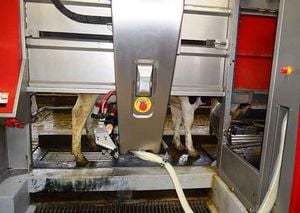
HUSTISFORD, Wis. — “I wanted to run the farm … not have the farm run me.” So says Dave Hafemeister who, along with his wife, Kathleen, owns and operates a dairy farm just outside of Hustisford. That’s one of the reasons the couple decided to install a robotic milking system.While their two robots don’t necessarily make their work load lighter, it does offer them greater flexibility to participate in other activities. In a few years, the Hafemeisters, who have two young children — Alayna, 3, and Ethan, 1 — will likely be busy in a growing number of programs as a family. “The robotic milking system will allow us more flexibility to go to evening school events and wedding receptions,” Kathleen Hafemeister said. She joked that she vowed not to marry a dairy farmer because milking schedules precluded attending many evening events.Having grown up on a 50-cow dairy in Jackson, Wis., she knew well the time demands on a family dairy farm. But now — because their 110 milking cows can walk to one of two robots and be milked anytime day or night — the Hafemeisters aren’t as tied down. Only if there’s a problem, such as a kinked hose, will they receive a phone call from the system indicating they might need to return and address the issue.“I didn’t want to go to a three-time per-day system so we began looking at robotic systems,” she said. “We thought a robot might also help us increase milk production. We had hit a production plateau of between 75 pounds and 80 pounds of milk per cow per day with a twice-per-day milking system.”Before they installed a Lely Astronaut system in December 2014, the Hafemeisters milked in a flat barn parlor. They first became interested in robots after attending a seminar at World Dairy Expo in 2012. While they went in with just a casual interest, afterward they left saying to each other, “I think we can do this.”At World Dairy Expo the following year, they talked with various robotic-system manufacturers. And over the next several months they visited about seven farms with robotic systems, asking dairy producers lots of questions. Dave Hafemeister also attended a seminar at Lakeshore Technical College on what dairy producers should look for in robotics. “It was very informative,” he said.After doing the research, the Hafemeisters decided on the Lely system, which could be serviced by a local distributor — Central Ag Supply in nearby Juneau, Wis.Since then, during the few times the Hafemeisters have needed help troubleshooting, a Central Ag Supply representative has come to help within minutes, they said. The robot hasn’t necessarily replaced any labor. But the Hafemeisters’ relief milker doesn’t need to work quite as often, and Dave Hafemeister’s parents — Richard and Gloria Hafemeister — have been able to reduce the amount of time they spend on the farm. He purchased the farm from his parents in 2010, but they have continued to help do chores when needed.“We still have a lot of work — it’s just different work,” Kathleen Hafemeister said. The robots enable the couple to spend more time on overall management of the farm as well as field operations. The robots require calibration to make sure their laser arms are in correct position to adjust to each cow’s udders and teats — those coordinates are stored in the software for a week’s worth of milkings. There’s also routine maintenance. Cows have transponder collars that transfer information to the robots and computer software. The technology provides a lot more cow data than what the Hafemeisters were able to capture before.“I like the rumination and heat detection functions,” Dave Hafemeister said. The rumination function helps him evaluate cows in the milk period, zero to 21 days. “As soon as a cow stops chewing her cud, we know there’s a problem,” he said. “The system provides another set of eyes that constantly watches cows.” The system monitors temperature, so if an individual cow’s milk is unusually warm he can tell if the animal is running a fever. The system also measures conductivity, which can help monitor potential issues with somatic cell count or mastitis.Since installing the robots, the Hafemeisters have been able to eliminate $250 per month in milk-testing costs. They recently won a milk-quality award from the National Farmers Organization for maintaining a somatic cell count under 100,000 cells per milliliter.The activity monitor also has helped detect more cows in heat, which has helped reduce the amount of prostaglandin injections needed to bring cows into heat. The two robots were placed side-byside with a work area for the Hafemeisters and their employees in the center. When the robotic milking system was first installed, about 80 percent of the cows needed only about two weeks to adapt.One of the reasons they adapted so well was that they were accustomed to walking forward in the old flat barn parlor rather than backing out of stalls. The other cows needed to be trained to stand still enough for the robotic arm to measure them and send coordinates to the computer. Dave Hafemeister kneeled down by those cows and coaxed them to stand still. Now that they’re comfortable with the robots, the cows generally go to them to be milked three or four times daily. Over the past two years, the farm’s milk production has risen to between 90 pounds and 95 pounds of milk per cow per day.