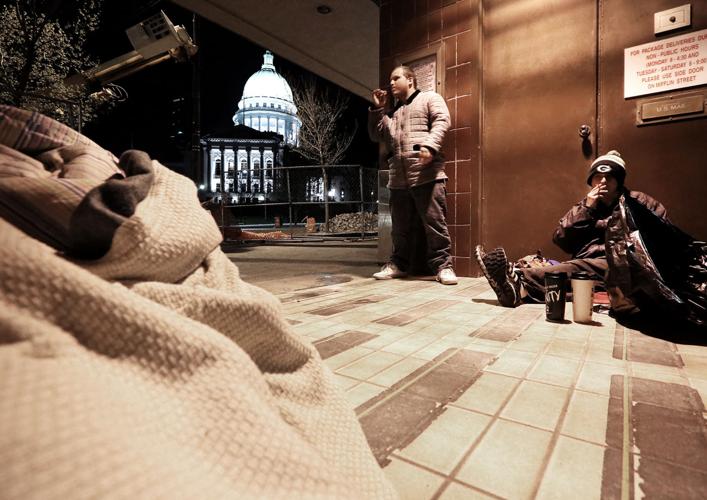
Members of Madison's homeless population, Bradley Marvin, 23, left, and Justin Kingan, 29, prepare to settle in for the night on Capitol Square in late April. State officials say Wisconsin delivers funding to address homelessness through multiple agencies, but advocates and service providers say state government must do far more to prevent and end homelessness.
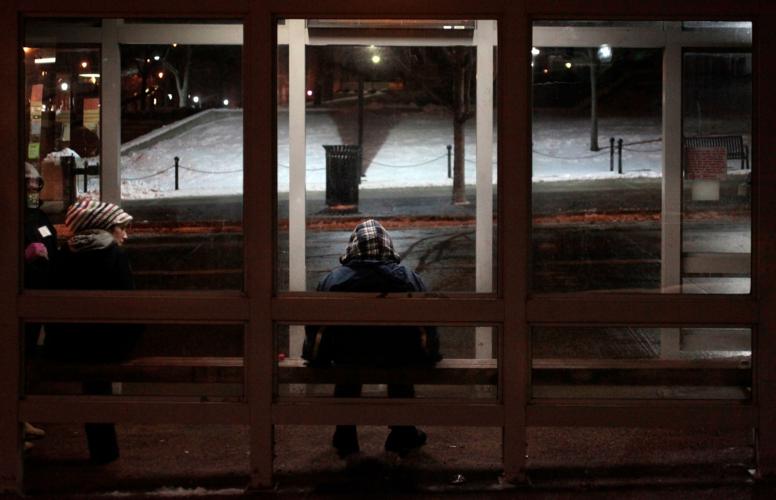
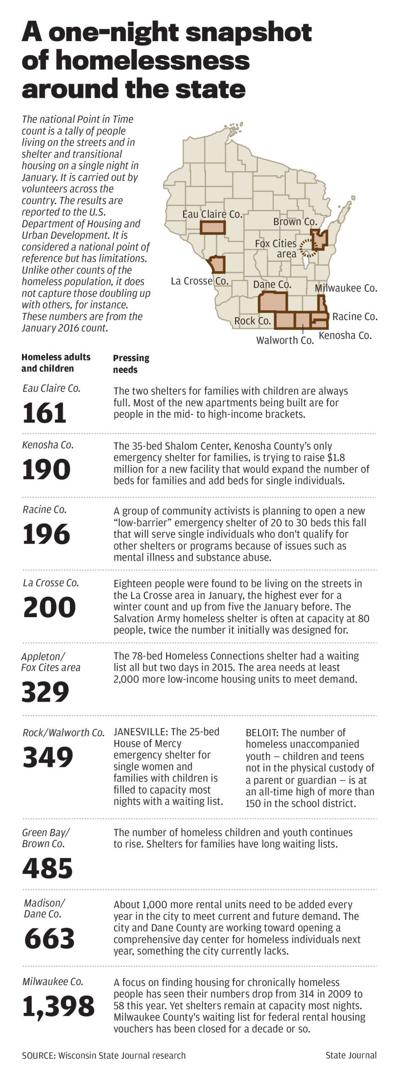
A volunteer, left, talks with a homeless man spending the night at a bus shelter in Downtown Madison during the city’s Point in Time count on Jan. 27. Volunteers across the country attempt to count on a single night in January all sheltered and unsheltered homeless people. Dane County's count that night was 663.
Emergency shelter: Short-term, nightly shelter. Supportive services may or may not be provided. The number of total days allowed often is capped at 90.
Transitional housing: An interim step between emergency shelter and permanent housing for households with significant barriers to housing. It helps homeless people overcome trauma, regain stability and rebuild their support networks within 24 months. Services can include case management and rent assistance.
Rapid re-housing: A temporary program for homeless people who have lived independently before and do not need permanent supports. It seeks a quick turnaround in fortunes, emphasizing housing search and relocation services and short- and medium-term rental assistance. Some participants will have disabilities, but most will not.
Permanent supportive housing: Assistance for people with the most complex challenges and most severe service needs. It targets people with chronic impairments and supports them on a permanent basis, with indefinite leasing or rental assistance.
Chronically homeless: An individual with a disability who has been homeless for the last 12 months continuously or on at least four occasions in the last three years that cumulatively total at least 12 months.
Affordable housing: Housing in which households, regardless of income, spend no more than 30 percent of their income on it. A household that spends more than 30 percent of adjusted gross household income on housing is considered cost-burdened.
Housing First: An approach in which homeless people are given immediate access to housing without prerequisites like sobriety or a willingness to participate in services. It typically is designed for people with complex needs and who are the least likely to be able to proactively seek and obtain housing on their own.
Intake system: The method by which homeless or near-homeless people can find and access shelter, housing and services. Typically, the intake process includes outreach, a basic assessment, an eligibility determination and program referral or placement.
How many are homeless?
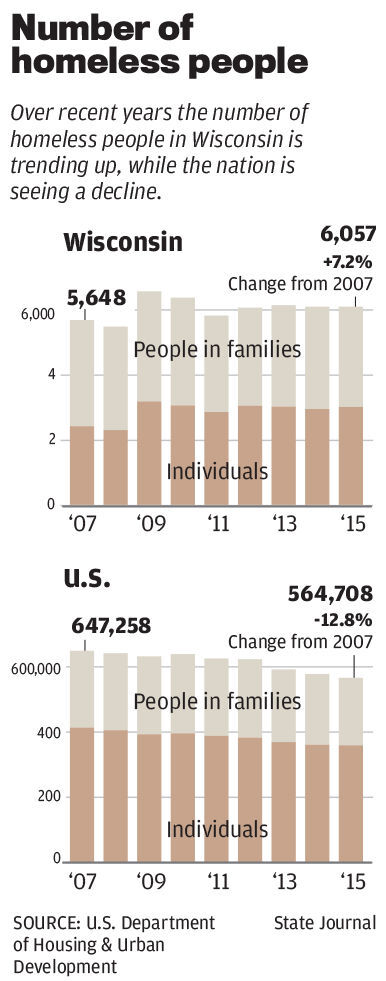
It's hard to count the homeless, with no single recognized method and varying definitions. The federal departments of Housing and Urban Development and Education use different methods; another count covers only those who have been served by agencies receiving government money. The Wisconsin Coalition Against Homelessness combines two counts and uses a formula to produce estimates. Here's a look at some state indicators:
Perhaps 20,000 people are homeless in the state on any given night, according to data-based estimates by the Wisconsin Coalition Against Homelessness.
An annual federally required count — which does not include those temporarily living in motels or with a family member or friend — ranks the state fifth nationally in the increase in homelessness, a 24.5 percent rise, between 2007 and 2015. The count, which relies on volunteers with a mix of training, savvy and support, helps shape how much HUD funding goes to each area.
The number of homeless children in the state rose a staggering 241 percent, from 5,354 in 2003 to 18,390 in 2015, according to Wisconsin Department of Public Instruction data.
27,532 people experiencing homelessness were served by state- or federally funded agencies in 2015, up 18 percent since 2010, according to the latest report of the Wisconsin Homeless Management Information System.
About the reporters
Wisconsin State Journal reporters Dean Mosiman and Doug Erickson have spent the last several months reporting on the issue of homelessness in Madison.
Mosiman, 58, has covered city government for the State Journal since 1997. A native of Minneapolis, he previously worked for newspapers in California, New York and Washington state.
Erickson, 51, covers K-12 education and religion for the newspaper and has worked here since 1999. The South Dakota transplant previously worked for The (Appleton) Post-Crescent, as well as newspapers in Georgia and Minnesota.
If you are homeless or near-homeless and need help: For emergency shelter, call the toll-free Dane County Housing Crisis Line at 855-510-2323. For other housing questions or general assistance, call the United Way of Dane County helpline at 2-1-1.
If you would like to help the homeless: The United Way’s 2-1-1 helpline also is the place to call to give help. Or go to volunteeryourtime.org.
Members of Madison's homeless population, Bradley Marvin, 23, left, and Justin Kingan, 29, prepare to settle in for the night on Capitol Square in late April. State officials say Wisconsin delivers funding to address homelessness through multiple agencies, but advocates and service providers say state government must do far more to prevent and end homelessness.
A volunteer, left, talks with a homeless man spending the night at a bus shelter in Downtown Madison during the city’s Point in Time count on Jan. 27. Volunteers across the country attempt to count on a single night in January all sheltered and unsheltered homeless people. Dane County's count that night was 663.