





Excluding the water areas there are about 35 million acres upon which man has worked since 1634 to create the present land-use pattern. Farm land occupies by far the greater portion of the land area and in 1945 accounted for 67.4 percent of the total. Most of this farm-land acreage is concentrated in the southern, western and eastern portions of the state. The middle north also has much farm land but the sandy central area and the northernmost counties have relatively little.
1848-1948 -- Century of Wisconsin Agriculture
1 of 6
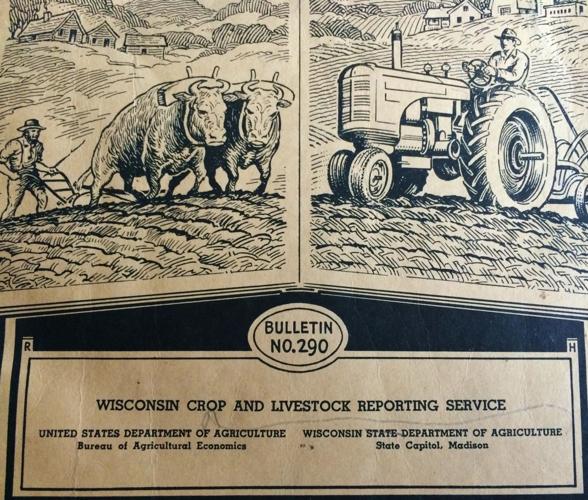
The Crop and Livestock Bulletin No. 290 is published in June 1948 with information on a century of agriculture in Wisconsin.

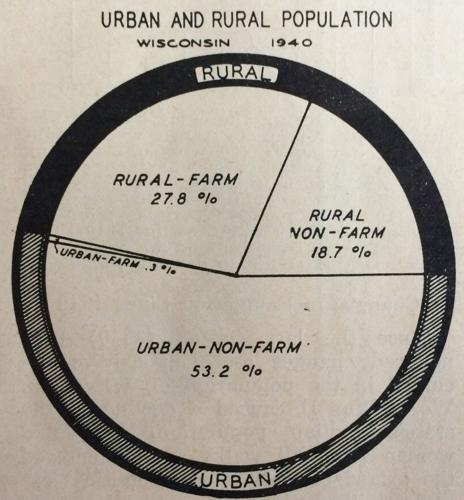
Not all the people living in the rural areas of Wisconsin were engaged in farming in 1940. In fact only 28.1 percent of the total population of the state was engaged in agriculture – 27.8 percent in rural areas and .3 percent within the limits of cities or villages with more than 2,500 inhabitants. The 18.7 percent of the population classed as rural nonfarm were largely in villages and cities with less than 2,500 residents.
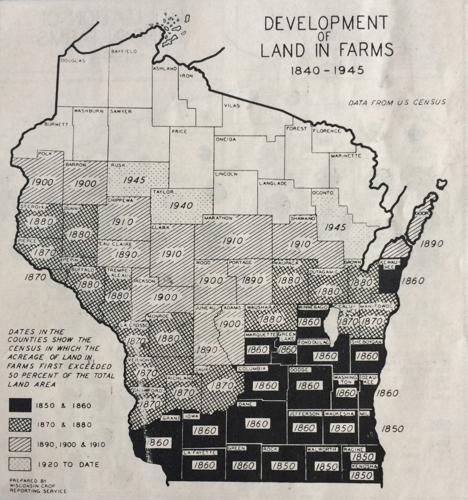
Settlement did not begin in Wisconsin until the close of the Blackhawk War in 1832. As late as 1840 there were only 30,945 people in the state. Yet in 1860 there were 22 counties in which more than 50 percent of the land was in farms. Another 18 counties were added to the first 22 during the 20-year period from 1860 to 1880. Six of those were in eastern Wisconsin and 12 in the western part of the state. Thirteen counties went over the 50-percent mark during the 30 years of 1880 to 1910. Except for Door, all the counties were in the central part of the state or the middle north. After 1920 it was 30 years before land in farms exceeded 50 percent of the land area in any additional county.
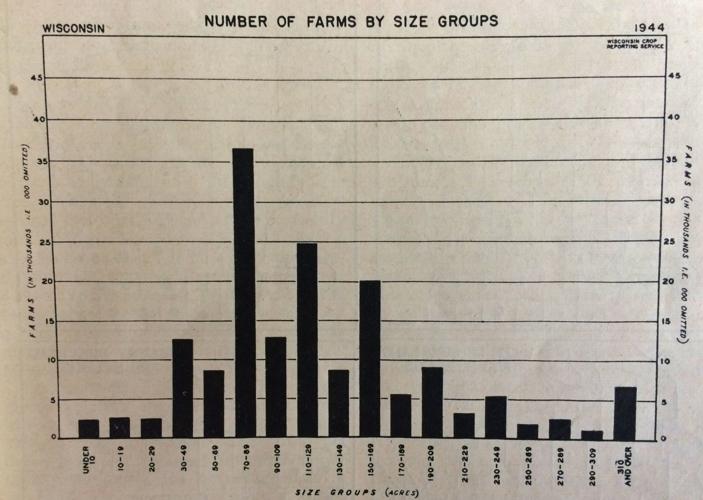
The most common farm size in Wisconsin is the 80-acre farm. The fact that farms are usually 40, 80, 120 or 160 acres in size is caused by the rectangular land survey and the fact that the early land sales were mostly in 40- and 80-acre units. In 1944 there were 37,000 farms in the 70-89-acre group. Almost 25,000 farms were in the 120-acre class and about 20,000 farms were between 150 and 169 acres. Only about 12,000 of the farms reported by Wisconsin assessors in 1944 were larger than 250 acres. Slightly less than 7,000 were larger than 310 acres.
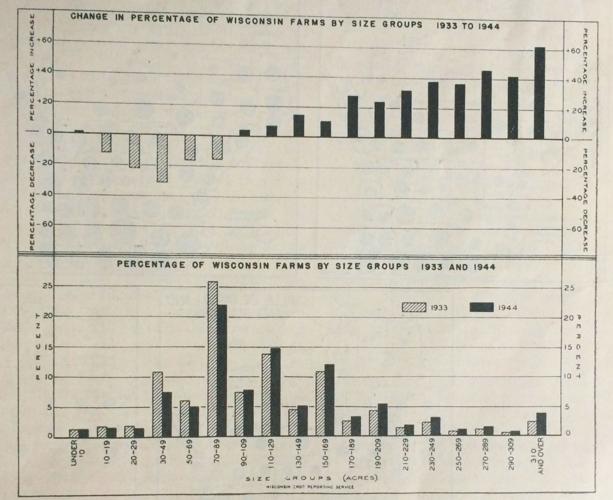
Wisconsin farms have tended to become larger in recent years. Farms of more than 90 acres increased in relative importance from 1933 to 1944, according to the reports of the state assessors. That increase in farm sizes reflects the ability of the farmers to handle more land through increased mechanization that was possible years ago. Farms of less than 90 acres, except those less than 10 acres, declined sharply in relative importance. The upper portion of the chart shows the percentage increase or decrease in farms by size groups. The greatest percentage decline was in the 40-acre class while the greatest percentage increase was in farms of more than 310 acres.
Most Popular

Wisconsin dairy breakfasts celebrate June Dairy Month. Agri-View is publishing a calendar weekly in print, as well as online, with updates as …

Nature is anything but predictable. Just ask hunters who spend many hours in the woods.

The name Ronald Edwards is etched on the Vietnam War section of the granite wall at the Richland County Veteran’s Memorial in Richland Center,…

The American elm, commonly called white elm, continues to inject its flowers, fruits, pollen and diseases into the lives of other organisms du…
Wisconsin dairy breakfasts celebrate June Dairy Month. Agri-View is publishing a calendar weekly in print, as well as online, with updates as …