Know your political committees
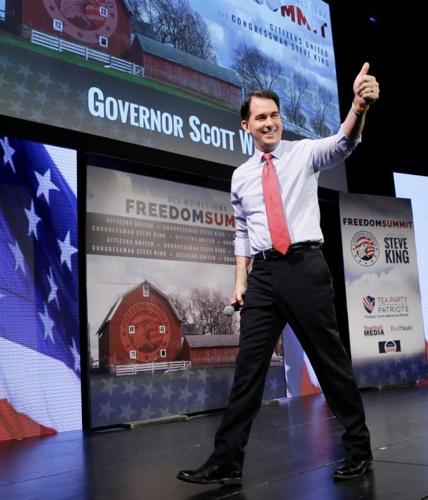
Gov. Scott Walker's national political organization, "Our American Revival," is one of several types of nonprofit groups that presidential contenders have formed as they contemplate a campaign. Here are some differences:
Campaign committee: Presidential contenders must set up a committee within 15 days of becoming a candidate and file regular reports with the Federal Elections Commission. In the 2016 cycle, contributions from individuals are limited to $2,700 and from political action committees (PACs) are limited to $5,000. Corporate and union donations are prohibited. Limits apply once in a primary and once in a general election.
Presidential exploratory committee: Also known as "testing the waters," prospective candidates can raise funds under the same rules as campaign committees, but don't have to report them until after becoming a candidate. Candidates who don't set up exploratory committees must also account for money they used to "test the waters" on their first campaign finance report. Such activities include conducting polls, traveling and making phone calls.
Multicandidate PAC: A committee registered with the FEC for at least six months, with contributions from at least 50 people and to at least five federal candidates. Individual contributions are limited to $5,000 per year going back multiple years. Corporate and union donations are prohibited. Must file regular reports with FEC disclosing donors and expenditures.
Leadership PAC: Same as multicandidate PACs, but can be controlled by federal officeholders, such as a U.S. Senator or Representative.
Super PAC: Independent expenditure political group allowed under the 2010 SpeechNow v. FEC court decision, which applied the U.S. Supreme Court's reasoning in Citizens United v. FEC. Can be controlled by non-candidates who aren't federal office-holders. Can raise unlimited funds from individuals, corporations and unions. Must file regular reports with FEC disclosing donors and expenditures.
527 organization: Technically all of the groups listed above are organized under section 527 of the Internal Revenue Code, but others, such as Walker's group, aren't organized as political committees, and therefore don't have to file with the FEC. Their primary purpose is to influence candidate nominations and elections, they can raise unlimited funds from individuals, corporations and unions, and must disclose donors and expenditures in regular reports with the IRS.
501(c)(4) organization: Organized under the Internal Revenue Code section dealing with "social welfare" organizations. Can conduct some political advocacy, but can't be primary purpose. Can raise unlimited funds from individuals, corporations and unions. Must file annual reports with IRS, but donors and expenditures are not public.
Source: Paul S. Ryan, The Campaign Legal Center
Presidential political committees
Gov. Scott Walker is the only 2016 potential presidential candidate who has so far formed a 527 group not registered with the Federal Elections Commission. Here are the committees formed by the top 10 Republican contenders based on recent national polling.
Candidate;Committee;Type;Contributions 2013-14
Former Florida Gov. Jeb Bush;Right to Rise;PAC and Super PAC;NA
Retired neurosurgeon Ben Carson;USA First;Multicandidate PAC;$430,828
New Jersey Gov. Chris Christie;Leadership Matters for America;Multicandidate PAC;NA
Texas U.S. Sen. Ted Cruz;Job, Growth & Freedom Fund;Leadership PAC;$2,196,311
Former Arkansas Gov. Mike Huckabee;Huck PAC and America Takes Action;Multicandidate PAC and 501(c)(4);$2,261,646
Louisiana Gov. Bobby Jindal;Believe Again and Stand Up to Washington and America Next;Multicandidate PAC and Super PAC and 501(c)(4);$274,830 (America Next reportedly raised $3.1 million last year)
Kentucky U.S. Sen. Rand Paul;Reinventing a New Direction (RAND);Leadership PAC;$3,742,138
Former Texas Gov. Rick Perry;RickPAC;Multicandidate PAC;$308,228
Florida U.S. Sen. Marco Rubio;Reclaim America;Leadership PAC;$3,905,825
Wisconsin Gov. Scott Walker;Our American Revival;527 Group;NA
Note: At least five other Republicans and two Democrats have formed some type of political committee. Of all 17, only two, U.S. Sen. Lindsey Graham, R-South Carolina, and former U.S. Jim Webb, D-Virginia, have formed presidential exploratory committees. Democrat Hillary Clinton has not formed her own committee, though her supporters have formed a Super PAC, Ready for Hillary, which raised $12.9 million over the past two years.
Source: Paul S. Ryan, The Campaign Legal Center