





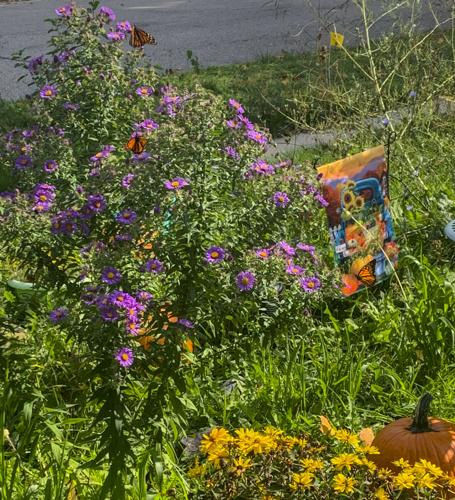
Bright splashes of color came in waves recently across Midwest yards, gardens and fields. The short-lived breathtaking beauty was awe-inspiring, knowing a creature lighter than a paperclip was headed south on a 2,000-mile-plus journey. It’s the monarch migration, from northern Wisconsin to the Mexican mountains.
People are also reading…
- Understanding mineral tags can help cattle producers better understand what to provide
- Bull breeding soundness exams should not be overlooked
- Trend of growing production expenses troubling for agriculture
- Finding her niche on family farm: Newman Grove farm wife builds pork business
- Missouri cowgirl bakes to fund her trick-riding ambitions
- Meristem focuses on reducing crop input costs for farmers
- Gustin's Diamond Gelbvieh Annual Production Sale
- Rollins highlights trade, farm policy progress during Commodity Classic general session
- Heart River Ranch Annual Production Sale
- MacDonald Ranches Performance Power 2026 Sale
- Variety of fencing meets needs on the farm
- Berwald Red Angus 4th Annual Bull & Female Sale
- Working cattle, then hitting the books
- Thorstenson's Lazy TV Ranch 45th Annual Bull Sale
- Feeder cattle prices hit temporary plateau
Julie Belschner writes on various agricultural issues; she is the managing editor for Agri-View based in Wisconsin.
Eastern butterflies need help
Wisconsin monarchs are part of the “Eastern Population,” which covers all the United States east of the Rocky Mountains. Those population numbers are more stable than in the past few years, but still critical. They should be listed as endangered in the United States – the government calls the listing warranted – but other species are ahead of them in the process. The International Union for Conservation of Nature does list them as endangered.
“Monarch populations are facing dramatic declines across (North and South America),” according to Monarch Joint Venture.
A record measurement of more than 45 acres occupied was documented in the winter of 1996-1997 at their Mexican overwintering sites, the organization states. But by a few years ago, the population covered a record-small area of only about 1.5 acres. Monarch numbers are currently better than that but still well less than the 20-year average and less than a population size that's considered safe. Some researchers say the Eastern Population will be extinct within 20 years if numbers don’t increase.
“The past four years or so things have been relatively stable,” said PJ Liesch, the “Wisconsin Bug Guy” with the University of Wisconsin-Department of Entomology. “It’s good they haven’t declined but it’s still concerning. … One big thing is loss of milkweeds from the general landscape, compared to 100 years ago. In recent times folks are replanting and restocking, but less milkweed overall is making it harder for monarchs to survive.”
Monarchs only lay their eggs on milkweed and it’s the only plant the caterpillars can eat.
The Pollinator Help Desk works with farmers and private landowners to find resources to help monarchs, Koenig said. Call 337-422-4828 for more information.
Researchers will estimate the acreage monarchs cover in Mexico this winter; they identify heavily-clustered areas and measure around them. That will tell if efforts to save the monarchs are having an effect.
Monarchs are currently in more than 90 countries and on islands. But they’re North American natives. As the last ice age receded 20,000 years ago, the monarch population occupying the southern United States and northern Mexico began to grow and expand their range and migration annually, according to Monarch Joint Venture. Now they could expand again – or die out.
“If we had an extended warm season, fall or spring, that may allow them to expand northward a little bit,” Liesch said. “We know they can go into southern Canada; that might have an impact in the long run. But if we get more extreme variations in weather, extreme drought or raininess, or extreme fluctuations in temperature – too hot can be bad. They overwinter in relatively small spots in Mexico in the mountains; that can have a devastating impact with bad weather there.
“They are in a very precarious spot. Anything we can do to help them will help.”
Visit farmersformonarchs.org and journeynorth.org and wimonarchs.org and monarchjointventure.org for more information.
Be the first to know
Get local news delivered to your inbox!
Julie_Belschner
Get email notifications on {{subject}} daily!
{{description}}
Email notifications are only sent once a day, and only if there are new matching items.


