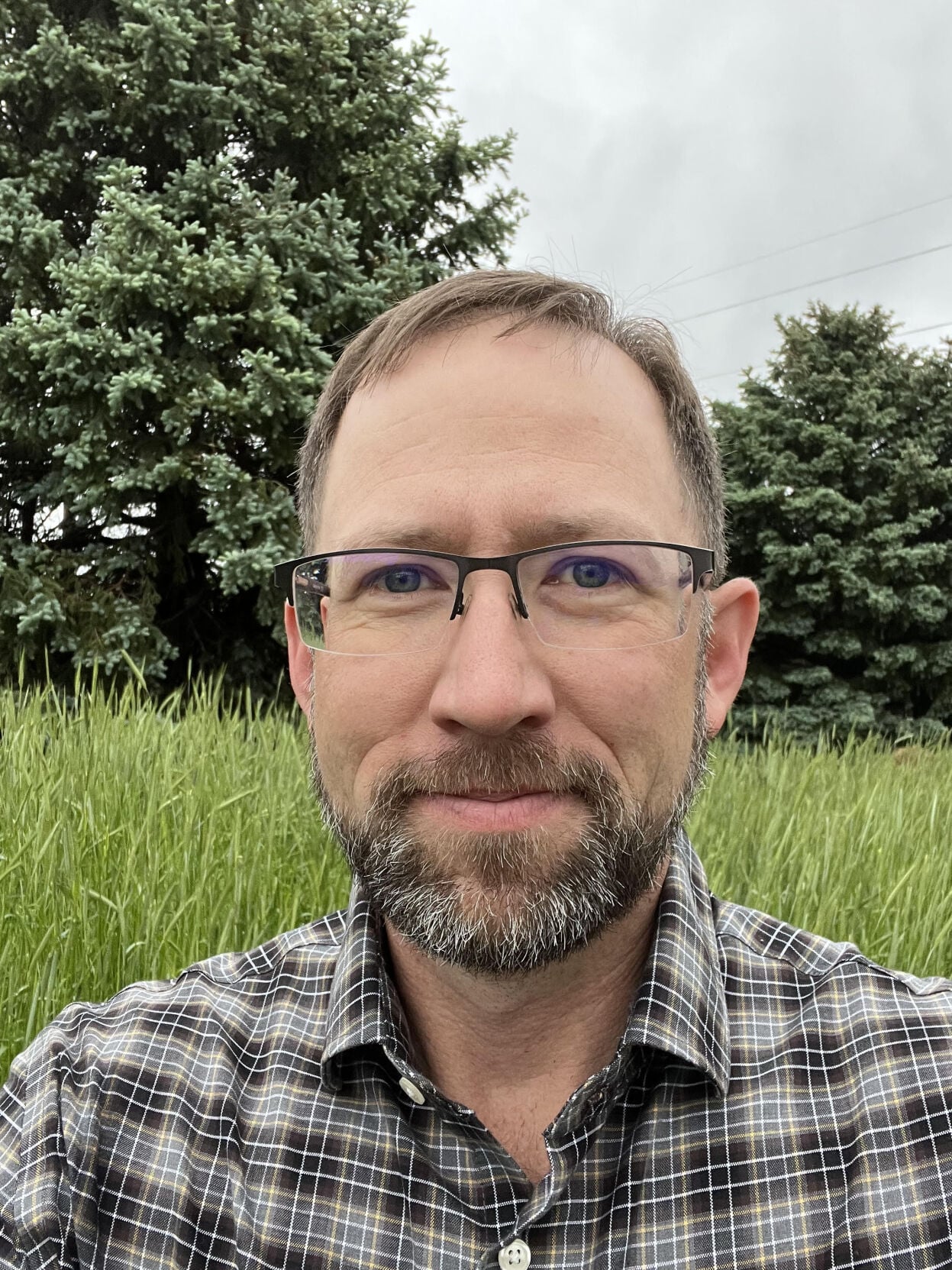
‘Round the NSHC Coffee Pot is a monthly feature special to the Midwest Messenger. It highlights the work of the Nebraska Soil Health Coalition, a nonprofit organization established in 2023 to advance producer-centered education, outreach, and the adoption of soil health principles to build resilient farms, ranches, and communities across Nebraska. Learn more at www.nesoilhealth.org.
Farmers focus on flexibility, alternative methods when planting in uncertain economy
Farmers across Nebraska are facing another year of planting into dust, but by diversifying their crops and staying flexible, farmers can make the most of it.
On Zach Mader’s farm north of Grand Island, the first week of April brought an inch of rain – the first significant moisture he’s seen since September.
Oats and peas emerge through corn stubble in Zach Mader’s field north of Grand Island. He planted them in late March, and the area received much needed rain in early April.
Earthworms peak out of a shovel full of soil from Zach Mader’s field. He and other producers have participated in a soil health benchmarking project, comparing their fields to native soil.
Late last June, Zach Mader’s farm north of Grand Island soaked in a 7-inch rain overnight. It left parts of the city under water, but it didn’t stop Mader from his work.
The next morning, he walked through his fields as planned to sample the nutrients in his corn crop.
Zach Mader walks through his corn field after a 7-inch rain last June without making tracks. “I believe this is a prime example of how soil health pays,” he said.
Armed with information, producers are ready to help fellow producers on their soil health journey
A producer-to-producer learning community is one of the key components of the Nebraska Soil Health Coalition’s mission to promote the adoption of soil health systems and help rural communities.
The organization is using economic and socio-behavioral interviews to arm producers with data to adjust their nutrients, improve water quality and foster trusting relationships in the name of improving sustainability.
Late last June, Zach Mader’s farm north of Grand Island soaked in a 7-inch rain overnight. It left parts of the city under water, but it didn’t stop Mader from his work.
The next morning, he walked through his fields as planned to sample the nutrients in his corn crop.
Zach Mader walks through his corn field after a 7-inch rain last June without making tracks. “I believe this is a prime example of how soil health pays,” he said.
Armed with information, producers are ready to help fellow producers on their soil health journey
A producer-to-producer learning community is one of the key components of the Nebraska Soil Health Coalition’s mission to promote the adoption of soil health systems and help rural communities.
The organization is using economic and socio-behavioral interviews to arm producers with data to adjust their nutrients, improve water quality and foster trusting relationships in the name of improving sustainability.
Late last June, Zach Mader’s farm north of Grand Island soaked in a 7-inch rain overnight. It left parts of the city under water, but it didn’t stop Mader from his work.
The next morning, he walked through his fields as planned to sample the nutrients in his corn crop.
Zach Mader walks through his corn field after a 7-inch rain last June without making tracks. “I believe this is a prime example of how soil health pays,” he said.
Armed with information, producers are ready to help fellow producers on their soil health journey
A producer-to-producer learning community is one of the key components of the Nebraska Soil Health Coalition’s mission to promote the adoption of soil health systems and help rural communities.
The organization is using economic and socio-behavioral interviews to arm producers with data to adjust their nutrients, improve water quality and foster trusting relationships in the name of improving sustainability.
Late last June, Zach Mader’s farm north of Grand Island soaked in a 7-inch rain overnight. It left parts of the city under water, but it didn’t stop Mader from his work.
The next morning, he walked through his fields as planned to sample the nutrients in his corn crop.
Zach Mader walks through his corn field after a 7-inch rain last June without making tracks. “I believe this is a prime example of how soil health pays,” he said.
Armed with information, producers are ready to help fellow producers on their soil health journey
A producer-to-producer learning community is one of the key components of the Nebraska Soil Health Coalition’s mission to promote the adoption of soil health systems and help rural communities.
The organization is using economic and socio-behavioral interviews to arm producers with data to adjust their nutrients, improve water quality and foster trusting relationships in the name of improving sustainability.
Late last June, Zach Mader’s farm north of Grand Island soaked in a 7-inch rain overnight. It left parts of the city under water, but it didn’t stop Mader from his work.
The next morning, he walked through his fields as planned to sample the nutrients in his corn crop.
Zach Mader walks through his corn field after a 7-inch rain last June without making tracks. “I believe this is a prime example of how soil health pays,” he said.
Armed with information, producers are ready to help fellow producers on their soil health journey
A producer-to-producer learning community is one of the key components of the Nebraska Soil Health Coalition’s mission to promote the adoption of soil health systems and help rural communities.
The organization is using economic and socio-behavioral interviews to arm producers with data to adjust their nutrients, improve water quality and foster trusting relationships in the name of improving sustainability.
Late last June, Zach Mader’s farm north of Grand Island soaked in a 7-inch rain overnight. It left parts of the city under water, but it didn’t stop Mader from his work.
The next morning, he walked through his fields as planned to sample the nutrients in his corn crop.
Armed with information, producers are ready to help fellow producers on their soil health journey
A producer-to-producer learning community is one of the key components of the Nebraska Soil Health Coalition’s mission to promote the adoption of soil health systems and help rural communities.
The organization is using economic and socio-behavioral interviews to arm producers with data to adjust their nutrients, improve water quality and foster trusting relationships in the name of improving sustainability.