



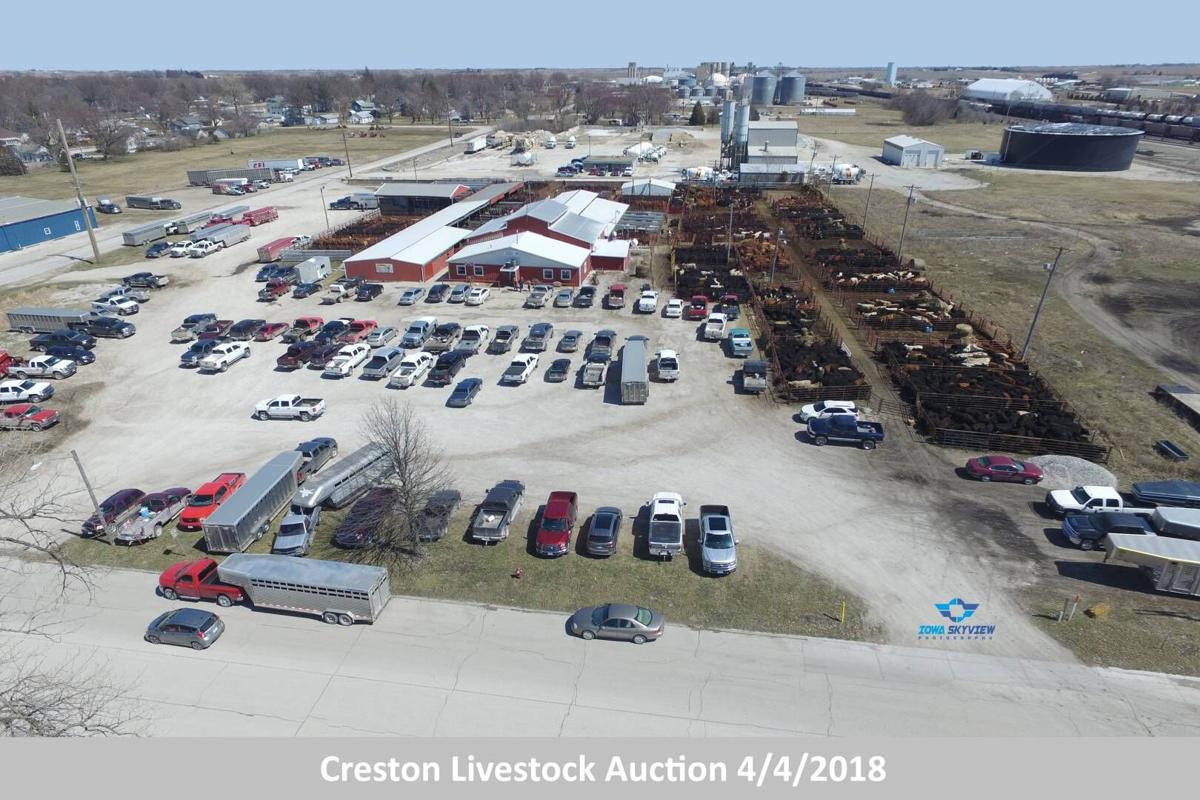
Located in the heart of cow-calf country amidst the rolling hills of Union County, Iowa, Creston Livestock Auction serves producers of Southwest and South Central Iowa as well Northern Missouri.
“The only thing we can promise anybody is that we’ll worker harder for them than anyone around,” says Cody Frey, who owns the business with Curt and Heather Sporleder. “It’s a family business” and “about the only thing I ever knew,” he says.
Cody and his partners, Curt and Heather Sporleder, bought the barn in 2019 from his parents, Tom and Leisa Frey, who had owned it since 1999, when he was a freshman in high school.
“I probably worked for them 12 years before 2019. It’s all Dad’s ever done and about the only thing I ever knew,” he says.
That’s probably why it took Cody “about five minutes” to say “yes” when Curt, who also owns a sale barn in Unionville, Missouri, asked him if he was ready to buy when Tom and Leisa decided to sell. Just as quickly, the partners decided not to mess with a winning formula.
Following his father’s example
“A lot of people asked what we would do different. Dad set a pretty good example, ran a pretty good business. We followed his example. It was running pretty good before, so we just kind of kept that mold,” says Cody.
The barn runs regular Friday sales and special Wednesday sales November through March, except for the May-August summer schedule. Cody’s brother Brandon, and 2019 World Champion Livestock Auctioneer Russele Sleep, both long associated with Creston Livestock Market, call the sales.
“Most of our cattle are feeder cattle. They go back to a growing yard or finishing yard in Iowa, Kansas, Nebraska to a guy that’s going to grow them a while,” says Cody.
The yard has a capacity of 3,000-3,500 head, and the barn can run 3,000 cattle through in about a six-hour period. All hydraulic doors coming in and going out of the arena help keep the sales going at a brisk pace.
“You have to be well-organized and keep the cattle moving,” says Cody. “A lot of it is having employees who know what they are doing, like working for you and do a good job.”
Back in the day, some sale barns would still be selling at 10 or 11 p.m. With his crew, it’s rare that a sale goes past 6 p.m., which makes things easier for everyone, Cody said.
More than a business
He appreciates that the sale barn is not just a business, but a show place and social center for producers. The on-site café is a must-stop for many buyers and sellers.
“We’ve got Kathy that runs it and does a heck of a job. It’s open five days a week with home-cooked meals every day at noon. She probably serves 100 meals a day and 200-plus meals a day on sale days,” Cody says.
“Everybody comes to town to sell their cattle and walk into the café. They have worked all year and are proud of their cattle, to have them on display for everybody to see that day,” he says.
Cattle brought in ahead of the sale are tended carefully.
“Every cow brought in overnight. Isaac and his crew out back take care of them. Everybody leaves it up to us. We take care of them and get them ready for the next day,” he says.
The coronavirus pandemic, hitting shortly after they took over the business, was a learning experience, Cody recalls.
“We were definitely in uncharted territory. Nobody had that crystal ball to tell us what to do,” he said.
The barn had changed online bidding companies after its purchase from Tom and Leisa. During the pandemic, some regular order buyers who attended sales in person began bidding from home.
“They trusted us. Some of those guys kinda liked it,” Cody says. “That way they don’t have to come all the way down here for a sale.”
For Cody, it’s all about serving the customer.
“The biggest part about it is making sure you see those customers, talking with them, making sure they know you care. If you’re not as proud to sell their cattle as they are to raise them, you ought to find yourself a different business,” he says.
As for the outlook for the industry, “It’s sure looks like there is a bright future ahead. These cattle guys are going to make some money. Our supply isn’t what everybody thought it was. In the drought areas, you can’t crop the ground. The only one thing to do is put a cow back on it when they do get some rain. The guys that have stayed in the cattle business are sure going to be rewarded for staying in it,” he says.
And Creston Livestock Market will be there to match buyers and sellers, passing on those rewards to producers.
— Emery Styron