






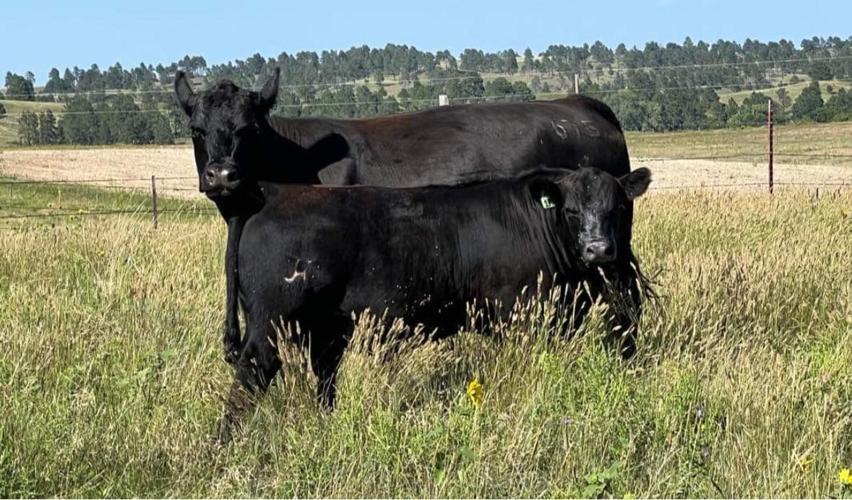
In the 24 years since Judd Hoos and his wife Brandy first purchased registered Angus, Hoos has poured his passion, determination, and a whole lot of elbow grease, into building one of the area’s premier Angus seed stock ranch.
Judd Hoos, Brandy, and their three children Hayden, Hannah, and Hadleigh, own and operate HoosCow Angus in Rushville, Nebraska.
Hoos knew he wanted to be a rancher from an early age. But when his dad sold his cattle when he was a junior in high school, it looked like a ranch career was going to be difficult, Hoos said.
But he was determined and continued to assert that ranching was what he wanted to do.
“Everybody kind of told me it was impossible. That took too much capital, too many other things,” Hoos said.
After graduating high school, Hoos went on to play football at Chadron State College, all the while planning how he could start ranching once he was done.
It was while at Chadron State that he met Rick Funston, now a professor and beef cattle reproductive physiologist at the University of Nebraska-Lincoln. Funston, who worked on heifer development and heifer fertility synchronization protocols, would serve as an inspiration for Hoos.
The two maintain contact now nearly 30 years later.
After graduating college, Hoos was still met with opposition to starting his own ranch. But he knew it was in his blood, so in 1998, he and Brandy moved back to Rushville, Nebraska.
“I moved back home, despite what everybody was telling me, to try to start a ranch from scratch,” Hoos said.
Like many producers, he got an off-ranch job. First at the local bank, then at the local elevator. He had commercial cattle at this point, but between ranching and working he and Brandy were “burning the cattle at both ends.”
Just over a year and half after starting at the elevator, some shifts took place and Hoos took his leave. He took a chance to start investing more into his cattle business, buying registered Angus and doing cattle marketing along with AI.
It paid off. Hoos ended up breeding about 5,000 head of cattle each year along with custom AI, though this past spring he ceased the AI services, particularly due to labor shortages.
Now, he and his family run the ranch without any outside employment, meaning the ranch is his only priority, which is okay by him, after burning the candle at both ends for 25 years he said.
But his business leading up to today ultimately benefited all aspects of his operation, including the traits he breeds into his cattle.
“I didn’t have time for problem cows,” he said. He was super careful in how he selected genetics and was quick to get rid of any problems.
“I think the selection pressure that we put on those cattle because of that makes a difference. We know how important the dollar is to all of our customers. So if you're trying to make a living solely on a ranch, when you go out and spend some money on a bull, you need him to work,” he said.
HoosCow Angus cow doesn’t feed any silage. They eat solely hay and grass. The bulls are much the same, feeding them hay and grain, developing them on a dry ration.
They’re developed in hilly pasture of about 60 acres.
“It's an environment that is very similar to what commercial producers have in western South Dakota and western Nebraska,” Hoos said.
“We're really focused on getting bulls to these commercial ranchers,” he added
That philosophy means Hoos isn’t always chasing new and exciting things and the unknowns that can lead to problems.
“We go a little slower and we're not anxious to go try out a new bull. We want to know more about those cattle before we bring them into our program,” he said.
HoosCow Angus uses a lot of their own genetics to stave off those unknowns.
“We know a lot more about the cattle that have handled our environment and excel here,” he said.
That means having cows that can handle the forage environment of western Nebraska along with those that have natural fleshability and a lot of body.
Hoos said a main priority is ease of calving, leading them to push birth weights a little more than others, he said.
“Nobody wants calving problems,” he said.
As Hoos reflects on the last quarter century, he knows that his struggles aren’t necessarily unique to cattle producers.
He said he understands why people told him that doing what he did was impossible. But he has no regrets.
“If you're determined and you're willing to work hard, the American dream still exists,” he said.
Learn more about HoosCow Angus at www.hooscowangus.com.


