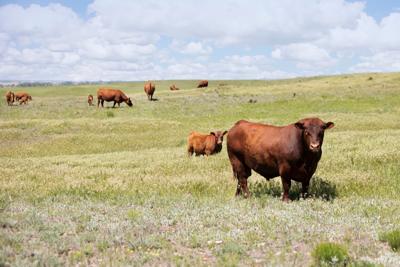





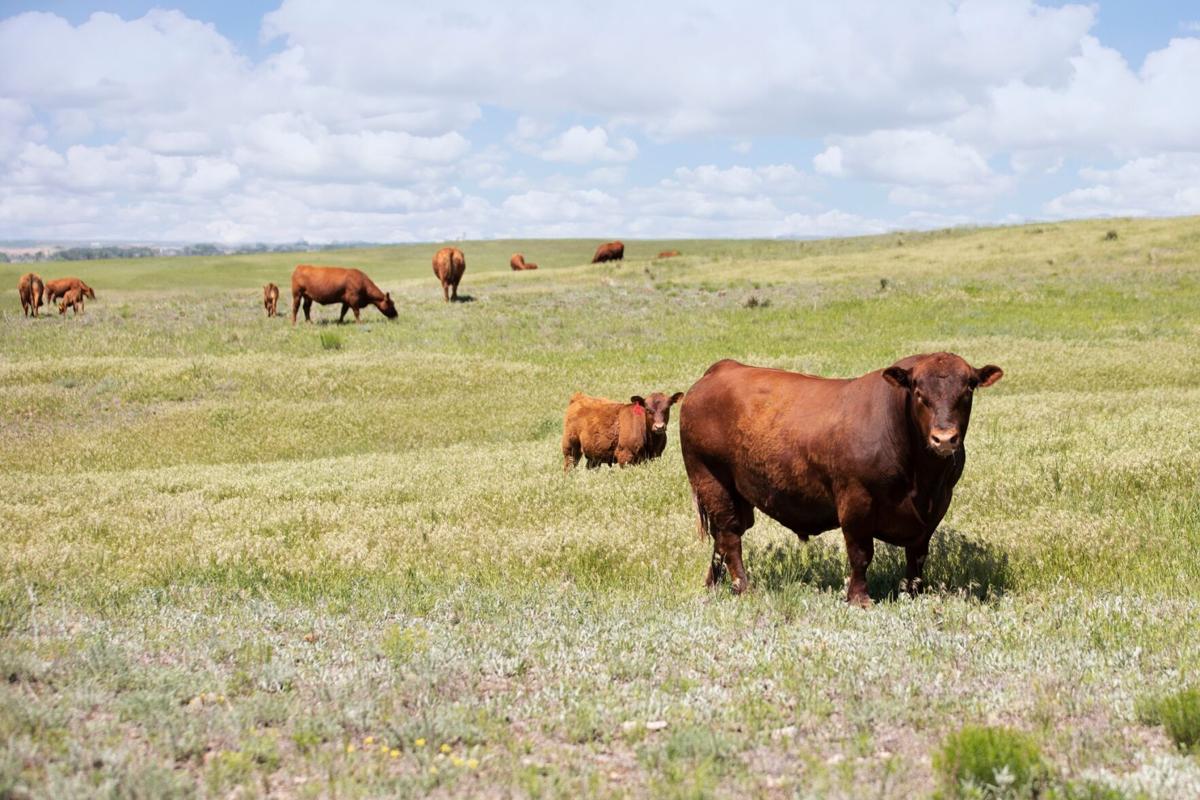
Dustin Frank is building his own legacy
While the Chappell, Nebraska rancher grew up on a north central Colorado row crop farm, he’s the first generation to run a Black and Red Angus and seedstock operation.
“Sometimes kids like to put their own spin on the family operation,” Frank said.
Frank owns and operates Frank Cattle and Genetics along with his wife, Kendra Frank. The couple has one young son, Jesse. His parents, Ron and Kara Frank, his brother Derek, and other extended family still operate the family farm in Colorado and make up part of the company.
As a first generation rancher, it’s not a huge surprise that when he was younger, ranching wasn’t on Frank’s radar.
He attended Colorado State University, majoring in agricultural education. He’d set out to become an ag teacher.
While at CSU, he competed on the livestock judging team, which Frank said influenced his decision to become a rancher.
He judged under the guidance of Shane Bedwell who became a mentor.
As part of the judging team, he got to tour several large seedstock operations, including the Hoffman Ranch in Thedford, Nebraska.
“I remember like it was yesterday, how amazed I was by their operation and how interested I was in what they do,” Frank said.
Near the end of his tenure at CSU, Frank realized that ranching, rather than teaching, was what he wanted to pursue.
His family had purchased some land near Julesburg, Colorado, near the Nebraska Panhandle. Frank started working there, all the while dreaming of starting his own operation. As he was driving through the Panhandle, he fell in love with the area and knew that was where he wanted to put down roots.
A decade later, Frank vividly remembers purchasing his first bulls shortly after buying property near Chappell.
What started with selling a dozen bulls in 2012 has grown into the full-fledged seedsstock operation he’d been dreaming of, selling 104 bulls at his 2023 sale.
“I think there's milestones when you're building something from the ground up. A big milestone for us was to market 100 bulls in a year. We accomplished that last year,” Frank said.
Being a first generation producer comes with some benefits that help Frank cater toF a wide customer base.
He knew that being relatively unknown, he’d have to quickly appeal to as many people as possible, a tactic he still uses today.
While some seedstock producers focus on certain traits, Frank is able to pivot to meet unique needs and do things the way he and the customer see fit.
“I don’t have to do things because that’s how grandpa did it. I don’t have anyone pulling the reins back on me,” he said.
He added, “It would be nice to open a playbook, but I don’t have that luxury.”
In the early days of his operation, Frank was focused on acquiring land, so he used IVF to build his herd as quickly as possible. He enjoyed the embryo work quite a bit, which led him to eventually partner with Vytelle as a satellite IVF location.
“I always felt like there was a void here. We were having to haul our cows to do IVF work. So that was sort of my motivation to do get something setup here on site,” Frank said.
His IVF business has grown significantly. In 2021, when he first started, they created 200 embryos.
This year, they’ve already done more than 1,100 for both his own operation and for customers in a 200-mile radius.
While he caters to customers with diverse needs, Frank keeps core values in check.
He keeps feet, utters and fertility at the foundation and then sprinkles in other genetic variations, though maternal traits take a front seat.
For Frank, there is nothing that can help the profitability of a herd more than the strength of a good footed and easy keeping Angus cow.
Frank believes that his multi-breed program is something unique that sets his operation apart. There is not only a great deal of genetic merit in both the Black and Red Angus programs but a benefit to using a crossbreeding rotation between both Black and Red is the maternal strength that will be realized in the resulting females.
Conditions in the Nebraska Panhandle are particularly rugged, leading to resilient cattle. Frank maintains “a moderate cow herd,” keeping them easy fleshing and fertile. He’s of the mentality that if he keeps his cattle in check and makes them work for living, those bulls would create those types of daughters.
“Eleven years down the road now and we're starting to get positive feedback and the reports that the daughters out of our bulls are really efficient,” Frank said.
That feedback is huge for him. While starting to branch out as his business grows, he wants a strong reputation with area producers first and foremost.
To build that reputation, one of Frank’s primary focuses is creating herd bulls for local cattlemen that are dependable and reliable in their environment.
“They rely on our genetics. That’s not something we take lightly,” Frank said.
As Frank reflects on just over a decade of being a first generation rancher and seedstock producer, he recognizes that his family is what makes it all possible and credits his success to them.
Kendra Frank has been with him every step of the way, even before they were married, he said. She works off the ranch as a realtor, taking their son Jesse with her everywhere she goes and still comes home to help out on the ranch and keep all the books.
His parents, siblings and uncle still operate the family farm in Colorado as well as help out with developing sale cattle and replacement females. They’ve been incredibly supportive of his venture, for which he’s thankful.
“No one can do this alone,” he said. “It takes an army.”