





Paul Geyer sits in the driver’s seat of his new vehicle, while Otto Sauer rides in the passenger seat. The photo was taken somewhere in Madison County, Nebraska.
Classic Photos
A collection of photographs featuring the farm and ranch lifestyle throughout America's history.
Submit historic photos to support@midwestmessenger.com; Midwest Messenger, Attn: Classic Photos, 717 S. 13th St., Tekamah, NE 68061.
Looking Back...
Looking Back: Steam threshing
James R. Vernon uses what may be a Waterloo Boy steam tractor to power the belt for a thresher on his farm located southwest of Lorenzo, Nebraska, in Logan County, Colorado.
This photo was taken prior to 1915. The original source of horse-power was still used to pull the water tanker and haul the crop in a box wagon.
Looking Back: Hintz horse
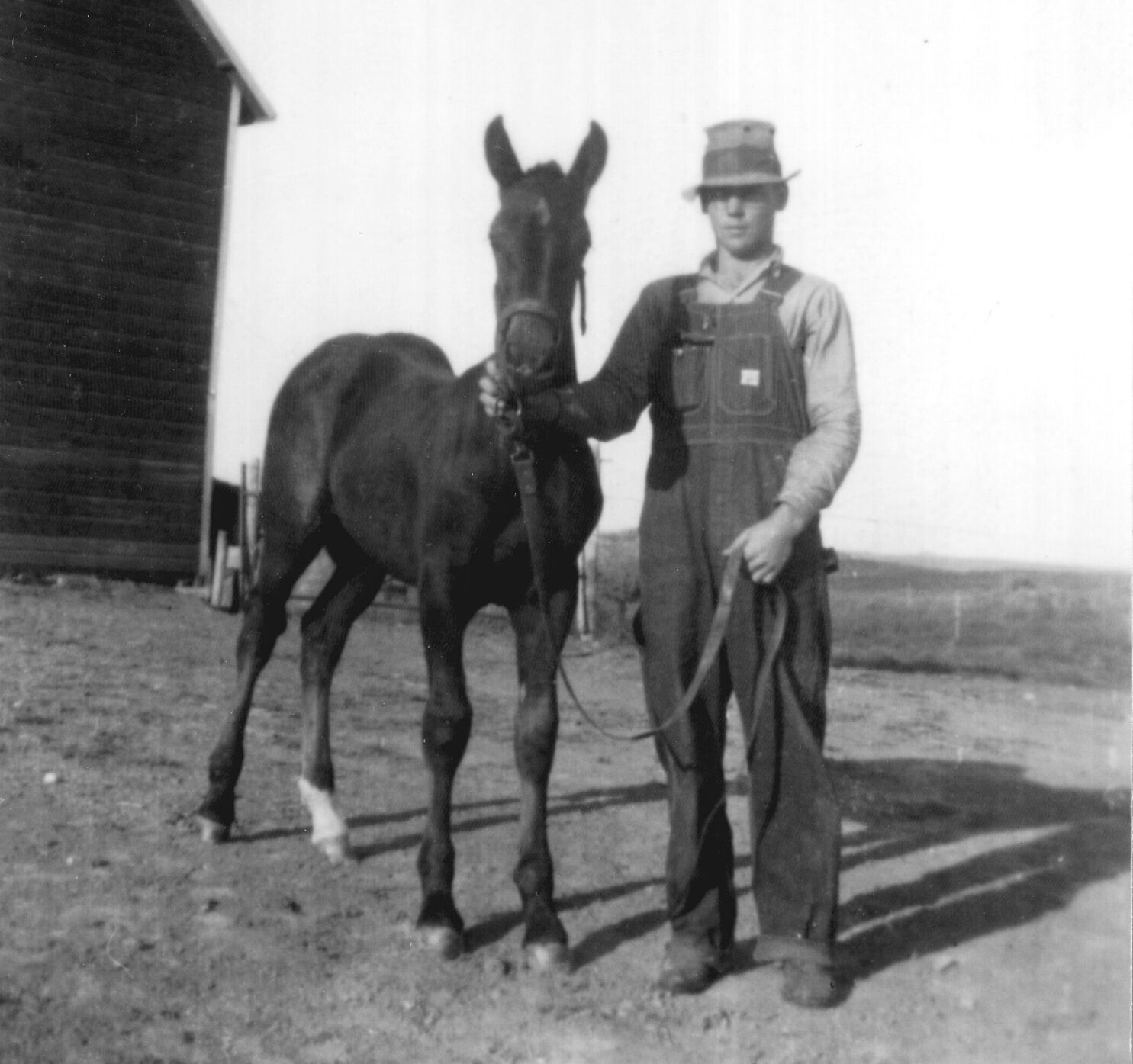
R.L. Hintz stands with a yearling around 1940.
Kopecky Ranch & Hay Co.

Lewis Kopecky Sr., founder of Kopecky Ranch & Hay Co., producers of Elkhorn Valley Hay, converses with two hay truck drivers hauling the company’s small square bales on Main Street in Inman, Nebraska. Date unknown.
Dunekacke, immigrant farmer

Fred J. Dunekacke prepares the field to sow wheat on the Henry Rohrs farm east of Johnson, Nebraska in the early 1930s. Fred, originally named Fritz Dunekacke, migrated from Germany to the United States in 1929.
Sybrant family ranch
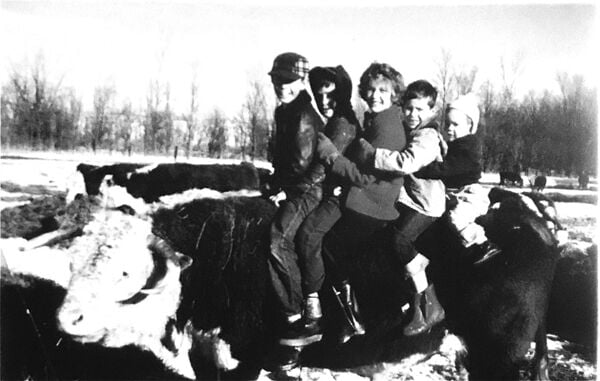
Siblings Dale Sybrant, age 10, Allen Sybrant, 9, Mary Sybrant Roggasch, 7, Jim Sybrant, 5 and Kyle Sybrant, 8 months, on a bull at their family’s ranch south of Bassett in Rock County, Nebraska. The children of Kenneth and Gladys Sybrant, all five siblings are ranchers in Rock County today.
The Stanford bridge collapse

A postcard once belonging to Claude and Crystal Rhynalds — a couple who farmed west of Oxford, Nebraska — depicts an engine that fell through a canal bridge east of Stanford, Nebraska.
Brohman family farm
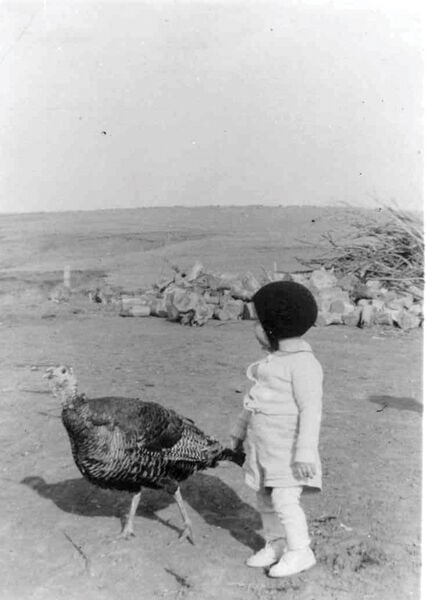
Harold “Breezy” Horatio Brohman watches the turkeys on his grandparents’ farm south of Callaway, Nebraska, in 1941. His grandparents, Horatio and Bessie Booth, farmed and raised turkeys. Breezy passed away in November 2016. Harold’s son, Mark Brohman, said that while the landscape is empty in this photo, the hills south of Callaway are covered in eastern red cedars today.
Bremer family farm

The Bremer family thrashes cob corn on a warm fall day in 1896 near Boleus in Howard County, Nebraska. The Bremer’s grandchildren, namely Phyllis, Evelyn and Fern Stepanek, were born years later on this family farm. Phyllis resides today near Saint Paul, Nebraska on a farm, as does her daughter, Rochelle Stepanek.
The Phillips siblings

Harold Phillips (left) with his sister, Bernice (Spahr), and brother, Eugene, and their calves. The photo was taken near David City, where they grew up, around 1940.
Ruth family farm
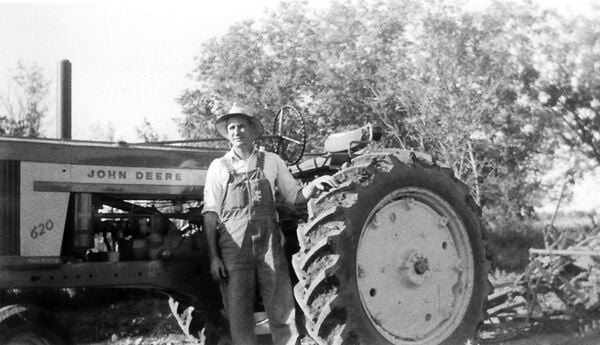
Wayne Ruth, of Rising City, Nebraska, stands in front of his John Deere 620 in 1958.
Neil Kort and his furry companions
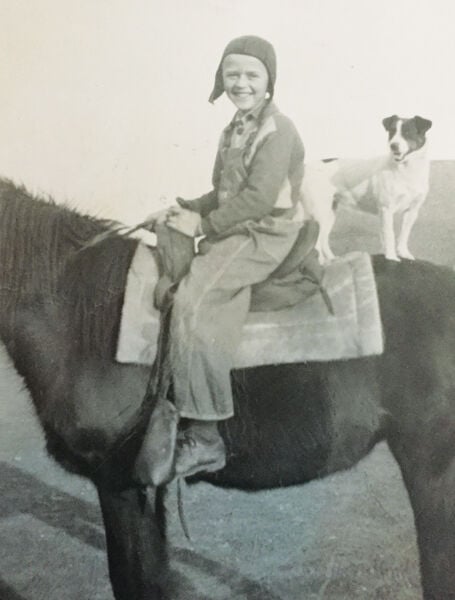
Neil Kort of Blue Hill, Nebraska, and his faithful companion, Penny, sit atop his first pony, Trixie, in 1947.
The Nicolite family

Ang Nicolite’s father and neighbors buzz wood in 1936.
Stateline German Tigers

The Immanuel Lutheran Church baseball team, the Stateline German Tigers, which was formed in 1919 after World War I ended. The team was comprised of (back row) Harm Tjaden, Harvey Ubben, Wilke Saathoff, John G. Saathoff, (front row) Mike Antons, Menno Saathoff, Ubbo Ubben, Herman Saathoff, and Clarence Saathoff.
Hay crew of St.John-Pease
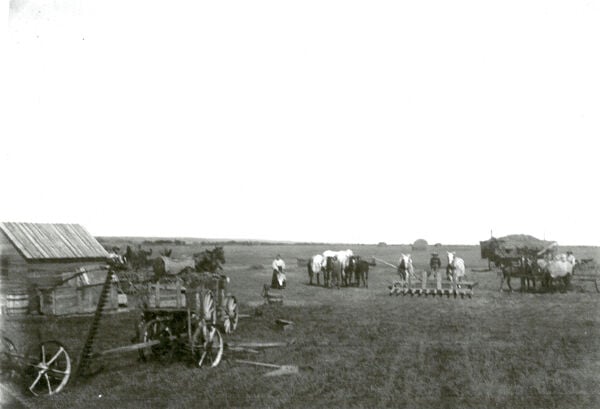
The St. John-Pease hay crew get to work on a farm southeast of Paxton, Nebraska in 1903.
The Farquhar brohers
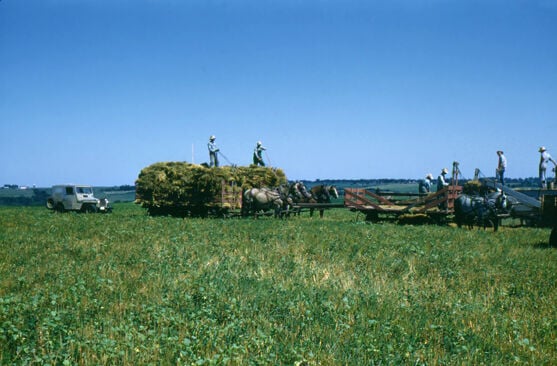
The Farquhar brothers use their horsepower while threshing the farm in College Springs, Iowa in 1951.
The Toll family

The E.B. Toll family combines wheat on Trehill Farm in Saline County, Kansas, sometime in the 1920s or 1930s. The farm is still in the family today, now operated as a feedlot by E.B.’s third cousin, Darcy (Came) Bradley and her family.
The Cech brothers farm
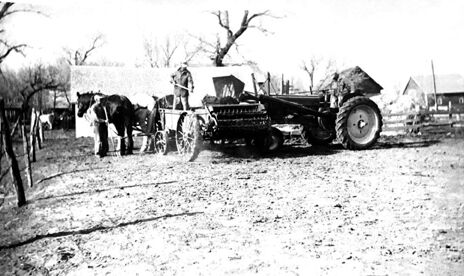
The Cech brothers work together on the family farm near Clarkson, Nebraska, sometime in 1950. Bohumil is on the tractor, Anton is on the spreader, and Ludvik is standing near the horse.
The Shoemaker farm
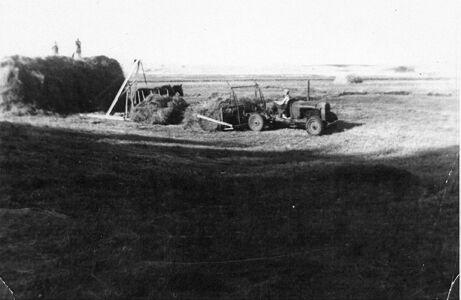
Ray Shoemaker stacks hay near the South Loup River in southern Custer County, Nebraska in 1945. The men atop the stack are Ezra Daugherty and Murble Whisman. Ruth Shoemaker was driving the team of horses, Prince and Bell, to pull the load up.
Smith's horses

Holding the reins, Charles E Smith poses for a photograph with his team of horses, Fred and Ted, as they sit in front of the Freight Depot loading dock in Nebraska City, Nebraska in 1913.
The Preister family

Ben Preister of Humphrey, Nebraska stands atop his brother Joe’s threshing machine as he works to harvest oats in 1937, while his sons Art, Alvin and Jim stand at the ready nearby.
Honey Creek School

The youth of Honey Creek School southeast of Dawson, Nebraska pose for a class photo in 1966. The school year’s third-, fourth-, and fifth-graders included: (Front row, from left) Scott Martinosky, Dan Wittwer, Pat Orr, Charlie Fiegener, Joni Albin, Cindy Burns, Geraldine Cook, Lanette Bucher. (Back row) Jerry Feek, Cecilia Fiegener, Gary Jones, Doug Wittwer, teacher Grace Watkins, Jill Harmon, Patrick Cook, Mary Tackett, Cindy Harmon.
The Miller family
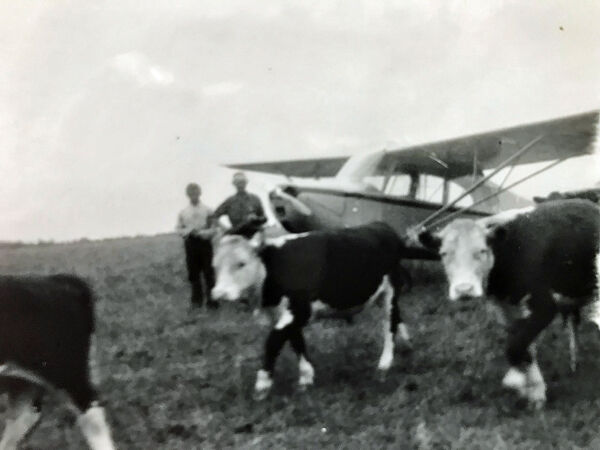
Rollie Miller and his son, Glen, pose with Rollie’s Cessna plane and Hereford cattle in the Opportunity Star area near O’Neill, Nebraska sometime in the early 1950s. Rollie’s granddaughter, Michelle Laska, said that after the blizzard of 1948-49, her grandfather decided he needed a plane for the family’s transportation needs when the roads became impassable.
The Noltes of Evergreen Hatchery

Circa 1939, Kathleen Nolte Pollard displays a heaping basket of eggs gathered on her family’s poultry operation, Evergreen Hatchery, which was owned and operated by her parents, W.F. and Nettie Nolte, of Plattsmouth, Nebraska.
Fuhr tractors

(From left) Gorden Fuhr, Ray Fuhr and Bill Fuhr line up in front of their tractors for a promotional photograph for Tractor Supply Co. during the spring of 1958. The advertisement featured Tractor Supply’s power blocks for two cylinder tractors, according to relative Darrell Fuhr.
Turner family farm

Lawrence Turner poses for a photo sometime in 1946-47 on the family’s homeplace, about 22 miles east of Valentine, Nebraska. The Turner land is still in the family today, owned by Lawrence’s son.
Osborne farm
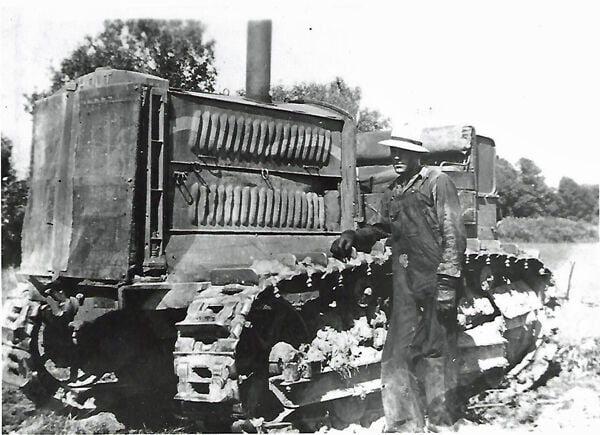
Vincent Osborne pulls trees with his Holt Cat sometime during 1937 in Atkinson, Nebraska.
The Long cousins
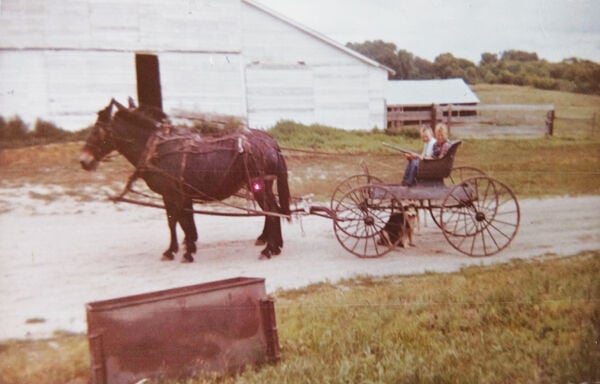
Cousins Fred and Scott Long take a team of mules out for a ride in July 1962 on the Dan Long farm in Stanton County, Nebraska. The team of mules belonged to Fred’s dad, Alan Long.
The Isaacson family
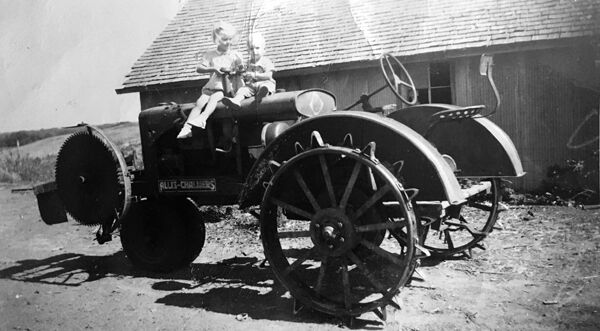
Rogene (Parr) Isaacson and her brother, Arlan Parr, sit on their dad’s Allis Chalmers tractor, which is outfitted with a buzz saw attachment, sometime in 1943. Edmund (Jack) Parr was a farmer in Roseland, Nebraska.
CW Lewis farm

CW Lewis heads out to cut wheat on his farm east of Wood River, Nebraska, sometime in 1954 or 1955.
Seven cousins and a horse

Seven cousins pose on the back of a very gentle horse around 1926 on the Arends farm near Talmage, Nebraska: Mayree Arends, left, Raymond Arends, Lucy Teten, Amelia Teten, the next two boys are unknown, and the last boy is Herman Arends.
Aksarben Reserve Champion of '53
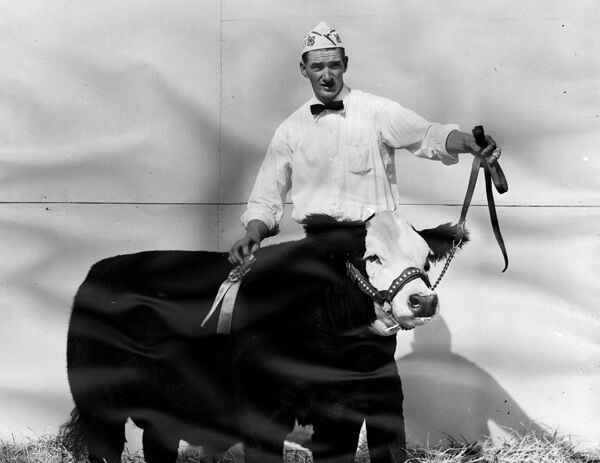
Leo Gentrup of Beemer, Nebraska, entered this calf into the 1953 Aksarben stock show, winning Grand Champion Black Angus Class and Reserve Champion for the entire show. The calf was purchased at Pender Livestock Sales Co. for $23.80 per hundredweight, and later bought at the Aksarben auction by Phillips 66 Co. for $66 per CWT.
Peggy Miller's Harley

Peggy Knisley Miller poses with her 1948 Harley Davidson in 1959. According to Peggy’s relative, Donald Miller, the cycle was a slightly rare 61- cubic-inch, which was the first pan head model at the time. Though it was sold for $200, Miller said this cycle would be worth upwards of $15,000-$20,000 today.
Friede family farm
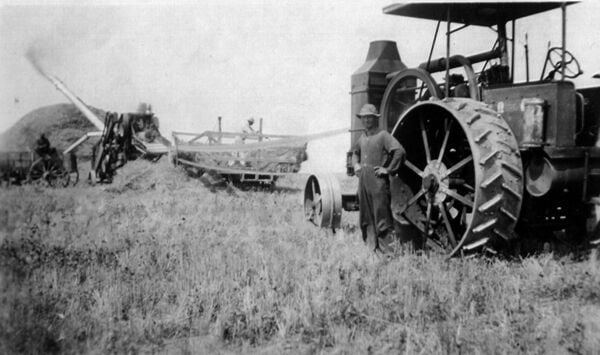
Carl Friede stands with his equipment on the family farm in Nebraska City, Nebraska in this undated photograph.
Kruse's Poland China hogs
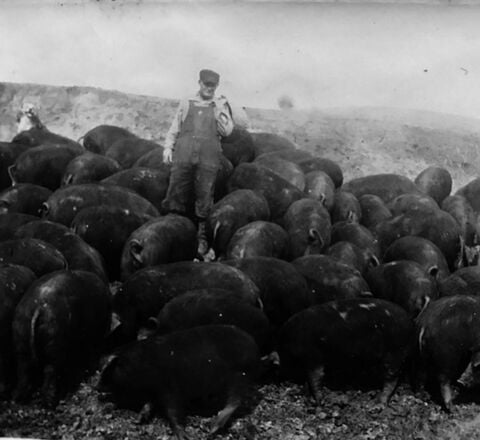
William Kruse Sr. stands amongst his black Poland China hogs on the farm in Winnetoon, Nebraska in the 1940s.
Peterman brothers
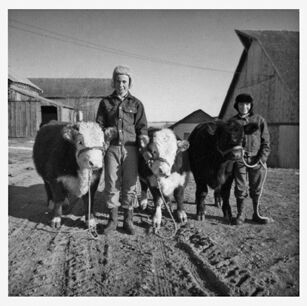
Ron Peterman, left, and his brother, Randy, pose with their 4-H calves for the Taylor County fair in Bedford, Iowa around 1964. The brothers grew up together on their parents’ farm south of Sharpsburg, Iowa.
Preston family farm
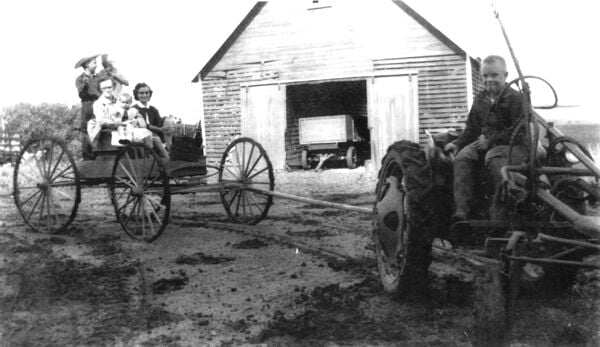
Two historical photographs show the same barnyard scene as Dick Preston takes family friends for a ride with his Allis Chalmers “G” tractor. The first photo was taken in the summer of 1955, and the second during the fall of 2016, both in front of the same corn crib on his family’s farm in Lyons, Nebraska. Photo submitted by Dick Preston, Omaha, Nebraska.
Preston family farm 2
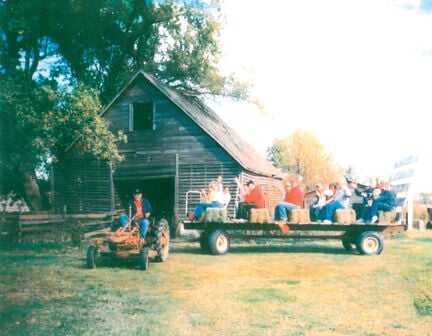
Two historical photographs show the same barnyard scene as Dick Preston takes family friends for a ride with his Allis Chalmers “G” tractor. The first photo was taken in the summer of 1955, and the second during the fall of 2016, both in front of the same corn crib on his family’s farm in Lyons, Nebraska. Photo submitted by Dick Preston, Omaha, Nebraska.
The Brinda equine crew
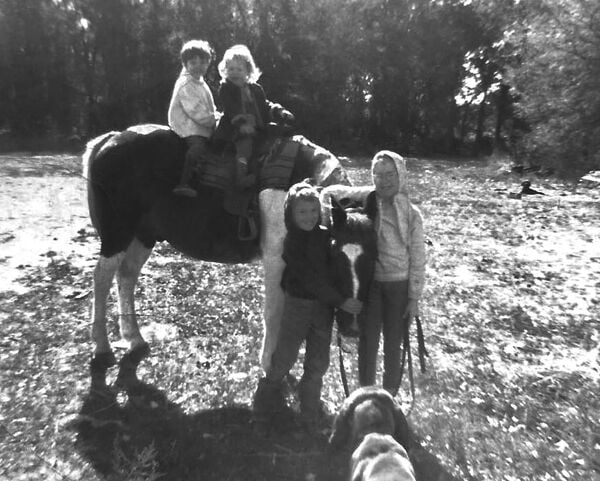
The Brinda sisters, (from left) Becky (Meester), Cathy (O’Neil), Kim (Parkhurst) and Bobbi (Buxbaum) show some love to their family pony in this undated photo. According to a relative, the sisters all still ride horses to this day.
Nelsen family farm

Hans Nelsen Sr. is joined by four of his nine children as he stacks oat bundles on the family farm west of Homer, Nebraska in the early 1940s. The family’s tractor, depicted in the photograph, was the first 1934 John Deere Model A sold at the John Green and Sons dealership in Hubbard, Nebraska, according to his son, Jon David Nelson.
Keller family farm
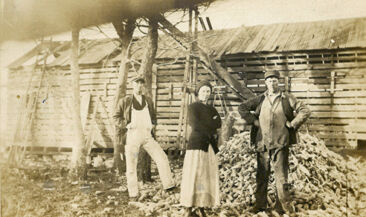
Vic Sowards, left, Frankie Laughlin Keller and her husband, Roy Keller, pose in this undated photo on the Keller family farm in Ashland, Nebraska.
Monnier family farm
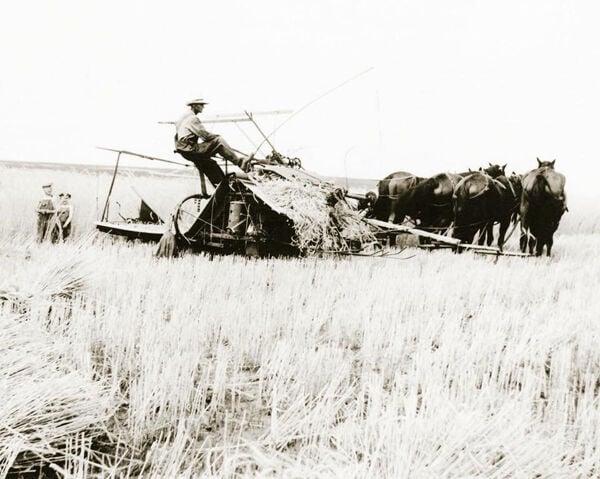
George Monnier drives his team of horses as his sons Robert and Richard watch nearby in their fields south of Kilgore, Nebraska, about 1933.
The Blacklys of Ralston

Edward Blackly’s grandchildren drive his horse and buggy around Ralston, Nebraska, possibly escorting the dairy cows from their acreage outside of Ralston to their winter quarters in town. Originally from Illinois, Edward and his wife, Emma, farmed in western Iowa for a time before moving to Ralston, where they first operated a harness shop in Ralston, then a restaurant, and finally ran a dairy and ice business at their home in town. From their milk and ice deliveries in the buggy to personally serving three meals a day to road crews as they worked on upgrades for Highway 30 in 1931 — including over 1,000 of Emma’s homemade pies — the couple was well-known in the area.
Cook's corn
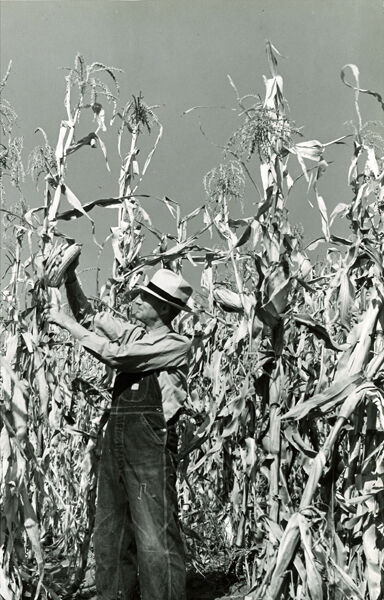
Cortez Cook surveys the corn crop on his farm near Arlington, Nebraska in the 1930s.
The Behrends family
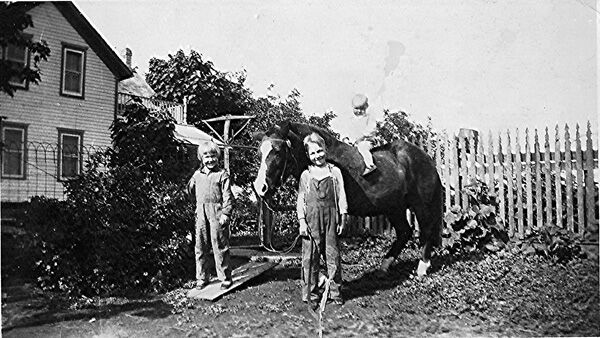
Alberta Behrends Hector, left, Marvin Behrends, and Harlan Behrends spend some time with the farm animals on the family’s homestead southwest of Auburn, Nebraska, in the 1930s. Though Alberta and Harlan have since passed, Marvin turned 100 years old this month.
Corn shelling day in Plainview
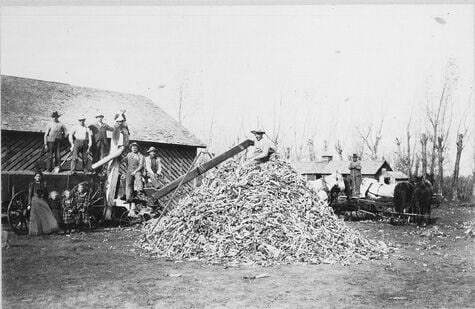
Anton Thomsen, far right, and his crew ready for the neighborhood corn shelling day at the Thomsen homeplace, five and a half miles south of Plainview, Nebraska, in the late 1910s. The shelling crew used three teams of horses to assist with the day’s work.
Vernon family farm
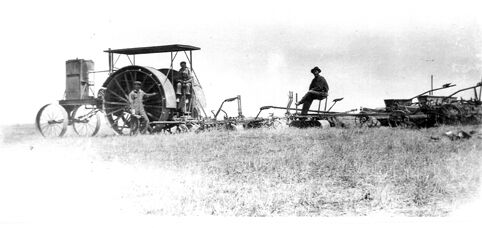
J.R. Vernon and his sons, Art (by the wheel) and Lester (atop the tractor), are hard at work on the family farm northwest of Peetz, Colorado sometime between 1914 and 1916.
Dan and Joe the horse
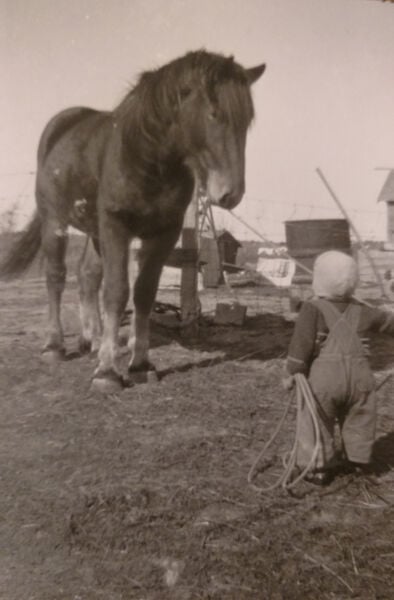
One-year-old Dan Connell Jr. grabs the reins of Joe, his father’s prize stallion in 1937 at the homeplace near Tryon, Nebraska.
Wendeln family farm
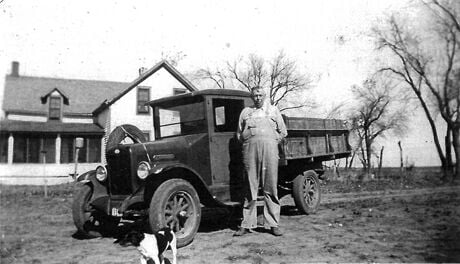
Henry Wendeln and his dog, Mickie, admire the new addition to the family farm — a 1929 International truck. Henry was born in 1876 and grew up to tend the farmland his father, Matthias Wendeln, homesteaded in 1869, located southwest of Syracuse, Nebraska. Henry passed away at the age of 92, but the family farm endured, now owned and operated by his descendants.
Wranglin' rattlers

Robert Brinda, left, and Tom Harvey wrangle a rattlesnake after a successful hunt in the 1950s near the Nebraska-South Dakota state line.
Cook Farm
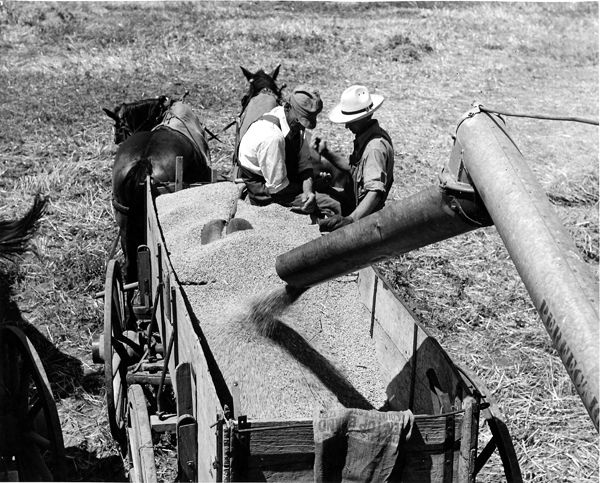
Brothers Bill Cook (left) and Lawrence Cook watch as their oat harvest pours from a threshing machine chute onto a two-horse-drawn wagon on the family farm near Arlington, Nebraska sometime during the 1930s.
The Jensen duck flock

Edwin M. Belina and his older sister, Marvine (Belina) Koliha, are surrounded by their parents’ flock of mallard ducks on the family farm in 1949.
Cook's poor man's crib

The 1938 corn harvest sits in a heap that Lawrence Cook liked to call his “poor man’s corn crib”. A farmer from the Arlington, Nebraska area, Cook encircled the corn crop with a slat snow fence, and built each consecutive layer smaller so the structure would sit stably atop the base. According to his son, David Cook, Lawrence built a two-section roof to fit on the top layer of corn years later.
Stover stacks hay
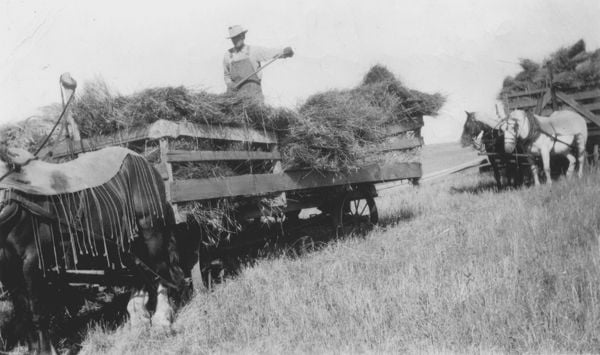
Laurence Stover gets some help from kindly neighbors to stack his hay in 1945 on the farm in Naponee, Nebraska.
The Olson boys
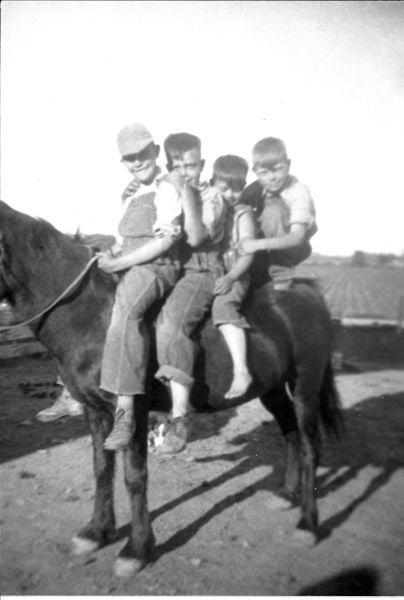
The Olson boys — Lloyd, Caroll, Raymond and Clarance — saddle up for a ride together at home east of Tekamah, Nebraska.
Nebraska harness shop
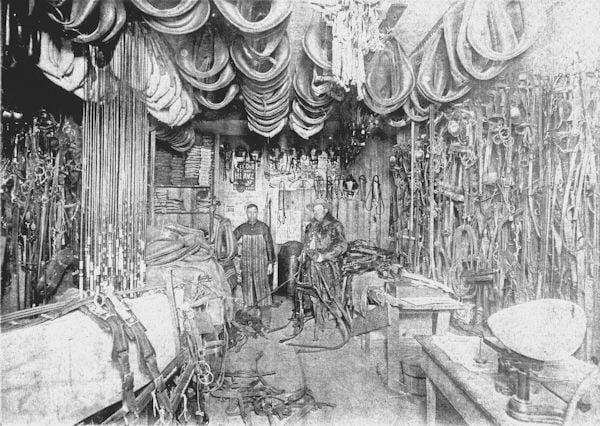
David Solomon Ogden stands in a harness shop, located in either Orleans or Alma, Nebraska. The photo was taken more than 100 years ago.
The Preisters of Humphrey

Humphrey, Nebraska farmer Ben Preister (standing atop the machine) works the 1939 hay harvest with his sons Art, Alvis and Jim, using his brother Ben’s machine.
Cook family farm
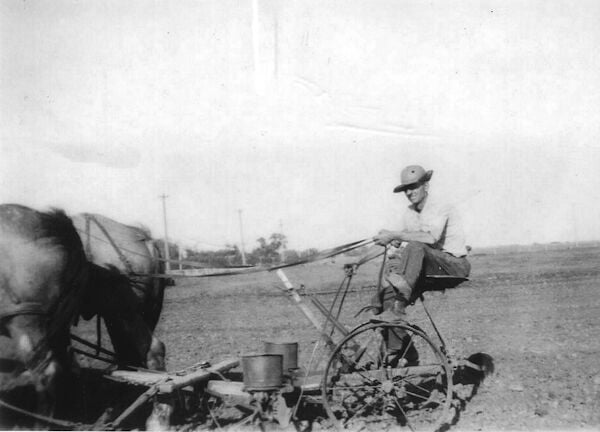
Lawrence Cook sits atop a two-row corn planter that he and his father, Cortez, used on the 160-acre family farm southeast of Arlington, Nebraska.
Behrends family farm
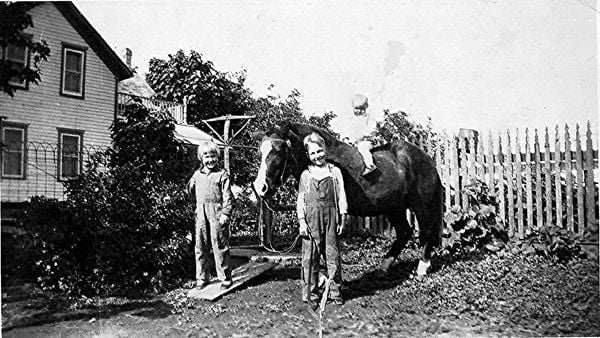
(From left) Alberta Behrends Hector, Marvin Behrends, and Harlan Behrends circa 1930s taken on the family farmstead southwest of Auburn, Nebraska. Marvin, the only living person in the photo, is a 99 (will be 100 in July) year old WWII veteran.
Blackbird Creek
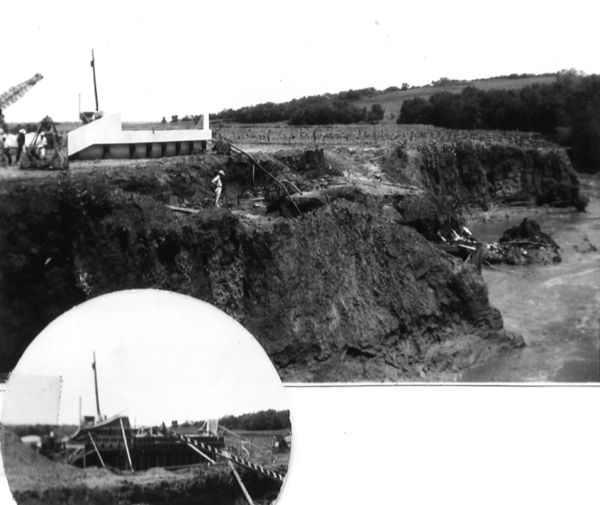
Nebraskan Stanley Johnson was the engineer on the project to build Blackbird Creek, south of Macy, Nebraska. In the main photograph, crews are beginning construction of the creek. In the inset photograph, the completed abutment and coffer dam for Pier Z can be seen during the summer of 1952. Johnson’s niece, Linda Maslonka, said the 160-foot bridge across Blackbird was originally built with two 44-foot spans and one 72-foot span.
Shoein' old Smokey

Five-year-old Jim Brown, formerly of New Market, Iowa, shoes his pony, Smokey, in 1960.
Cook farm, Arlington, Nebraska
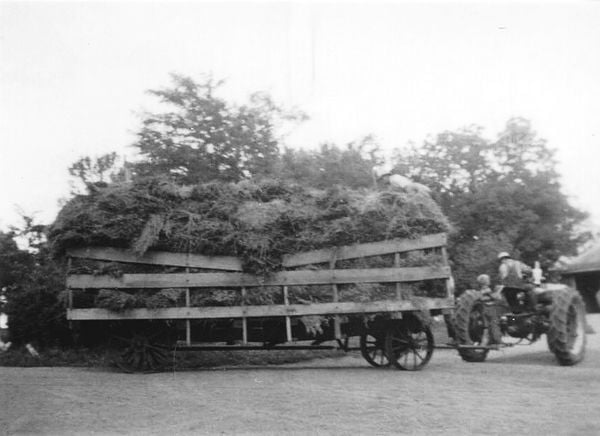
Lawrence Cook brings in a load of hay from the fields at the family farm in Arlington, Nebraska with his son Howard, who is riding on the back of the tractor. Another of Lawrence’s sons, David Cook, said they used a hay stacker powered by another tractor to hoist hay onto the wagon. This particular load was put in the barn loft to feed the dairy cows.
Corn champs of '39

The “Champions of ‘39”, Lillian Sommerhalder Bausch and Adelaide Sommerhalder Wehrbein celebrate a bountiful corn harvest on the John Sommerhalder farm near Steinauer, Nebraska in 1939.
Don Dyson's horse team

Donald Dyson and his team of horses, Dolly and Louise, during oat harvest on the family farm near Lyons, Nebraska in 1949.
The Spike family of Primrose
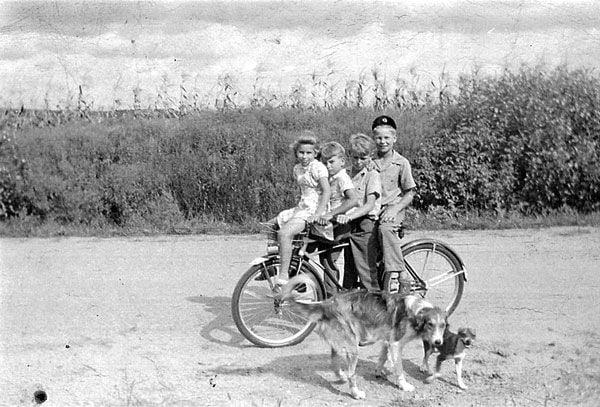
Four of the five children born to Walter and Helen Spike, (from left) Darlene, Wayne, Don and Dean spend some quality time with their dog, Dandy, the beloved troublemaker. According to Wayne, Dandy had quite a story of mischief to tell. It all started when the Spike family moved from their home in Newman Grove to Omaha, Nebraska, to help the Tomlinsons run their dairy farm near Tomlinson Woods Estate. The family took care of the cattle, milking all 20 cows by hand, as well as tended the acres of hay. Their trouble began one day in 1944 when, for reasons unknown, Wayne said that Dandy brought the milk cows home too early and too fast. “The boss was there and told Dad, ‘That dog has to go!’ Dad replied, ‘If the dog goes, we go.’ And we did.” In solidarity of their beloved Dandy, the family moved to a farm/ranch in Primrose, Nebraska, where Wayne and his wife Virginia still live and farm today. Wayne added that he and his siblings still look back on their year in Omaha fondly, enjoying the memories of the farm, Dandy’s escapades, and even the bike they all rode to school — at the same time. “We only had one bike, so Don stood and pedaled, Dean sat on the seat, and Darlene and I took turns riding on the side bar and handlebars. Sometimes two little kindergartners joined us by riding on the back fender,” Wayne marveled. “And not one accident.”
The Hunsaker family of Mansfield, Missouri
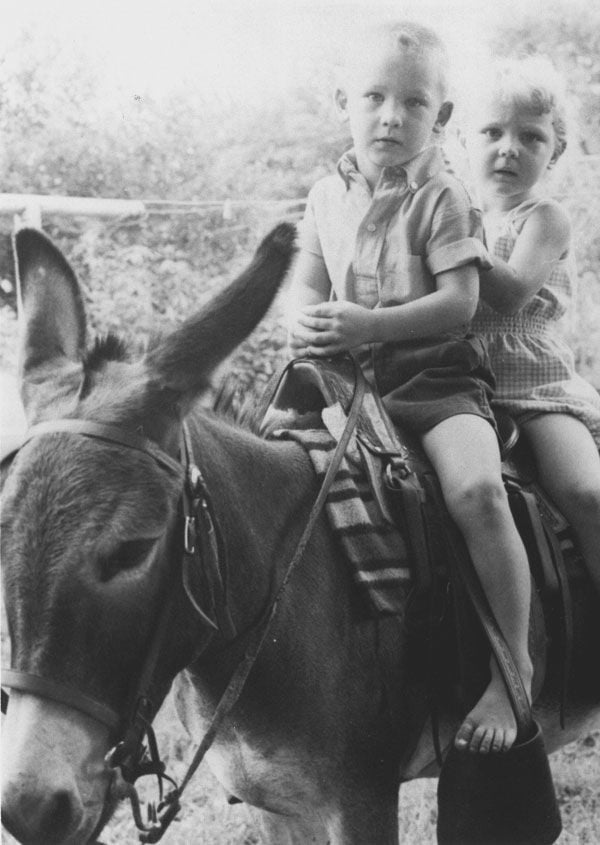
Steve and Susie Hunsaker on a ride in Mansfield, Missouri, circa 1962.
Wyman's horse and buggy
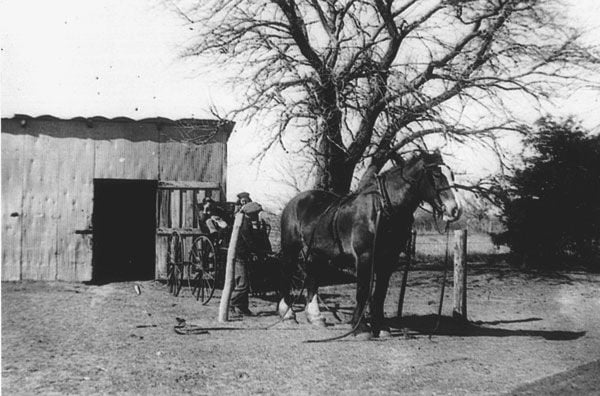
Ted Wyman drives a horse and buggy with his passengers Joyce Starostka Grossnicklaus, Donna Wyman Engel, and Robert Wyman in front of the District #23 schoolhouse in Polk County.
Spike family on the Tomlinson dairy farm

Walter and Helen Spike’s children watched as hay was stacked on the Tomlinson family farm sometime around 1943-44. The Spike family moved from Newman Grove, Nebraska to Omaha to help the Tomlinson family with haying and the cattle on their dairy farm, which was located near Tomlinson Woods Estate.
The McDonalds' threshing machine

The McDonald brothers, sons of Thomas McDonald of Fort Calhoun, Nebraska, travel home with a new steam threshing machine. An article in the local paper of the time, the Blair Pilot-Tribune, reported that when the brothers “steamed up and went puffing through the streets with the engine hauling the separator and other paraphernalia last evening they drew as big a crowd as a circus parade.” Photo submitted by Lloyd Olson, Tekamah, Nebraska.
Jensen farm

Ruth Jensen feeds the chickens on her family’s farm sometime around 1920.
Tekamah football team

The Tekamah, Nebraska football team of 1938 poses just prior to their last game of the season. Pictured are George Sop, Harold Sop, Ronald Melzter, Coach Schvel, Bill Latta, Chatt Lee, Lee Dale and George Bray. (Four team members are unidentified.)
Planting popcorn
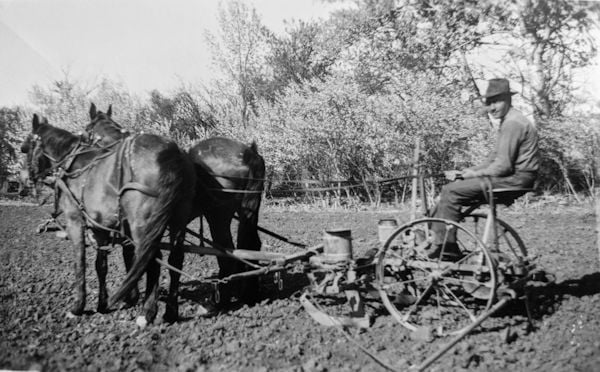
Felix Grossman plants popcorn on a pleasant spring day, May 17, 1944, on the family farm near Carroll, Iowa.
Exeter 4-H Club
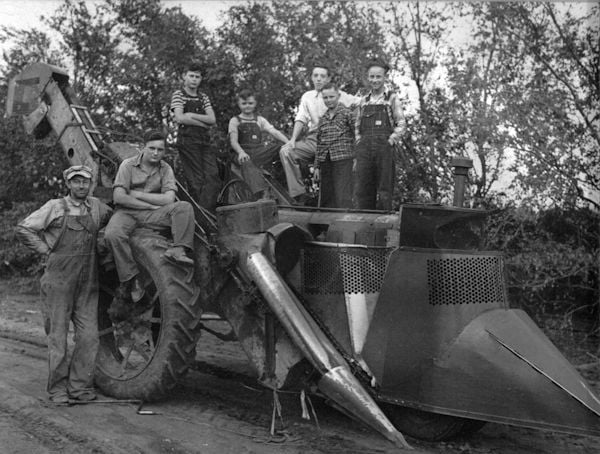
The farm boys who comprised Exeter, Nebraska’s 4-H Club between 1945-46 included John W. Leif Sr., left, John Tous Jr., Robert “Bob” Leif, Sterling Dyer, Richard “Dick” Krejci, George “Milo” Springer and Rene Rozanek.
Omaha Livestock Market

Albert Sprick, left, herded his cattle two miles to the train at Nickerson so they could be shipped to the Omaha Livestock Market on June 7, 1904, where they sold for 30 cents higher than any other cattle that day.
Laughlin family
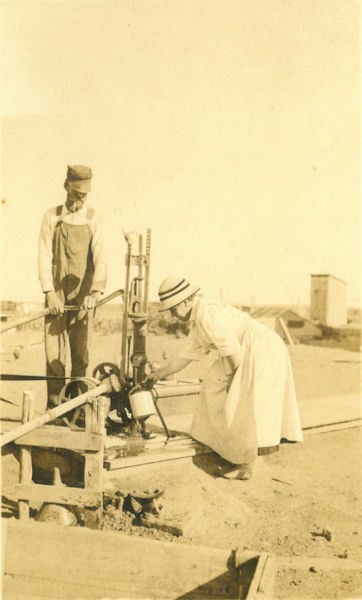
Chilt and his wife Jennette Laughlin pump water from what appears to be an early irrigation system on their farm in Ashland, Nebraska. In the mid-1940s, America’s irrigation challenges were revolutionized by Nebraska farmer Frank Zybach’s center pivot invention, which recently earned him a posthumous induction into the National Inventors Hall of Fame.
The Cook boys
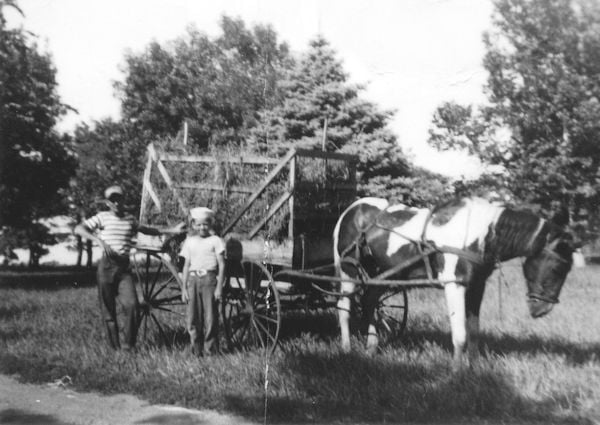
(From left) Pet rabbit enthusiasts and brothers, Howard and Leslie Cook haul hay from the fields using a cart their fashioned from a box frame and buggy running gear. Dutiful Spot is pulling the wagon full of rabbit food.
Ron Schellpeper

Ron Schellpeper drives the tractor while his dad, Harold, cuts oats with their new binder on the family farm in Stanton County, Nebraska, in 1942.
George Sears

George Sears, age 12 with his team of horses. He used to pick up garbage in Logan, Iowa. George went on to be an electrician, running Sears Electric and a grain and livestock farmer. Photo taken June 1, 1940.
Robert Fuchs

On a snowy day in the late 1940s, Robert Fuchs sits atop his dad’s 1945 Farmall H on the family farm in Arlington, Nebraska.
Dorr, Dick, and Dan
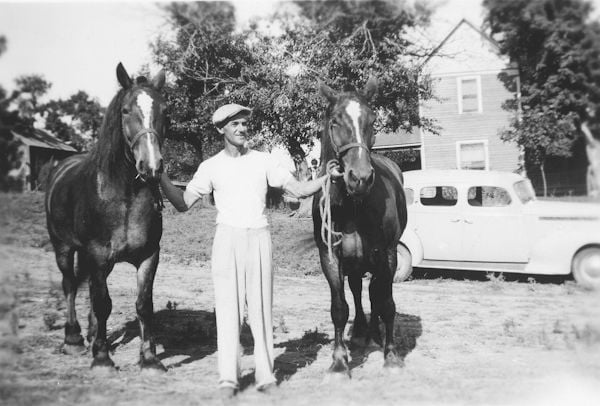
Karl Porr was still farming his farmstead south of Humbolt, Nebraska with his horses, Dick and Dan, when this photo was taken, but the Ford 8N would soon take up the slack.
Four friends

Four boys, Francis Sellhorst, left, John Kleffner, Stanley Kleffner and George “Shorty” Schrage stand by a wooden wall circa 1937.
Clarence Roenfeld
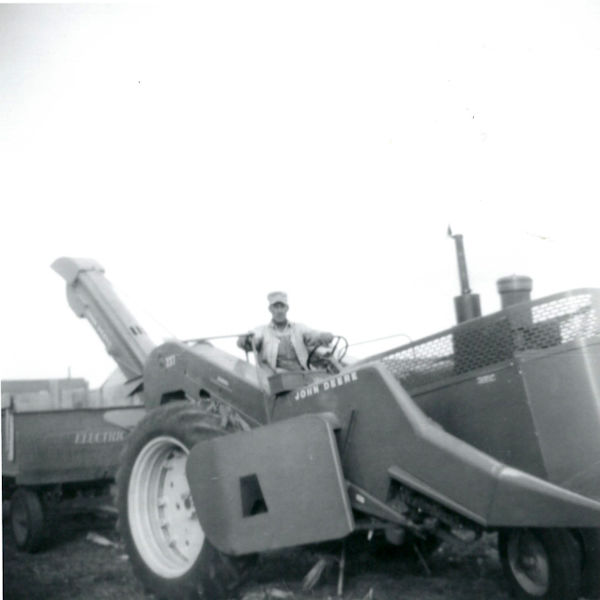
During the fall of 1966, Clarence Roenfeld sits on his 1962 John Deere 4010 tractor with a John Deere Model 237 corn picker.
Harvest on the Hansen farm
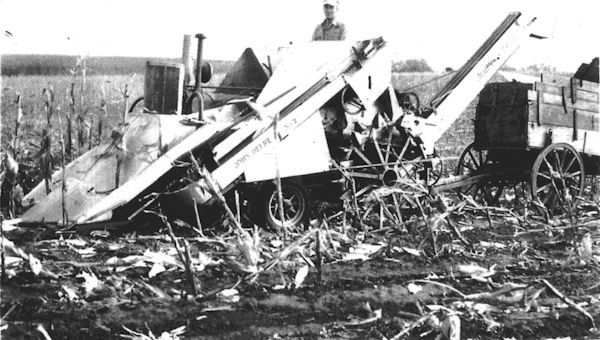
Arthur Thomas “Art” Hansen, of Murray, Neb., sits on his John Deere Model A tractor while harvesting his crop with a John Deere No. 25 corn picker.
Monnier family farm
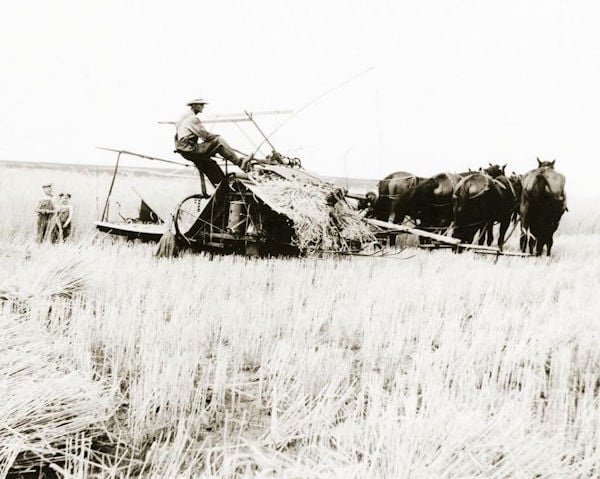
Janice Stuhmer’s grandfather, George Monnier is driving the team while his sons Robert and Richard stand and watch in this photo taken about 1933 south of Kilgore, Neb.
Zella Mae and Dagwood
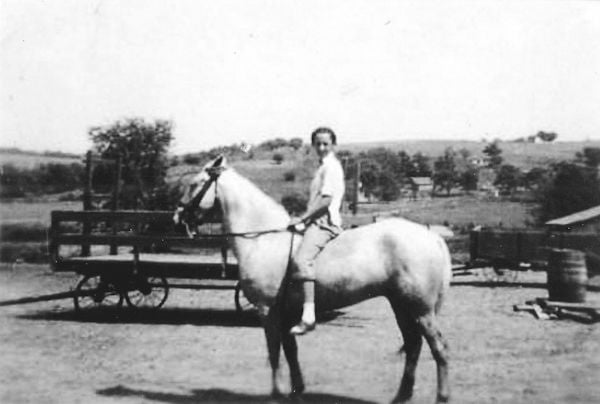
Cowgirl Zella Mae McDowell riding a horse named Dagwood. Photo taken around 1950 at the old McDowell farm.
Newark Band
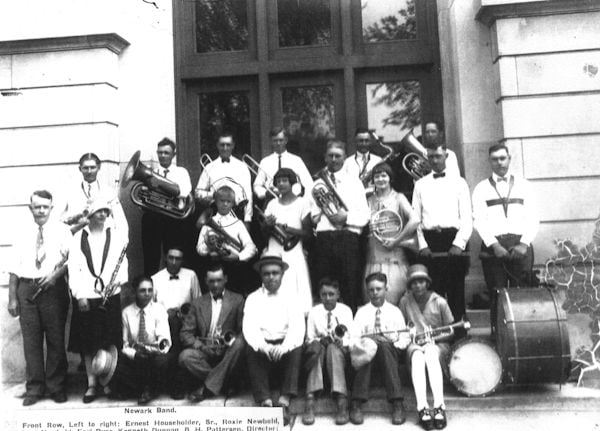
Neal Jason Radford, 9, (highlighted) was the youngest member of the Newark Band from his hometown of Newark, Nebraska. He holds what appears to be a three-valve baritone horn in this photo taken some time in the early 1920s.
Hog riding at the Malloys

Charley Malloy riding a pig at their homestead property near Atkinson, Neb., around 1923.
Harold Hecox farm
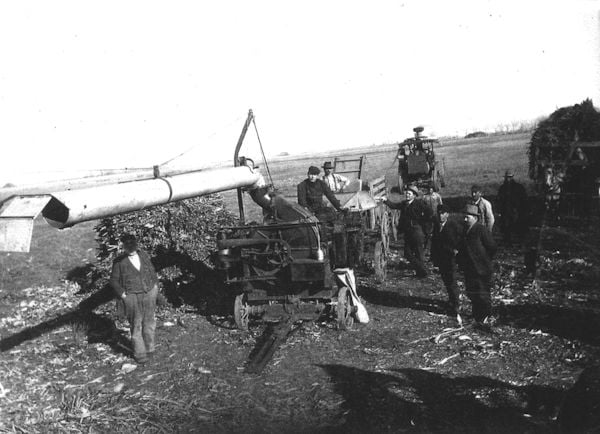
Harold Hecox uses a steam tractor and mechanical sheller to shell corn on his farm near Newark, Nebraska, in this photo from the early 1920s.
Kimballton Sale Barn

Kimballton Sale Barn, Kimballton, Iowa. Left to right; Cecil Savage, Hans Jensen (partially hidden), Folmer Jensen, Tim Larimore (auctioneer), Alvin Johnson, Theo R. Andersen Sr., “Brownie” the Jersey cow.
Buescher family
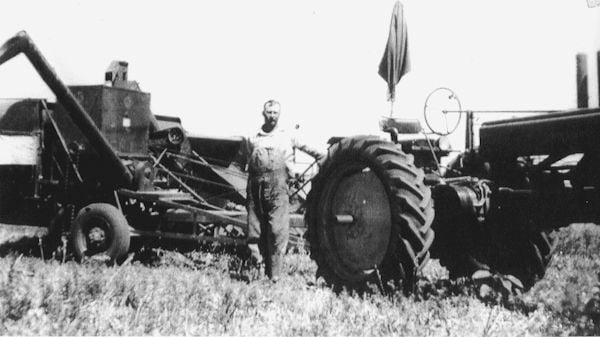
Father of Walter Buescher of Hastings, Nebraska, combining oats north of Mt. Clare, Nebraska in 1953.
Horses for sale
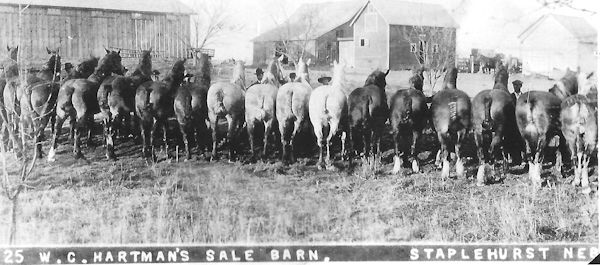
Horses line up at W.C. Hartman’s Sale Barn in Staplehurst, Neb.
Brohman's tractor and binder
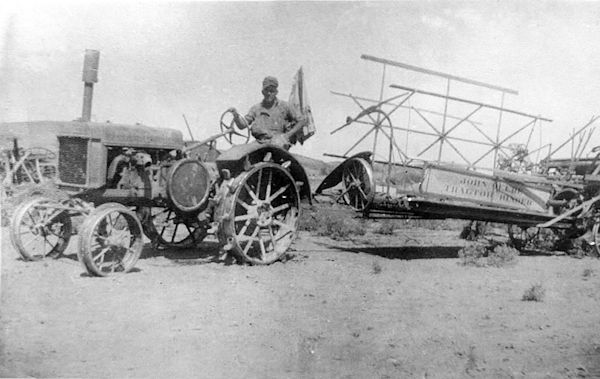
Harold Brohman sits on his new John Deere GP tractor with a John Deere grain binder sitting behind him. This photo was taken in 1929, about 7 miles south of Callaway, Nebraska.
Josiah Brown and his family

Josiah H. Brown and granddaughter Florence Brown sample a watermelon from his garden in this photo taken circa 1900 at Kearney, Nebraska. Sadly, Florence preceded him in death in 1911 at the age of 14.
Grone's Prince Charming II

Edward H. Grone, and his prize winner Prince Charming II (registered Tennessee Walker Stallion). He won over 33 horses in front of the grandstand, at the Wayne County Fair, Aug. 1961.
Carlson plowing snow
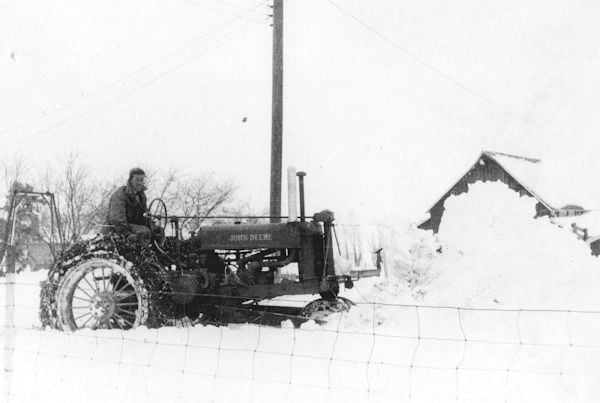
Marvin Carlson, of Stanton, Iowa, pushes snow in 1952 with his John Deere A tractor and a homemade plow blade.
Olson family farm
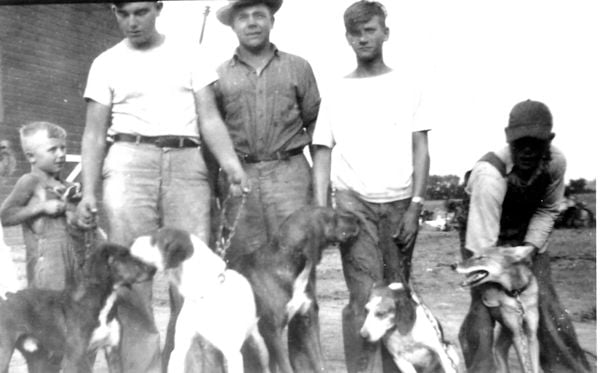
This photo was taken in 1948 at the Ron Olson farm, in Tekamah, Neb. Ron Olson, holding a pet raccoon, Lloyd Olson, Carroll Olson, Gene Kohler, Rick Olson with pet coyote. The hounds are trail hounds mostly used for raccoon and other wild game hunts.
Bando family farm

Henry Bando sits on his 1941 Case SC tractor while his son, Ralph Bando, stands on their new Case A6 combine just before heading out to cut wheat on their farm near Nebraska City, Nebraska, in 1946. Thanks to Peter Easterlund of TractorData.com and Chris Pratt of Yesterday’s Tractors Co., for identifying the tractor.
Raising steam to raise crops
Local farmer Henry Schmitz (who would have been about 21 at the time the photo was taken) of Paul, Nebraska, may have been on the cutting edge of agricultural technology if he acquired the new Rumely Advance Straw-Burner with which he is standing.
Little schoolhouse on the prairie
The Sunshine School in District No. 70, in Knox County near Niobrara, Neb., was one of the last one-room school houses in the state, and therefore, in the country.
According to historian Matthew Spencer, in 1918, Nebraska had nearly 7,000 of these old-fashioned structures still being utilized. In 1986, there were still 385 one-room schoolhouses. In only two decades they would all be gone, due to department of education reclassification policies.
Taubenheims putting up hay
Relatives of Herb Deets, Otto, Ernest and Paul Taubenheim, are cutting hay in the late 1920s. 100 years later Deets is putting up hay also for his livestock.
'53 Aksarben champs
Aksarben 1953 pen of champions, five club steers. Bill Willers is on the left with his champion club steer.
Omaha’s history as a livestock hub
There is a lot of history depicted in this 1955 postcard advertisement from radio station WOW.
The first bit deals with WOW, a radio station in Omaha started by the Woodmen of the World in 1923 as WOAW. The call letters became WOW in 1926.
Kohler’s rollers
Robert W. Kohler was born in Arizona Township some time before the turn of the 20th Century. He was initially a farmer, but a creative focus saw him become the town blacksmith.
He built and ran his own blacksmith shop in Arizona Township for many years. He continued some farming and merchant work on the side, but his mind was as fertile as the rich soil he farmed. From it sprouted many metallic originations, some of which he patented.
Rusty the mule
Wilmer and Clarence Stevens with their father George (Bruiser) Stevens and their mule Rusty. Circa. 1920.
Changes in altitudes
At the beginning of the 20th Century, farm families from Iowa and Kansas were making their way further west to, hopefully, greener pastures.
Among these ag migrants were the future grandparents of Leonard C. Hadachek of Wray, Colo.
Making hay in a whole new way
Making hay in a whole new way
Hay — alfalfa, grasses, clover or legumes — is a great source of protein for feeding animals. In the 1940s, there were major advances in the machinery that cut, dried, processed and stored the crop.
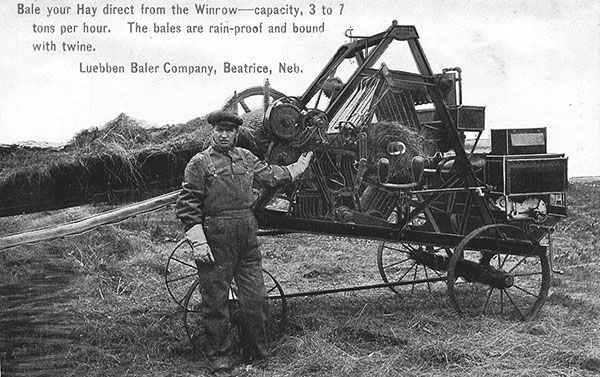
Ummo Luebben displays his machine, the Luebben round baler, in an advertisement that circulated in 1909. The first model of the Luebben baler was invented by Ummo and his brother Melchior, and their father Hugo, all farmers in Sutton, Neb. Melchior's great-grandson Eric Luebben encourages anyone with knowledge of existing Luebben round balers to contact him at ejluebben@gmail.com to further his ancestral research.
Tony rides again
Tony rides again
Dean Stuck, Hugh Terwilliger and Rex Stuck are riding a horse named Tony in Ringgold County, Iowa in 1936.
1954: A year of change
1954: A year of change
Clare W. Roe started farming in Jewell County, Kan., in 1931. According to its Office of the Register of Deeds records, he purchased 240 acres in the northwest quarter and the west half of the northeast quarter of the county for $11,760 in September of that year.
Lurkey turkeys
Lurkey turkeys
This photo, originally appearing in the May 6, 2011 edition of Midwest Messenger, depicts the turkey farm of Etta and Claude Paine, circa 1940s. Their grandson, Jim Weber, recalled looking for the red turkeys’ eggs on their Nebraska farm as a child.
McDonald had a farm
Henry McDonald and his wife Ethel owned a 150-acre farm located on Pratt Drive, six miles south of Knoxville in Marion County, Iowa. They raised corn, dairy cattle and a few sheep on the farm situated near the convergence of English Creek and Wolf Run. They also raised a passel of children.
Nine children in all — six boys and three girls. The McDonald siblings were not separated by too many months in age. There was the eldest, Raymond Lee, followed closely by brothers Walter Glen, Thomas Lain (named for his grandfather), Isaac Herbert, Frank, Jr., and John Malcolm (called Johnny). The sisters were Zella Mae, Ruby Floretta and, youngest of all, Mary Maratha.
Hladky's horse
This photograph, originally published in the Aug. 6, 2010 edition of Midwest Messenger, features John F. Hladky of Morse Bluff in Saunders County, Neb.
Send your old livestock photos to support@midwestmessenger.com; P.O. Box 239, Tekamah, NE 68061
Cream dream team
Cream dream team
Martin David Christensen and his little brother Harry. When Martin was a teenager, he had a cream route from their home place west of Exira, Iowa. Circa 1915. Photo as taken by Clara (Christensen) Nissen.
Traveling harvesters, hobo hotels and the automobile
Traveling harvesters, hobo hotels and the automobile
Traveling harvest crews have long been part of Nebraska’s agricultural scene. But the ways of these itinerant workers change with the times, as this 1925 account reports:
The tractor take-over
The tractor take-over
The gradual transition from horse to tractor power on Nebraska farms was well underway by 1916 for many reasons. Horses were expensive to buy, feed, and maintain. Farmers needed about five acres of land to grow the oats, hay, and fodder that each horse needed for the year.
Afternoon Albion buggy ride
Afternoon Albion buggy ride
Mr. and Mrs. Gabral Johnson, Albion, Neb. Taken late 1890s.
Nebraska corn makes royal debut at agriculture exposition
Nebraska corn makes royal debut at agriculture exposition
The World’s Industrial and Cotton Exposition opened in New Orleans on Dec. 16, 1884. As the largest world’s fair held in the United States to that date, it attracted international attention. Many nations, including England, France, China, Japan, Austria, and the South American countries, had exhibits. The Nebraska display was largely the result of the efforts of ex-governor Robert Furnas and a small group of volunteers.
Missile bases bring Nebraska to Cold War front
Missile bases bring Nebraska to Cold War front
On a Friday afternoon in October 1958, more than 1,000 people gathered in Mead, Neb., for the opening of the Farmer’s Union Co-op Grain Elevator. Flyers distributed throughout the county invited everyone to an open house to marvel at “Saunders County’s Newest Largest Most Modern Landmark of Progress.” The four-story structure towered over the town. Built along the railroad tracks, the new grain silos could hold more than 300,000 bushels, and the temperature within the bins was monitored and maintained by state-of-the-art electronics. To celebrate the achievement, cigars were passed out to men, and women who attended were given flowers. The local newspaper reported that the commotion of the event caused the town’s first traffic jam. All told, the project boasted a price tag of $200,000.
The milkman of Omaha
The milkman of Omaha
His entrepreneurial spirit was big, but his heart was bigger.
The game is afoot in Nebraska
The game is afoot in Nebraska
When A. N. Ward reminisced about his early hunting exploits with a reporter from the Omaha World-Herald in 1910, he recalled the days when the Nebraska prairie abounded with wild game. Ward, according to census records, was 70 years old and had lived in the vicinities of first Arapahoe, and then Milford, for nearly half a century. The Sunday World-Herald's account of his hunting yarns, published on Oct. 2, 1910, noted: "In recounting some of his experiences of the early days in the state, Mr. Ward said that he was thoroughly convinced that he killed the last wild buffalo killed in Nebraska. 'With Dan Prime and John Russell,' he remarked, 'I was up at the head of the Birdwood river, in McPherson County, hunting blacktail deer. In October 1881, and on coming into camp down the valley, the second day we were out, I saw this buffalo, which proved to be a two-year-old heifer, coming out of the shallows where it had been for water. I made a capital shot, killing the heifer stone dead at 160 yards, with a bullet back of the left fore-shoulder. That was the last buffalo killed in the state, or at least the last one of which I could get any authentic account. In fact, I never heard of one being killed later, but was told that a herd of six or seven were seen later that month up on the Dismal.'"
Getting rid of the need for bees
Getting rid of the need for bees
Bees aren’t just about honey.
Peeping chicks
Peeping chicks
Bathtime baby with young chickens watching. Photo taken early summer in the early 1930s.
Pests on the Plains: The potato bug
Pests on the Plains: The potato bug
With the sole exception of grasshoppers, perhaps the most hated insects to afflict the pioneer farmer were potato bugs. So prevalent were they at one time in Nebraska that one of the state’s early nicknames, the “Bug Eaters,” was said to refer partly to them. According to John A. MacMurphy, secretary of the Nebraska Territorial Pioneers Association, writing in November 1894, an easterner came to Nebraska to visit relatives during the lean years of the 1870s and on his return home, was asked about conditions here. According to MacMurphy’s account, the man responded, “Oh, everything is gone up there. The grasshoppers have eaten the grain up, the potato bugs ate the ‘taters all up, and now the inhabitants are eating the bugs to keep alive.”
Saluting the American flag
Saluting the American flag
According to a Congressional Research Service report, the National Flag Conference adopted the National Flag Code on June 14, 1923. June 14 commemorates the day the U.S. adopted the Stars and Stripes as its official flag in 1777, and had been celebrated as Flag Day since President Woodrow Wilson issued a proclamation in 1916 (Library of Congress). Americans further elevated the flag when President Herbert Hoover signed a congressional act into law on March 3, 1931 that made “The Star-Spangled Banner” the national anthem (History.com).
Keller's picks
Keller's picks
Roy Keller corn picking day on his farm at Ashland, Neb.
Edith gets her ducks in a row
Edith gets her ducks in a row
Edith Reese feeding her ducks as her husband Earnest works with his horses, on their farm in Nebraska City, Neb. Photo taken about 1912. Submitted by their granddaughter, Janis Gress, also of Nebraska City.
The 19th Century Nebraska veterans pension fight
The 19th Century Nebraska veterans pension fight
Governmental bureaucracy is nothing new. Almost a hundred years ago, Nebraska veterans discovered missing records and “red tape” when they applied for military pensions. The Nebraska State Journal reported:
The mystery of Nebraska’s round barns
The mystery of Nebraska’s round barns
The following is an excerpt from Roger Welsch’s 1970 Nebraska History article, “Nebraska’s Round Barns”:
Keller's threshing machine
Keller's threshing machine
Threshing with a horse drawn threshing machine on Roy Keller Farm in Ashland, Neb.
A butchers’ brawl turned beerfest
A butchers’ brawl turned beerfest
Labor Day in 1890 was celebrated on Monday, Sept. 1, although some events associated with the day were celebrated several days before. One, a butchers’ picnic held at Loveland, Iowa, on Sunday, attracted the attention of the Omaha Daily Bee, partly because of the role played by the butchers of Omaha and South Omaha in what the Bee on Sept. 2 described as a rowdy event.
Teacher shortage spawns junior normal schools
Teacher shortage spawns junior normal schools
Although the United States Superintendent of the Census reported in 1890 that the frontier had ceased to exist, pioneer conditions continued in teacher education in Nebraska into the 20th Century.
Hans harnesses his high-strung horses
Hans harnesses his high-strung horses
Part of Hans A. Hansen’s daily ritual of harnessing his horses included donning a specially fashioned pair of overalls too. The horse was extremely sensitive to biting flies, and was well trained and accepting. He would lift one leg at a time, so the overalls could be slipped on and worn all day while working in the fields.
The failed tree harvest legislation
The failed tree harvest legislation
Of all the land laws affecting Nebraska, the Timber Culture Act of 1873, designed to promote the planting of trees, was perhaps the least successful and subject to many abuses. The author of the act was U.S. Senator Phineas W. Hitchcock of Nebraska. The Timber Culture Act was repealed in March 1891.
Morrissey for county commissioner
Morrissey for county commissioner
A flyer for Bernard Morrissey, who was pursuing a seat as county commissioner of Johnson County, Neb., features Bernard and his grandson inspecting one of their bulls on the Morrissey farm in 1954. (Photo courtesy Bernard’s grandson Bob Hothan, Tecumseh, Neb.)
Tinker toys of the Smolczyk twins
Tinker toys of the Smolczyk twins
The Smolczyk brothers had a farm toy collection that made the history books — but they didn’t just collect, they invented.
Buster Brahman
Buster Brahman
This photograph, originally published in the Jan. 14, 2011, edition of the Midwest Messenger, features a Brahman, which was raised as a bucket calf and was said by its owner to break any piece of glass it could reach with its horn.
Hogzilla tours the country
Hogzilla tours the country
Dazzler, a Poland China from Leigh, Neb., held the unofficial title of World’s Largest Hog in 1928.
Anstey cattle drive
Anstey cattle drive
In this photograph originally appearing in the March 8, 2011, edition of Midwest Messenger, George Anstey and his family embark on a cattle drive in 1937, guiding their Herefords to the depot in Massena, Iowa, to be loaded onto a train and sent onto a buyer in Georgia.
A celebration of corn
A celebration of corn
It may have been the Christmas season, but it was corn that was on everyone’s mind in Lincoln in December of 1905. That year over 500 Nebraska boys and girls descended on the Capital City for the first State Corn Contest. Sponsored by the Department of Public Instruction, the “well-arranged program” enabled contestants from around the state “to enter their exhibits, and visit the state farm, university and manual training and domestic science departments.”
A rabbit "hutch" in your get along
A rabbit "hutch" in your get along
In this photo originally appearing in the April 1, 2011 edition of Midwest Messenger, Margory M. Thomas and Johnny H. Thomas feed rabbits on the Witt Farm in Pottawatomie County, Iowa, sometime in the early 1900s.
The Olson boys ride again
The Olson boys ride again
The Olson boys — Lloyd, Caroll, Clarence, and Raymond — pose with their farm animals on the family farm east of Tekamah, Neb., circa late 1930s to early 1940s.
Fur ruffled over early meat inspection laws
Fur ruffled over early meat inspection laws
Inspection of meatpacking plants used to be a matter of state or local law. Omaha’s meat inspection ordinance in 1901 was the subject of a whimsical account by the Omaha Daily News of October 10, 1901. When shady entrepreneurs tried to game the system, a resulting court battle came down to the size of rabbits:
The class of ’43 at 79
The class of ’43 at 79
Twila Suhr has fond memories of her old schoolhouse District 79.
Hunting game on the prairie
Hunting game on the prairie
Many European and American settlers noted the abundance of game as they moved out onto the prairies. “Prairie-chickens and quails, when I first went on the overland [stage] line were numerous between the Missouri River and the Platte,” said Frank A. Root, author with William E. Connelley of The Overland Stage to California (1901). “They were seen every day from the stage-coach, numbering thousands.”
Bruiser and Maggie's Place
Bruiser and Maggie's Place
The homestead and horses of George “Bruiser” and Maggie (Morgan) Stevens in Kendrick Township, Scranton, Iowa.
Sleigh parties of the 19th Century
Sleigh parties of the 19th Century
Present day snow ties up more than its share of Nebraska’s traffic, but in pioneer times it added to the ease and pleasure of travel. A good coat of snow made farm hauling easier — much easier than the heavy ruts developed by the thawing weather — and perhaps more important, made sleigh riding one of the year’s most pleasant entertainments.
Ed & Marvine's Quackers
Ed & Marvine's quackers
Edwin M. Belina and his sister Marvine Koliha are surrounded by the family’s ducks on their farm south of Pilger, Neb., in 1949.
Cook & chicks
Cook & chicks
Lawrence Cook checks on his new batch of young chicks on the family farm south of Arlington, Neb., in the 1930s.
Tinker Technician Farmer Friend
Tinker Technician Farmer Friend
He loved coffee and pickles, his accordion, and building things with his hands.
Edwin & Bernie
Edwin & Bernie
Five-year-old Edwin M. Belina stands near his first sow, Bernie, and her piglets, on the family farm in 1949.
Operation Snowbound relieves 1949 blizzard disaster
Operation Snowbound relieves 1949 blizzard disaster
January will always call forth discussion of blizzards in Nebraska. One of Nebraska’s most notable, and to many the biggest blizzard ever to hit the state, occurred Jan. 12, 1888. To some, it was the single most devastating storm ever.
Musicians unite for Farm Aid concert
Musicians unite for Farm Aid concert
During the 1980s farm crisis, Willie Nelson was outspoken about the needs of farmers.
Poland China hogs by way of Winnetoon
Poland China hogs by way of Winnetoon
William Kruse Sr. of Winnetoon, Neb., with his black Poland China hogs in the 1940s.
Looking Back: Holstein Uncle Sam

Looking Back: Holstein Uncle Sam
Just another day at the Dodge County Fair, as a holstein pulls Uncle Sam during the fair parade, Sept. 26-27, 1941.
Fruit pyramids at Nebraska State Fair
Fruit pyramids at Nebraska State Fair
J. Sterling Morton, as president of the State Board of Agriculture, in April 1874 issued an appeal for agricultural exhibits for the upcoming Nebraska State Fair, to be held in Omaha. The Nebraska Herald (Plattsmouth), of May 21, 1874, and other state newspapers published his request:
Winning the war with pigs
Winning the war with pigs
After the United States entered World War I in April of 1917, President Woodrow Wilson appointed Herbert Hoover head of the U.S. Food Administration. Hoover believed that food would win the war and established specific days to encourage people to avoid eating particular foods in order to save them for soldiers’ rations and use overseas: meatless Mondays, wheatless Wednesdays, and “when in doubt, eat potatoes.”
Perfect economic storm sets off Tractorcade
Perfect economic storm sets off Tractorcade
Lincoln police said it was one of the worst traffic jams they’d ever seen, “even worse than the football game.”
The Christmas postal rush
The Christmas postal rush
“One great trouble with the Christmas business,” remarked the Nebraska State Journal of Dec. 24, 1892, “is the habit formed by the great unthinking public of waiting until the last minute to put the packages into the post office. Now and then you find level-headed people who begin 10 days before Christmas and drop carefully packed presents into the office in time to go through in good order before the rush commences. But these folks are the exception.
Calves En Route to Frontier County Fair '52
Calves En Route to Frontier County Fair '52
Siblings Mary and Robert Ruppert, center, pose with their 4-H calves near McCook. The Ruppert children picked the calves from their father’s feedyard, and showed them in the Frontier County fair in Stockville, Neb. in 1952.
Missouri River monopoly on catfish
Missouri River monopoly on catfish
Catfish have a colorful history in Nebraska. Lewis and Clark wrote about fishing in the Missouri River. Just north of an Omaha tribal village they reported catching 318 fish of various kinds, and the next day caught “upwards of 800 fine fish,” 490 of which were catfish.
Better butter in Nebraska
Better butter in Nebraska
The Fairmont Creamery Company was incorporated March 29, 1884, in Fairmont, Fillmore County, Nebraska. Wallace Wheeler, an implement dealer, and Joseph H. Rushton, an attorney, founded the company for the production and sale of butter, eggs, and poultry. Local townspeople and farmers owned the remainder of the total stock of $5,000. From a small business, the company became one of the nation’s largest food processors, later known as Fairmont Foods.
The 1918 flu pandemic in Nebraska
The 1918 flu pandemic in Nebraska
November 11 marks the centennial of the armistice ending World War I. The war killed some 15 to 19 million people, military and civilian, including 751 Nebraska soldiers.
Thanksgiving in the 1890s
Thanksgiving in the 1890s
Two Thanksgiving reports from the 1890s illustrate the coming of hard times to Nebraska. The 1890s saw the country’s worst economic depression until the 1930s.
Pack mules and Art
Pack mules and Art
Art Reynolds of Harlan County, Neb. poses with his pack of mules in 1942. Art was the father of Gayle, Arla, Frona, Ruby, David, Lorene, Norene, June and Lois.
How tractors revolutionized agriculture
How tractors revolutionized agriculture
One of the most useful farm machines, the tractor, was developed prior to World War I. Probably the first big demonstration of gasoline tractors in the United States was held at Omaha, Neb., in 1911. Beginning in 1913, shows were held annually at Fremont, Neb., for several years. The University of Nebraska Tractor Testing Laboratory — the first in the world — was established in 1919 to inform buyers of the relative merits of tractors.
4-H livestock past
4-H livestock past
Otis Scheer and his 4-H calf on the family farm two miles east of Arlington, Neb., circa 1920s. Otis was the son of Fred and Wilma Scheer.
Putting the ‘heart’ into Heartland
Putting the ‘heart’ into Heartland
Lending a helping hand is a time-honored tradition among farmers.
Sorting pairs for the war effort
Sorting pairs for the war effort
J.J. Johndreau, center, and a hired hand sort pairs to be placed with one of the breeding bulls on the J.N. Johndreau & Son Purebred Hereford Cattle ranch, south of Gordon, Neb., in 1940. Now owned by third generation rancher Roy Johndreau, the Johndreau ranch raised and sold registered Hereford bulls from the 1920s to 1950s. During the annual bull sale in 1943, a single bull was resold and redonated five times, earning more than $2,000 on the sale, which the Johndreaus donated in full to World War II efforts.
Hog sitter
Hog sitter
Accompanied by his mother and sister, Leonard Bartels sits atop a hog on the farm in 1924.
Saloon shenanigans on the Farmers’ Excursion
Saloon shenanigans on the Farmers’ Excursion
It’s become a cliché that business trips to distant cities can become opportunities for behavior of the “what happens in Vegas, stays in Vegas” variety. This was also true in 1875, even when the travelers were Otoe County farmers and the big city was Lincoln, Neb.
Postcards from the past
Postcards from the past
There’s a book of memories sitting in a house in Scranton, Iowa.
The greenhorn mule wrangler
The greenhorn mule wrangler
In this photo, originally published in the June 17, 2011 edition of the Messenger, two-and-a-half-year-old Gerald Pierson holds the reins tightly on his father’s pair of mules, circa 1930-1931. (Photo courtesy Joann Pierson, Arcadia, Neb.)
Perseverance is the farmer
Perseverance is the farmer
For Norman Dirks, there was no throwing in the towel.
Farming roots in the forge
Farming roots in the forge
There was a time in America’s history when a farm didn’t work without a blacksmith.
Ropin’ ain’t only for cattle
Ropin’ ain’t only for cattle
Cowboys occasionally roped more than cattle or horses, as James E. Farley recalled in Solomon D. Butcher’s Pioneer History of Custer County, Nebraska (1901). “Towards the end of my cowboy career,” Farley said, “I worked for the Bar-T ranch, of which David Rankin was principal owner. This ranch was located on the Middle Loup.
World War II spawns new gardening era
World War II spawns new gardening era
World War II wasn’t just about far-off battlefields. The home front was also important. With farming disrupted in much of the world, and with many farm workers joining the military, food became a huge issue.
It’s all in the family (farm)
It’s all in the family (farm)
Maxine has fond memories of her childhood on the farm.
A lead foot and a lotta love
A lead foot and a lotta love
In that old ’28 Chevy, it was love at first sight.
Cornhuskers vital to early 20th century harvests
Cornhuskers vital to early 20th century harvests
Cornhusking was once an annual autumn activity on many Nebraska farms. Before the advent of the mechanical corn picker, the corn crop was harvested by hand and “shucked” in the field. This activity usually called for extra hired men, whose only tools were pegs or hooks strapped to their palms.
Nebraska man paves way to tractor transparency
Nebraska man paves way to tractor transparency
The Nebraska Tractor Test Laboratory (NTTL) was established in 1920 in response to requirements of the Nebraska Tractor Test Act of 1919, which required all agricultural tractors sold and advertised in Nebraska to have manufacturers’ performance claims verified by the Tractor Test Laboratory. The act was vigorously promoted by Wilmot F. Crozier of Osceola, a state representative who purchased a tractor that did not perform as advertised. Crozier thought he had purchased a Ford, but afterward discovered that the manufacturer had hired a man with the surname of Ford and was using the man’s name to confuse consumers.
Texas cattle trade booms in Omaha
Texas cattle trade booms in Omaha
“The Texas cattle trade has increased wonderfully in Nebraska within the past three or four years,” said the Aug.7, 1875, Omaha Daily Bee, “and this morning a reporter of the Bee took occasion to interview Captain [Eugene] Millet and D. R. Fant — two well-known Texas cattle men, who make their headquarters in Omaha —with a view of obtaining some facts which would prove of general interest to a large number of our readers.”
The 1874 state fair: A time to show off
The 1874 state fair: A time to show off
These days, fairs promote entertainment, but when Nebraska was a new state, fairs were mostly seen as a way to promote Nebraska by demonstrating its potential for agriculture.
The potash boom of Antioch
The potash boom of Antioch
Highway 2 through the Sandhills is one of Nebraska’s most scenic drives. Deep in the Sandhills lakes country, near the tiny town of Antioch, stand desolate, oddly-shaped concrete ruins visible from the highway — as if Antioch had once been a much larger city, or home to some inexplicably large enterprise. And that’s pretty much what happened during World War I when Antioch became a potash boomtown.
The sugar beet palace
The sugar beet palace
The Grand Island Sugar Palace was erected in 1890 to commemorate the birth of the state’s sugar beet industry. Patterned after the Sioux City Corn Palace, the building housed an exposition devoted to the production and processing of sugar beets.
Cornhusking, a Midwestern sport
Cornhusking, a Midwestern sport
Cornhusking was once considered almost a sport. There were cornhusking contests, and farmers “kept score” on the bushels shucked per acre per day. Most of the crop was harvested in the field and called for extra hired men whose skill sometimes gained them a reputation well beyond their home communities.
Less magic, more mystery in bean’s origins
Less magic, more mystery in bean’s origins
There is a mysterious plant in Nebraska’s past.
A kids’ view of Fourth of July in Beaver City, 1897
A kids’ view of Fourth of July in Beaver City, 1897
Two boys in Beaver City published their own little newspaper in the 1890s. Brothers Willie and Jay Green called their four-page, semimonthly paper The Kid. Here’s their take on the local Independence Day celebration in 1897, which included not only speeches and parades, but also elements of popular “Wild West”-style entertainment, and even a balloon ascension:
Frontier hunting accidents in the Midwest
Frontier hunting accidents in the Midwest
Hunting on the frontier had many drawbacks besides firearms accidents. Among them were mishaps to horses and the problems of preserving and safely storing game after it was killed. The Nebraska State Journal of Lincoln on Sept. 25, 1869, included a letter from Victor Vifquain describing his hunt along the Republican River south of Fort Kearny, Neb. Although Vifquain and his friends intended to hunt chiefly buffalo, they also bagged wild turkeys, elk, and antelope.
The Chicken War of Nebraska
The Chicken War of Nebraska
Sometimes it takes a good guy with a chicken to stop a bad guy with a chicken. Consider this strange tale about the founder of today’s Lincoln Journal Star and his revenge on his hen-raising neighbors.
The inspiration behind six generations
The inspiration behind six generations
Their story is more than a century in the making.
The Chicken Challenge, a timeless social game
The Chicken Challenge, a timeless social game
A game long played by kids on the farm is perhaps the forerunner of today’s viral challenge trend.
The lighter side of farming
The lighter side of farming
Sometimes one photo is all it takes to remember a lifetime.
Hay isn’t just for horses
Hay isn’t just for horses
When there’s cattle to feed, there’s hay to throw.
North Edition Livestock Roundup 5/11/18

This is a 1953 picture of the pupils of Master’s School District No. 10. This was a typical school day. Back row Raymond Cook on his horse Tip, Marilyn Cook, Leslie Cook on horse Spot and Melvin Schmidt with his horse. Front row, Gary Wulf, Bob Brown, Diane Wulf, Rita Sperling, Ralph Sperling, Phyliss Specht and David Cook holding the reins of Spot. Photo Submitted by David Cook of Arlington, Neb.
Lenger, legendary musician of the Midwest
Lenger, legendary musician of the Midwest
Noted musician and bandmaster John F. Lenger was born in 1849 in Bohemia. He attended a government school and music conservatory in Prague until he was 14, when he enlisted as a musician in the Austrian army. In 1869 he came to the United States, living in Baltimore and Chicago before settling in Yankton, S.D. In Yankton, he formed the Yankton City Band, the first of many municipal bands he organized during his long life.
South/East Edition Livestock Roundup 5/4/18

Ross Nelsen and his granddaughters, Lori and Sheri Nelsen from Anita, Iowa, riding in the Exira, Iowa’s Fourth of July Parade. Photo submitted by Jerry and Faye Nelsen of Anita, Iowa.
A hero of the farming people
A hero of the farming people
“Nellie Bly” was the professional pseudonym of Elizabeth Cochrane Seaman (1867-1922), one of Joseph Pulitzer’s best reporters at the New York World. She won international fame in 1889 and 1890 by outdoing Jules Verne’s fictional hero in going around the world in fewer than 80 days (72 days, six hours, 10 minutes, and 58 seconds). However, Nellie Bly was chiefly an investigative reporter with a driving zeal for social justice. Although not a political radical, she saw her mission as aiding the oppressed and downtrodden — the “neglected inmates of the New York City madhouse; degraded dwellers of filthy slum tenements; or malnourished, overworked, and underpaid women and children in sweatshops.” (Nebraska History, Spring 1986)
The Missouri River's first pontoon bridge
The Missouri River's first pontoon bridge
Although Congress had chartered the Nebraska City Bridge Company in the early 1870s, by summer 1888 only the new Burlington Railroad bridge spanned the Missouri River there. Nebraska City leaders were receptive, when Col. S. N. Stewart of Philadelphia proposed to build a pontoon toll bridge if the community would subsidize its construction.
A solid foundation in mobile farming
A solid foundation in mobile farming
The bygone era of community farming
The bygone era of community farming
Back in the days before combines, it was just kids, pitchforks and water jugs.
Nebraska — The Completely Random Weather state
Nebraska — The Completely Random Weather state
There’s nothing quite like playing in an April snow or sun-tanning on a tropical December afternoon.
The disappearance of Florence
The disappearance of Florence
Florence, Neb., has ceased to exist independently. By annexation it has become part of its larger neighbor, Omaha. Situated in northeastern Douglas County, Florence had the distinction of being the site of the first white settlement within that county. As early as January 1846, the Mormons fleeing across Iowa from Nauvoo, Ill., crossed the Missouri River and began a settlement at the site of Florence, which they called their Winter Quarters.
Entertainment in Nebraska Territory
Entertainment in Nebraska Territory
Although Nebraska's first permanent theater, the Omaha Academy of Music, was not opened until 1867, there had been for a decade prior to this time sporadic theatrical activity in Nebraska Territory, most of it in Omaha. Early Nebraskans had little money for entertainment but like all emigrants to the American West, they brought with them a nostalgia for the culture they had left behind and a determination to re-establish it as soon as possible in their new communities. One of the important elements in this culture was the theater.
Medicine for Lewis and Clark
Medicine for Lewis and Clark
In 1804 the Lewis and Clark expedition traveled up the Missouri River along present-day Nebraska’s eastern border. Despite the risks of the long journey to the Pacific Coast and back, only one man died along the way. Sgt. Charles Floyd died apparently of a ruptured appendix near present-day Sioux City, Iowa. At that time, even the best physicians would have been unable to save Floyd’s life.
South/East Edition Livestock Roundup 3/9/18
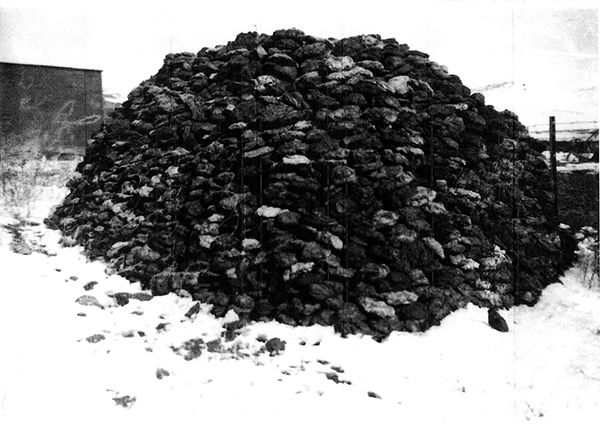
Alternative or main fuel supply? There was not a lot of trees where Sherman and Mary Nielson lived in Cherry County, so they used the alternative. This is a picture of 32 wagon loads of cow chips used for heat and cooking. As my mother Mary explained it, you carried in 1 bucket of chips and carried out 2 buckets of ashes. Sherman and Mary lived in a sod house and there were times that ice froze in the water bucket in the house. Knowing how things work I would think she probably did most of the work stacking them so water would run off. Sherman and Mary (Johnson) Nielson were married in 1913 and lived on this ranch in Survey, NE. Mary Nielson took this picture November 1919.
The dangerous art of well digging
The dangerous art of well digging
Few jobs in early Nebraska required more courage than that of a well digger. Henry Sands of Nebraska City related some of his narrow escapes to the editor of the Nebraska City News, June 22, 1888. Sands was recuperating from injuries sustained when a tub of rock fell on him in a well a few days before:
The near-extinction of Nebraskan buffalo
The near-extinction of Nebraskan buffalo
Some Nebraskans were aware of the values of wildlife conservation years before effective measures were enacted into law. The Daily Nebraska State Journal of Lincoln carried the following editorial in favor of saving the buffalo in its Feb. 1, 1874, edition:
A contentious game of polls
A contentious game of polls
Nebraska, as we all know, didn’t go to a bowl game in 2017. They didn’t go to one in 1938, either, despite a winning record. (The 1940 Rose Bowl was the Huskers’ first-ever bowl appearance.)
The dangers of pre-machinery days
The dangers of pre-machinery days
Working in a deep, hand-dug well was risky business in the days before machinery made human descent into the bowels of the earth unnecessary. Graphic evidence of the danger was provided by an account in the April 26, 1877, issue of the Seward Nebraska Reporter.
The comic Valentine
The comic Valentine
South/East Edition Livestock Roundup 2/9/18

Joan VanderLinden looking out the window, Jonny VanderLinden feeding the lamb and Carolyn VanderLinden posing for photo at old McDonald’s farm. Submitted by Henry McCall.
South/East Edition Livestock Roundup 1/26/18

Dad and his combine. Photo submitted by V. Lottman of Diller, Neb.
Soggy pioneer life
Soggy pioneer life
Reminiscences about pioneer life frequently describe droughts, blizzards, and grasshopper infestations. Job E. Green recalled a more personal event when he wrote his memoirs in 1922. In 1872 he and his wife homesteaded near the future site of Albion in Boone County, Neb. Green wrote,
South/East Edition Livestock Roundup 1/12/18

Kate and Dan with the drill. Duane Topp on the drill and Lila Topp on the F20 tractor. Photo taken about 1939, submitted by Duane Topp of Adams, Neb.
Carry Nation in Nebraska City, 1902
Carry Nation in Nebraska City, 1902
Carry Nation’s visits to Nebraska in early 1902 were among the few she made to this state. She was in Hastings in March, speaking at the Kerr Opera House and touring local saloons, where she reportedly disapproved of barroom art as well as liquor. In early April of 1902 she arrived in Nebraska City.
From a young age, Jay Lautenschlager’s comfort was on the farm
From a young age, Jay Lautenschlager’s comfort was on the farm
Don’t blame a toddler if he confuses a tire valve stem for a zerk. Jay Lautenschlager is just 2 or 3 years old in this photo and that grease gun is nearly as big as he is.
Beauty and the Beast with Willa Cather
Beauty and the Beast with Willa Cather
The Red Cloud Opera House on Feb. 4, 1888, was the scene of an amateur theatrical entitled Beauty and the Beast. Small-town opera houses hosted such entertainments frequently, but the unique feature of this particular play was the inclusion of the young Willa Cather among the cast. Donning suit, top hat, and wax mustache, Cather played Beauty’s merchant father to a large and appreciative crowd.
South/East Edition Livestock Roundup 12/29/17
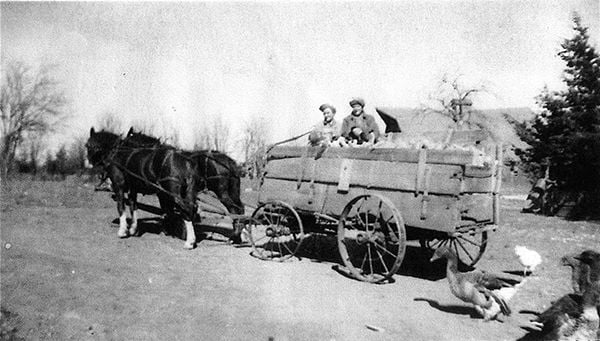
What a load of corn, girls! Champions of ‘39. Lillian Sommerhald Bausch and Adelaide Sommhalder Wehrbein on the farm of John Sommerhalder west of Steinauer, Neb. Photo taken in 1939 and submitted by Jerald Bausch of Burchard, Neb.
Teaching for $35 a month
Teaching for $35 a month
The Omaha Daily Bee noted on Oct. 3, 1903, that Nebraska’s corps of rural school teachers was changing, both in the relative percentages of men and women teachers and in the rates of pay awarded to members of each group. To modern readers, the article reveals much about attitudes of the time. The Bee noted:
Today’s (1889) young people aren’t always as bad as you think
Today’s (1889) young people aren’t always as bad as you think
College commencement exercises have always been marked by advice showered upon new graduates. The Daily Nebraska State Journal, May 16, 1889, offered its congratulations and recommendations to the “graduates of the present year”:
Rabbit drives in western Nebraska
Rabbit drives in western Nebraska
On top of all the other hardships of the Great Depression of the 1930s, some parts of western Nebraska had an overabundance of rabbits. The Nebraska State Historical Society Library/Archives includes a copy of Kimball County, Nebraska, 100 Years, 1888-1988, which reported:
When Omaha jailed the Lincoln City Council
When Omaha jailed the Lincoln City Council
A city-wide reform program under Lincoln Mayor Andrew J. Sawyer in 1887 culminated in legal maneuvering which imprisoned both Sawyer and eleven members of the city council in the Douglas County Jail in Omaha. Following a move against gambling interests in Lincoln by newly elected Mayor Sawyer, complaints were lodged against Police Judge A. L. Parsons, charging that he had not accounted for all funds collected by him as fines. After an investigation indicated that the charges of corruption were true, the city council discovered it lacked the power to act. A city ordinance was amended and the police judge position in question was declared vacant.
South/East Edition Livestock Roundup 12/1/17
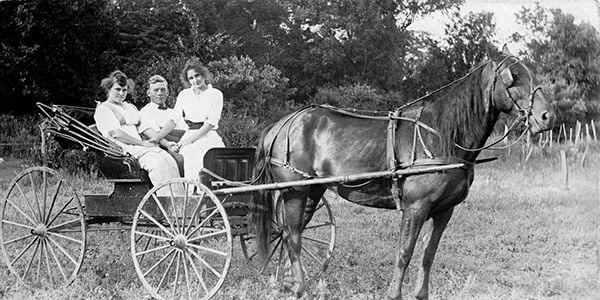
Left to right: Unknown passenger, Sigurt and Alta (Wells) Nelson pose for photo. Photo taken in Hamilton County around 1915. Sigurt was a share-cropper in mostly Harrison and Pottawatamie Counties, Iowa. Photo submitted by granddaughter Kelly (Nelson) Tedford of Pisgah, Iowa.
North Edition Livestock Roundup 11/24/17

Carl Behrendt on his farm near Ravenna, Neb. Photo submitted by Carl’s nephew Don Behrendt and his wife Valerie of Ravenna.
Free auto camps
Free auto camps
Long distance travel in the early days of the automobile was difficult, and comforts along the way were few. Motorists pitched their own tents and cooked their own meals in the auto tourist camps that soon sprang up along the nation’s roads. Some were free; others were operated by a commercial businessman. Pay camps, with more conveniences, soon became common.
The Army’s bicycle corps
The Army’s bicycle corps
Bicycling was a national craze in the 1890s. Even the U.S. Army experimented with bicycles as an affordable way to move troops across country. In the summer of 1897 a 1,900-mile bicycle trip was made by the all-black 25th Infantry Bicycle Corps from Fort Missoula, Montana, to St. Louis for the purpose of testing bicycles for military use. Led by Lt. James A. Moss, the soldiers left the fort on June 14, 1897, and passed through Wyoming and the southwestern corner of South Dakota before reaching Nebraska. The July 16, 1897, issue of the Humboldt Leader (on microfilm at the Nebraska State Historical Society in Lincoln) reported the cyclists’ arrival:
South/East Edition Livestock Roundup 11/17/17

Photo submitted by Richard Burmeister of Harlan, Iowa.
Airmail airplanes in Nebraska
Airmail airplanes in Nebraska
An early use of the airplane in Nebraska was mail delivery. The Omaha Daily News, January 8, 1920, microfilmed copies of which are at the Nebraska State Historical Society, included the following account of the first airmail flights into and from Omaha on January 8, 1920.
Little city of a thousand pictures
Little city of a thousand pictures
Cairo was dry. A little too dry, some might say.
Halloween pranks of the 1800s
Halloween pranks of the 1800s
Nebraska’s newspapers reveal frequent news and occasional comment on Halloween observances, legal and otherwise. The editorial column “Topics of the Times,” in the Nebraska State Journal of Nov. 1, 1883, noted:
Airboating — the Nebraska way
Airboating — the Nebraska way
In Nebraska, airboating means more than whisking through some soggy wetlands.
Dairy trains

A Chicago and Northwestern “dairy special” train in Farnam, Neb.
Kearney’s one and only cotton mill
Kearney’s one and only cotton mill
A cotton mill in Nebraska? It really happened in 1890. The Kearney Cotton Mill was established by the Cumnock brothers, cotton manufacturers from the East. Local men had urged them to build. Before the Cumnocks agreed to build the mill in Kearney, they required the community to grant several concessions on city taxation and water rates, grant them a 20-acre factory site, and pay $250,000. Tax incentives for economic development are not a new idea.
Planting a forest in the Sandhills
Planting a forest in the Sandhills
Nebraska used to be known as the “Tree Planter’s State,” and the most audacious attempt at tree planting was the project to plant an entire forest in the Sandhills.
Grasshopper swarms
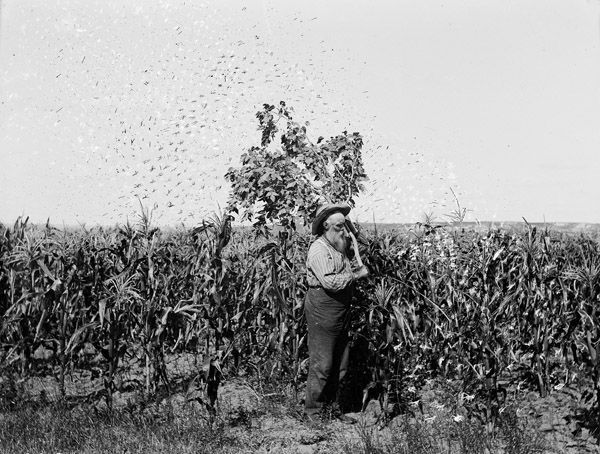
Swain Finch of Custer County demonstrates in 1900 how he tried in vain to kill swarming grasshoppers in 1876. Photographer Solomon D. Butcher re-created the cloud of ‘hoppers by scratching them into the emulsion and adding others with ink.
Nebraska’s biggest prairie fire
Nebraska settlers found a vast expanse of bluestem, which could be highly inflammable. The danger was greatest during the late autumn of a dry season before the winter’s snows or after the snow melted during a dry spring. Smoke indicating a prairie fire was sometimes visible for days, and the horizon correspondingly illuminated at night. Fires sometimes originated as far away as Dakota Territory.
Several prairie fires during historic times have captured the attention of human residents of the Plains. In recent years, some news accounts have reported certain wildfires as the largest in Nebraska history. That claim may be true for the past century or so, but at least one much larger fire burned off a major section of Nebraska and the Great Plains in 1865 — and it was an act of war.
The bison herds of old Nebraska
Overland travelers almost always made some mention of buffalo. The mere sight of so many animals in such vast herds amazed them. Estimates have placed the number of bison, as they are more correctly known, at figures ranging from 60 to 125 million prior to the 19th Century.
Horace Greeley, the influential editor of the New York Tribune, on May 9, 1859, set out on an overland journey to California. As he traveled, he sent back to his paper 32 dispatches describing whatever caught his eye as he journeyed overland.
Looking Back: Double S Farms
Joseph Schlickbernd’s father displays the beginnings of what would become the Double S Farms and the Schlickbernd Cattle Co., herd.
The Double S is still in the family. Joseph passed away at the age of 94 in 2016.


