



With 2025 markets particularly uncertain, the temptation to cut input costs by reducing herbicide applications or choosing cheaper alternatives is growing. However, agronomists warn that these short-term savings could cost growers between $40 and $70 per acre and lead to long-term consequences.
“We don't know what 2025 is going to bring, and the weeds are going to be there,” said Madison Wozniak, FMC Technical Service Manager.
Yield losses from waterhemp alone can range anywhere from 43% to 73%, she said.
Cutting rates at the beginning of the season will likely result in growers trying to make up for lost time later in the season.
“Are we really saving anything by hitting them two to three times with post products rather than utilizing strong residuals at the beginning of the season?” Wozniak posed.
But the damage extends beyond the present growing season. By cutting corners on overlapping residual herbicides in 2025, yield impacts could be felt for years to come. Survivor weeds from reduced herbicide rates or multiple applications of the same post-emergence product will contribute to the weed seed bank, creating more problems in the future, she said.
"The unseen ghosts that are hanging out in the weed seed bank will haunt us for years to come," Wozniak said.
Using cut-rate herbicides exposes weeds to a lower lethal dose, which allows some weeds to survive because they are exposed only to a weaker, non-lethal dose. Over time, the weeds that survive are those with genetic traits that make them more resistant to the herbicide. These resistant weeds then reproduce and pass on their resistance to future generations, leading to a population of weeds that is increasingly difficult to control with the same herbicide.
Research from the University of Illinois demonstrates just how quickly these problems can develop. Without full-rate, residual herbicide control, waterhemp can reach the critical four-inch height in just 19 days.
With such a short time frame, growers can find it difficult to finish planting before needing to apply herbicide.
However, when using a strong overlapping residual herbicide program, that window extends to 32 days, giving growers nearly twice as long to manage weeds effectively.
“If your time window is closing too fast, build yourself a bigger window,” said Gail Stratman FMC Regional Technical Manager.
Using a strong residual program not only gives more time to do a post-emergence application but also prevents growers from sacrificing yield potential, he added.
The yield impacts of inadequate weed control can be dramatic and swift. Research in Nebraska showed that soybeans without proper residual herbicide control suffered yield penalties of 2.5 to 5.5 bushels per acre just two weeks after emergence.
At current soybean prices, that can translate to approximately $40 to $70 per acre in lost revenue when the plant is barely established.
Implementing a comprehensive two-pass approach using residual herbicides with long-lasting control is crucial, Stratman and Wozniak said.
Authority Supreme and Authority Edge herbicides from FMC each combine two powerful active ingredients from different herbicide groups to provide extended residual control of problematic weeds like waterhemp and Palmer amaranth starting in the preemergence stage.
“They combine the two longest residual active ingredients that we can use in soybeans,” Stratman said. “It makes it a really powerful combination.”
This approach becomes particularly crucial as growers push earlier planting windows to capture more sunlight and growing days. Earlier planting means slower early-season growth in colder conditions, extending the period when young soybeans are most susceptible to weed competition, Stratman said.
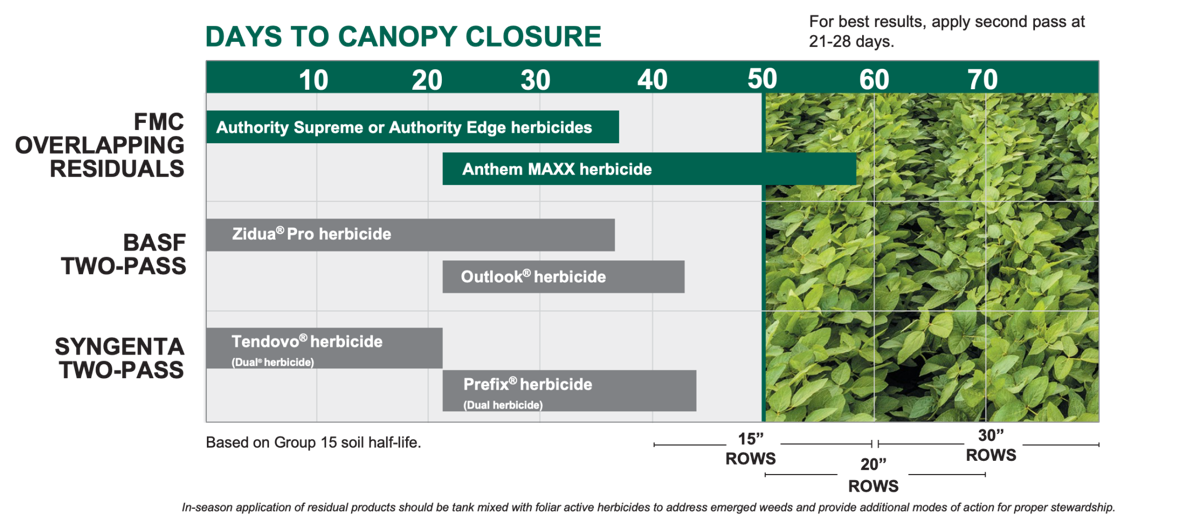
Following Authority Supreme or Authority Edge herbicide pre-emergence with Anthem MAXX herbicide post-emergence gives another layer of residual protection.
“When we do that post-emergence application to extend it, we get another 30 days to get us to canopy closure,” Stratman said.
The active ingredients in Authority Supreme, Authority Edge and Anthem MAXX herbicides not only provide long residual control, but also have activity on a wider spectrum of weeds.
While cutting herbicide programs might save money up front, the long-term costs like yield penalties, herbicide resistance and growing weed seed banks make it a risky gamble that likely will not pay off.
“Any potential dollars you think you might be saving, you're quickly losing in yield potential from the trade off,” Stratman said.
Instead, investing in a comprehensive overlapping residual herbicide program, like an Authority herbicide followed by Anthem MAXX herbicide, provides both immediate protection and long-term sustainability for soybean production.
When it comes to farming, there are countless uncertainties, so focus on what can be controlled, Wozniak said.
She added, "You've put in all this effort to get the plant off to the best start. Weeds are something we can manage, so why not take advantage?”