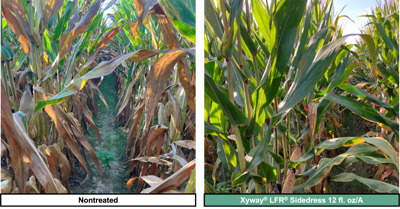





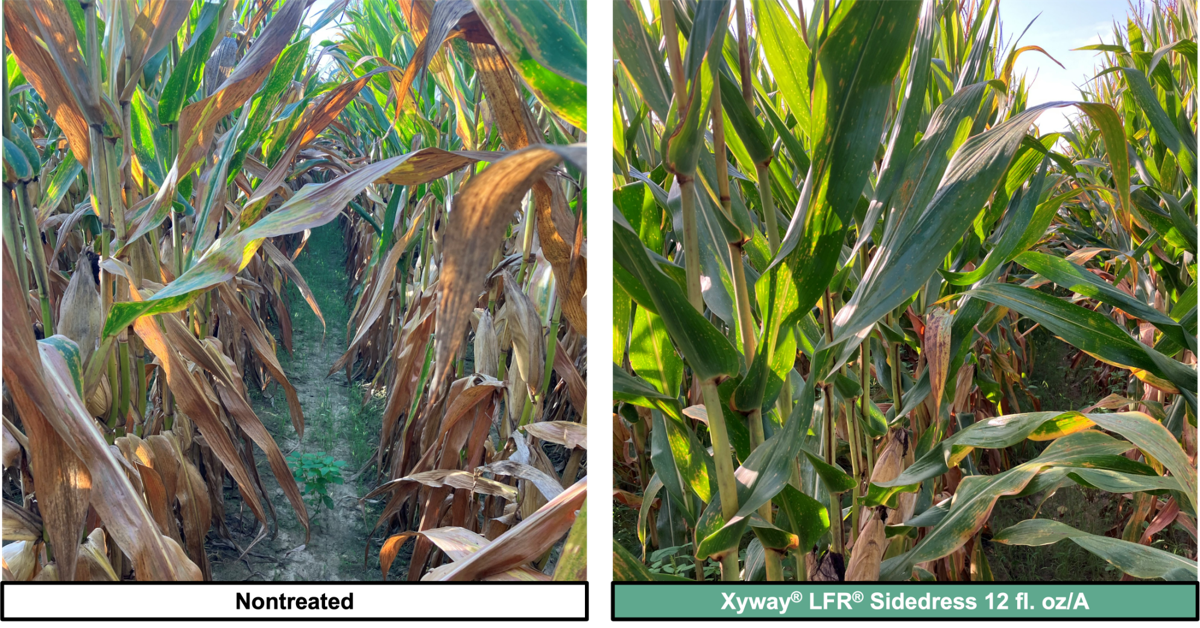
Unexpected challenges call for increased options when it comes to disease management in corn fields. To help growers stay ahead of disease pressure, FMC has expanded application options for Xyway fungicide to now include side-dress usage.
The 2025 growing season brought several unanticipated issues for corn growers across the U.S., with foliar disease pressure arriving earlier and more aggressively than in recent years, said Adam Byrne, technical service manager for FMC.
While many growers anticipated tar spot to be the primary concern, southern rust emerged as the dominant threat, thriving in unusually hot conditions and appearing in northern climates where it's rarely seen. The disease was heavily present in northern areas that it very rarely impacts.
Tar spot was still present, as was gray leaf spot, which appeared earlier and heavier than in recent seasons. It’s that unpredictability of disease pressure from year to year that underscores the importance of proactive management strategies, Byrne said.
A new application window
Expanding the application timing window for Xyway gives growers another option to stay ahead of unexpected diseases. Previously limited to at-plant applications placed two-by-two or off the seed, Xyway can now be applied at side-dress up to the V6 growth stage, giving growers nearly another month to apply it and still be beneficial for disease prevention.
Not all growers are set up to do at-plant applications so a broader list of application options widen the number of growers who can access these benefits Byrne said.
“That's where Xyway has the greatest benefit. It gives you in-season flexibility to react to the disease pressure of the year. Instead of prescriptively applying at tasseling time like we've been trained to do for decades, you can use that timing to better protect the grain fill period,” Byrne said.
The expanded timing isn't meant to replace at-plant applications for growers already equipped to apply fungicide at planting. Rather, it provides flexibility for those whose systems don't accommodate at-plant fungicide applications but who regularly make side-dress nitrogen passes.
Diseases like crown rot and stalk rot can start infecting as soon as V2 or V3, so getting ahead of them is key. “The earlier you get it in the ground, the better,” Byrne said, especially as early application gives the plant’s roots more time to take up the benefits.
Inside-out protection
Plants pulling in Xyway by their roots is exactly what sets the fungicide apart from its traditional foliar counterparts. The product is applied as a concentrated band in the soil, creating a reservoir that roots access as they take in water and nutrients.
The roots grab Xyway from the soil and pull it through the xylem, up through the plant and disperses it evenly throughout the leaf tissue.
"As new growth happens, it continues to infuse that plant with that fungicide,” Byrne said.
Research at Michigan State University demonstrated that flutriafol, Xyway's active ingredient, when applied at planting, could still be detected in leaf tissue at the R3 growth stage at levels effective against diseases like gray leaf spot and northern corn leaf blight. This systemic movement through the plant provides what Byrne describes as "an immune system boost from day one."
"It's much like an immunization," he said. "You're protecting yourself from the inside against things that are coming from the outside to attack you."
Beyond Disease Control
While Xyway functions as a triazole fungicide effective against leaf spot diseases, its benefits extend beyond disease suppression. University studies have documented improvements in root mass development, water utilization efficiency and nutrient uptake.
"We're seeing broader leaves and darker green color. It works to keep the plant healthier longer,” Byrne said.
The yield benefits have been consistent across grower demonstrations and university trials, with averages ranging from six to nine bushels per acre. In heavy disease pressure situations, the returns can be even more dramatic. In one trial during the 2025 season in heavy tar spot conditions, Xyway followed by a well-timed foliar fungicide showed up to a 93 bushel per acre advantage over untreated corn, Byrne said.
Increased flexibility
For side-dress applications, growers can apply Xyway as far as row middle, standard practice at 15 inches off the row or via Y-drop. Data from Purdue University validates that roots will access the fungicide at that distance. The product can be mixed with liquid fertilizer and integrated into existing fertility programs.
At-plant application can be placed anywhere from half an inch to four inches off the seed.
With disease pressure varying significantly from year to year and disease losses potentially reaching 40 to 80 bushels per acre in severe situations, the "start clean, stay clean" approach offered by early fungicide applications provides valuable insurance.
"We're getting ahead of the season by starting from the beginning. That's where Xyway really is different from everyone else,” Byrne said.