





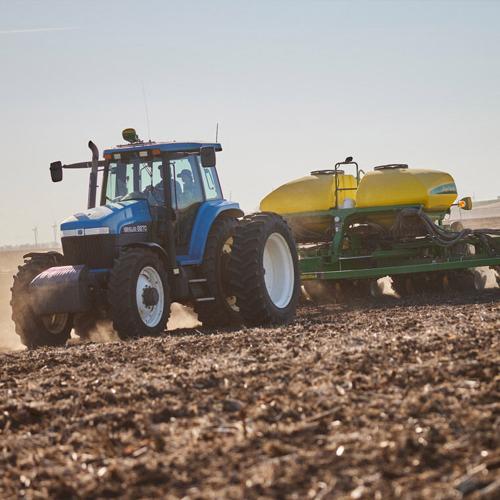
As planting season ramps up, uncertainty around the season does as well. Wyffels Hybrids has introduced a free, online tool that can help take some of the guess-work out of spring field work.
“There’s a lot of curiosity around planting time,” said Ryan Gentle, Wyffels agronomy manager for Western Illinois. “Growers sometimes wonder if they’re behind schedule, who’s had rain, etc.”
Wyffels Planting Progress Report is a practical, grower-driven tool that fills a key information gap during planting season. Designed with simplicity and accessibility in mind, the report provides real-time insights into corn planting progress across the central Corn Belt, helping producers, agronomists and industry professionals better understand regional trends and conditions.
Originally developed internally by Wyffels, the Planting Progress Report was made available to the public last year. It quickly evolved into a widely used resource across Iowa, Illinois, southern Minnesota, southern Wisconsin and eastern South Dakota.
At its core, the Planting Progress Report is an interactive, user-generated map. Growers simply enter their zip code and select a general planting progress category—such as 0–25%, 25–50%, 50–75% or complete. They can also indicate planting conditions, such as good or marginal.
“It’s super easy and only takes about 30 seconds,” Gentle said.
Growers don’t have to enter any personal data, a deliberate choice to encourage participation and ease concerns about privacy. Once submitted, each entry appears as a color-coded dot on the map, offering a visual snapshot of planting activity across regions.
The result is a dynamic and evolving picture of planting progress that can vary dramatically across geography making it simple to compare progress with neighboring operations and neighboring counties.
Users don’t need to be Wyffels customers to view or contribute data, and the more producers to partcipate directly improves the map’s accuracy. As more entries are added throughout April and into May, the tool becomes increasingly representative of actual conditions across the region.
On the same site as the Planting Progress Report, growers can also watch videos from the field, explore agronomic tools and resources, and stay up-to-date on field conditions to better inform planting decisions.
Beyond the Planting Progress Report, Wyffels also offers several complementary digital tools that support decision-making throughout the growing season.
One of the most widely used is the Growing Degree Unit (GDU) calculator. This tool helps producers estimate crop development based on accumulated heat units rather than calendar days.
For example, after an early planting followed by a stretch of cold weather, growers may worry about delayed emergence. The GDU tool can provide reassurance.
“Corn doesn’t care how many days it’s been in the ground. You can run the calculator for your ZIP code or location, and while it may show the crop has been planted for 14 days, it might also indicate you’ve only accumulated 60 GDUs. Based on that, the tool can predict when emergence should occur,” Gentle said.
The calculator integrates historical weather data with short-term forecasts to project future development stages, including emergence and even pollination. This level of insight can help producers manage expectations and make informed decisions about crop management without overreacting to short-term weather variability.
Another valuable resource is the replant calculator, which assists growers in evaluating whether replanting a field is economically justified. By inputting factors such as planting date, current stand counts and expected yields, the tool estimates potential gains or losses associated with replanting versus maintaining the existing stand. While no producer wants to face a replant decision, having a data-driven framework can reduce uncertainty and support more confident choices.
For more information on these tools and more on their website, head to wyffels.com or reach out to your local Wyffels representative.


