Rural residents tackle water quality testing questions
For some farmers or small communities, there may be an issue getting enough water in any kind of affordable fashion. For others, the problem may be a well that is not providing the water quality necessary.
Rural water associations fill gap in small towns
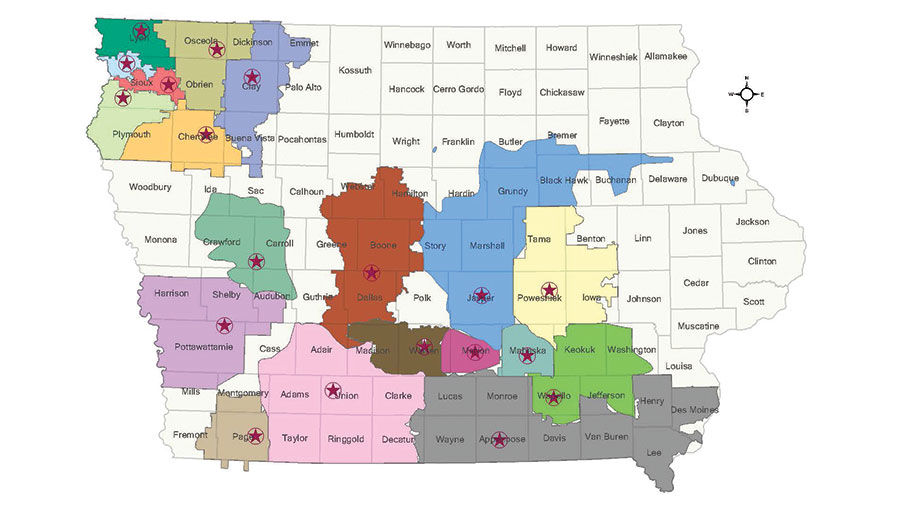
Map of Iowa’s regional water systems courtesy Iowa Rural Water Association
Rural water associations exist in all 50 states and serve many farmers and small communities, filling the gap for those living outside urban areas.
“Rural America a lot of times has unique challenges,” says Brendan Murphy, a project manager for the National Rural Water Association in Duncan, Okla. “Rural water associations help with the economies of scale.”
Water quality, availability key issues for Missouri farms
For Rachel Hopkins, taking care of the land is one way to carry on her family’s tradition. She is a University of Missouri Extension county engagement specialist based in Washington County, and she is a fourth-generation Crawford County cattle producer.
“We have a place here on the Huzzah River, crystal clear water,” she says.
Routine water tests are uncommon for many Illinois wells
CAMBRIDGE, Ill. — Henry County farmer Courtney Ericson recently did something most of her neighbors don’t do on a regular basis. She got her private well water tested.
Free testing shows high-quality well water in Southwest Iowa
GLENWOOD, Iowa — Paul Speck was not too concerned about the quality of water from his well. He and his wife Leslie built their Mills County home 21 years ago.
“I figured it was pretty good,” Speck says. “We tested it 10 or 12 years ago, and it was fine. But it didn’t hurt to check again.”
Private well provides reliable water source in Osage County
KOELTZTOWN, Mo. — On a sunny and humid August day in the rolling hills of Osage County, Ken Rademan and his family stay hydrated with water from a private well.
“We drilled that well in 1981 when we started dairying,” he says.
Flooding across the Midwest this year presented heightened concerns about water well contamination.
After the floodwaters recede, one thing homeowners whose water supply comes from a private well should do is check the quality of the water, according to state and county officials. That is especially true if floodwater covered the above-ground portion of the well.
Strategy shows progress, but more farmer buy-in needed
When J. Gordon Arbuckle arrived at Iowa State in 2007, he learned his new job might put him into the middle of some sensitive subjects.
As a rural and environmental sociologist, he wanted to focus on how to maintain productivity in agriculture, but also wanted to see how to minimize environmental impacts.
AKIN, Ill. — The water well on the Franklin County farm on which Noel Summers grew up was dug by hand, probably more than a century ago. The water was never tested until this year.
And although coliform was detected in a faucet sample taken recently, there was a lack of other contaminants.
Northeast Iowa farmer earns confidence in his water supply
DECORAH, Iowa — The last time Bob Hemesath tested his drinking water was when he put in the well.
The Decorah, Iowa, farmer replaced his well in 2013, and while he didn’t have too many concerns, he said he knew getting an updated test was a good thing.