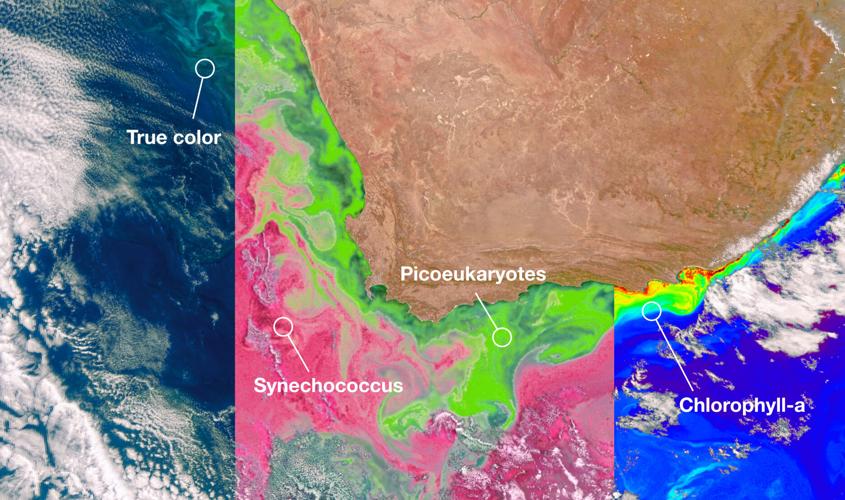
NASA’s PACE satellite’s Ocean Color Instrument detects light across a hyperspectral range, which gives scientists new information to differentiate communities of phytoplankton – a unique ability of NASA’s newest Earth-observing satellite. This first image released Feb. 28 from the Ocean Color Instrument identifies two different communities of microscopic marine organisms in the ocean off the coast of South Africa. The central panel shows Synechococcus in pink and picoeukaryotes in green. The left panel shows a natural-color view of the ocean, and the right panel displays the concentration of chlorophyll-a, a photosynthetic pigment used to identify the presence of phytoplankton.
As the world’s oceans have moved into their 12th consecutive month as the warmest on record, a new National Aeronautics and Space Administration Earth-observing satellite mission has come online. It will monitor the ocean health and particulates in the atmosphere.
PACE will reveal how aerosols might fuel phytoplankton growth in the ocean and help identify harmful algal blooms.
NASA’s PACE satellite’s Ocean Color Instrument detects light across a hyperspectral range, which gives scientists new information to differentiate communities of phytoplankton – a unique ability of NASA’s newest Earth-observing satellite. This first image released Feb. 28 from the Ocean Color Instrument identifies two different communities of microscopic marine organisms in the ocean off the coast of South Africa. The central panel shows Synechococcus in pink and picoeukaryotes in green. The left panel shows a natural-color view of the ocean, and the right panel displays the concentration of chlorophyll-a, a photosynthetic pigment used to identify the presence of phytoplankton.