





The cultivation of rice -- the staple grain for more than 3.5 billion people around the world -- comes with extremely high environmental, climate and economic costs. But that may be about to change, thanks to new research led by scientists at the University of Massachusetts Amherst and China’s Jiangnan University. They have shown that nanoscale applications of the element selenium can decrease the amount of fertilizer necessary for rice cultivation while sustaining yields, boosting nutrition, enhancing the soil’s microbial diversity and cutting greenhouse gas emissions. In a new paper published in the Proceedings of the National Academy of Sciences, they demonstrate for the first time that such nanoscale applications work in real-world conditions.
Grow nutritious rice with less fertilizer
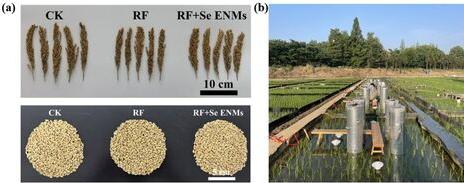
Rice receiving selenium and 30 percent less fertilizer -- RF+ Se ENMs -- is far bulkier than rice receiving less fertilizer -- RF -- and comparable to conventionally grown rice -- CK. Figure b shows a field experiment testing the greenhouse-gas emissions of rice with nano-treatments of selenium.
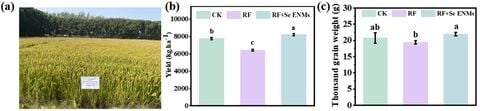
Figure a shows one of the experimental fields in Kunshan City, China. Figures b and c compare yield and grain weight of conventionally grown rice -- CK -- rice treated with 30 percent less fertilizer -- RF -- and rice treated with 30 percent less fertilizer and nano-selenium -- RF+Se ENMs.
Most Popular

The 2014 Agricultural Improvement Act -- a.k.a. the farm bill -- established industrial hemp pilot programs with state governments and at cert…

Adam Kronback has been looking for ways to innovate since coming back to his fourth-generation family farm in Lamberton after eight years work…

When it comes to irrigation, one of the greatest dangers is salt – the tiny molecule that can wreak havoc on the plants’ ability to function. …

Almost everyone realizes that farmers have a keen interest in weather. So do most other folks who engage in outdoor endeavors. But not many de…

Baby corn, essentially unfertilized young ears of corn, is a specialty food gaining interest for its high nutrition and low-calorie count. It …