Prayers on the Prairie is a regular feature of the Tri-State Neighbor, taking the place of the Crop Watchers report during the winter season. If you have a suggestion for a rural church to feature here, contact editor Janelle Atyeo at janelle.atyeo@lee.net.
Monthly gatherings keep church families close
In 1880, when settlers from Poland began to build up farms and homes on the prairies of what was to become northeastern South Dakota, they also wanted to grow in their faith.
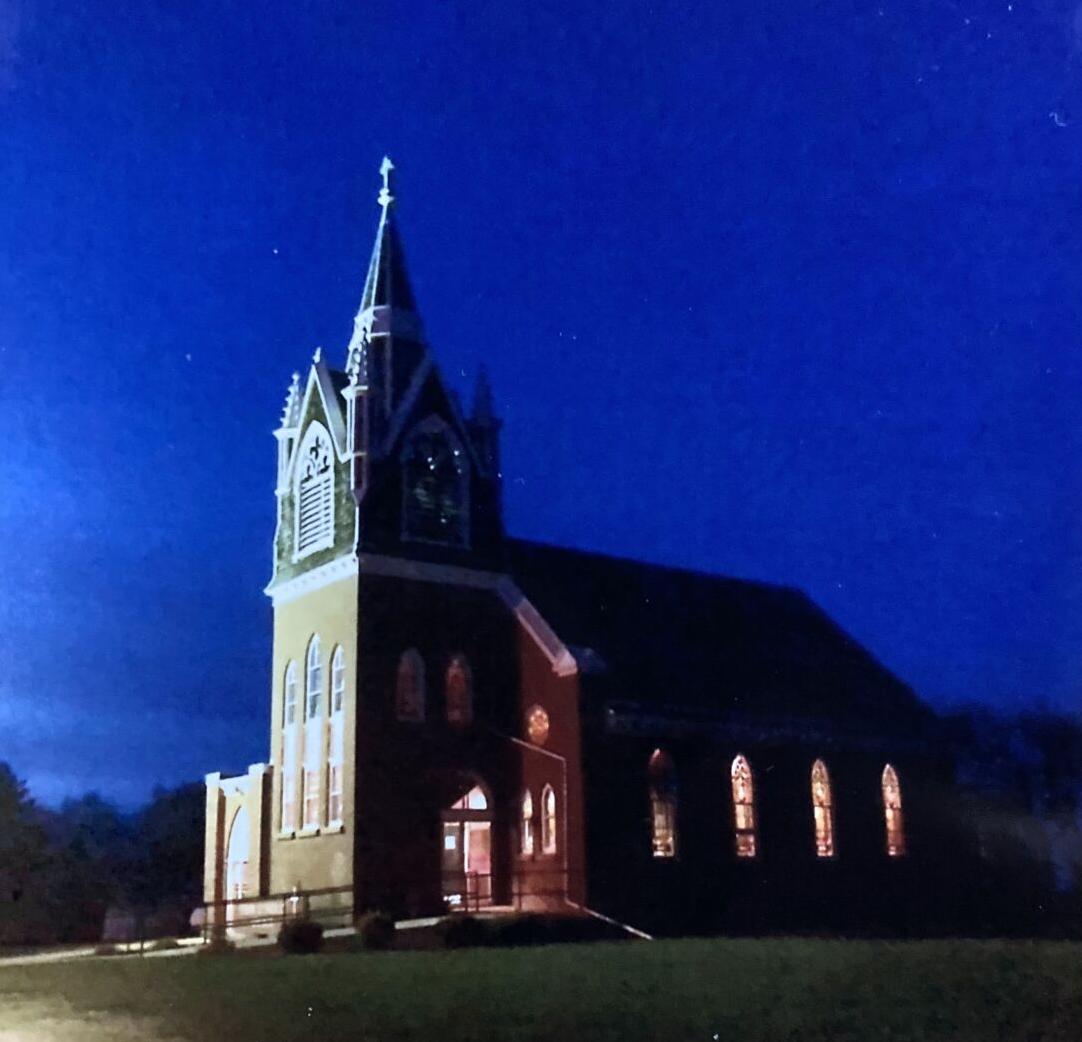
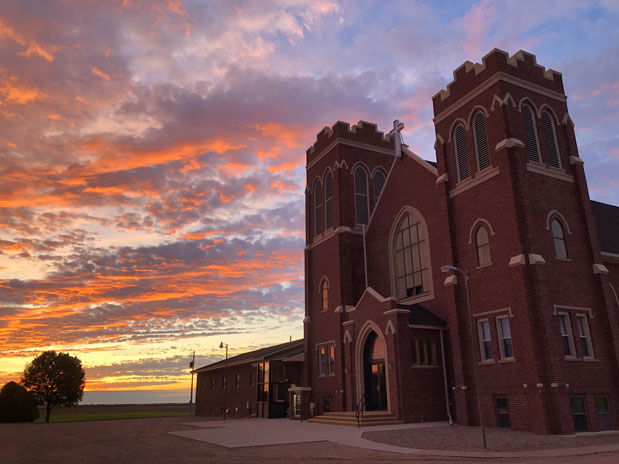
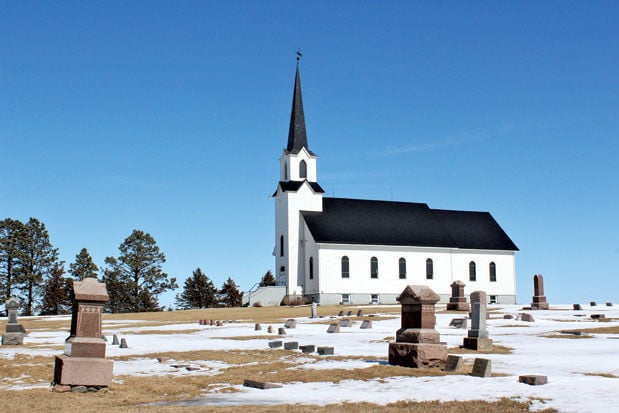
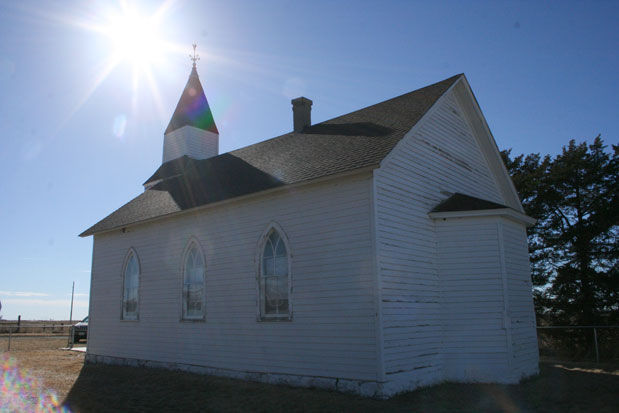
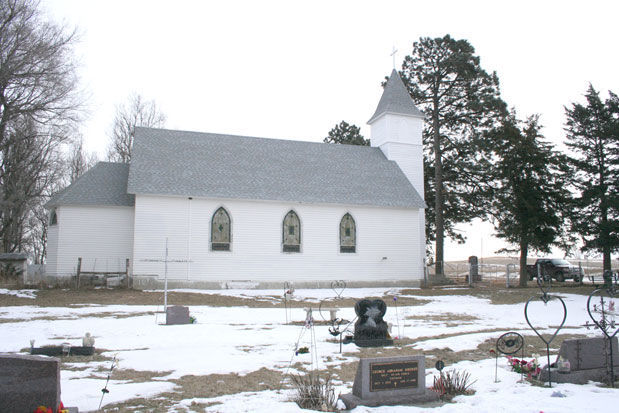
St. Joseph Catholic Church in surrounded by tall pines in Grenville, S.D.
Tri-State Neighbor photo by Janelle Atyeo
They eventually formed the congregation of St. Joseph Catholic Church of Grenville, a tiny town on the northern shores of Waubay Lake.
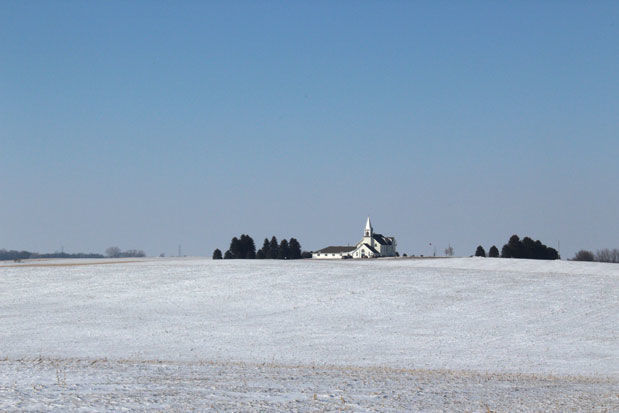
St. Josep's steeple rises above the trees of Grenville, S.D., across a frozen Waubay Lake. The water wasn't always so close to the church. Floods of the 1990s changed the lake level.
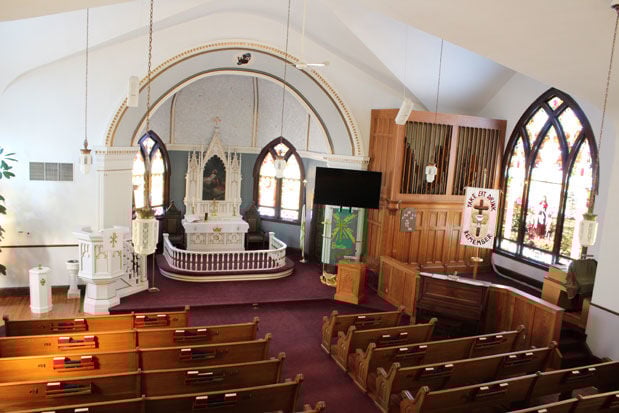
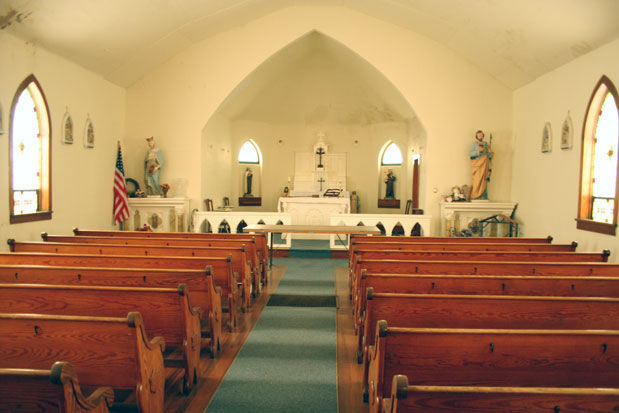
A Pieta, a statue of Mary holding the body of Jesus, is lit by sunlight through a stained glass window in St. Joseph sanctuary. The statue was purchased for the church in 1907.
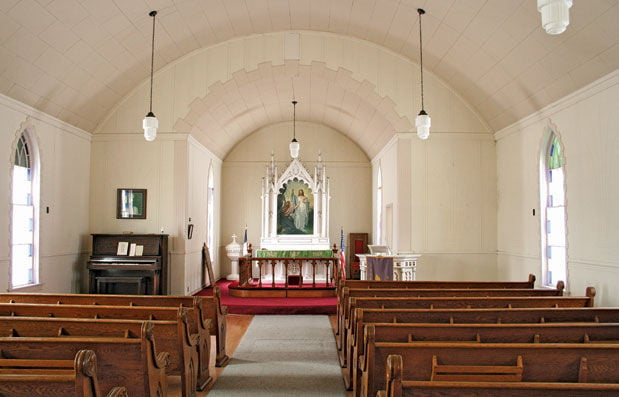
St. Joseph Catholic Church sits amongst tall pines on the shore of Waubay Lake in the town of Grenville, S.D. Since the diocese reorganized in 2024, the church hosts one Mass a month, but continues to hold funerals, weddings and baptisms.
My father-in-law used to love driving. Whether it was to the corner convenience store for a cup of coffee and a newspaper or to an out-of-the-way truck stop for soup and pie, Dale Hult loved to going out to eat, seeing other regulars at cafes and teasing waitresses with nonstop dad jokes. The day we sold his minivan was perhaps one of the saddest of his life. Dementia stole his ability to motor about eastern South Dakota safely a few years ago, though he held on as long as he could (and maybe a little longer than his family would’ve preferred). He lives in a nursing home now, where naps are more his speed.
One of his favorite destinations during his late rambling years was the Sunday morning service at Komstad Church, just a couple miles from the “homeplace,” his term for the farm south of Centerville, South Dakota, where he and his brother grew up. The church was a trek from his home in Huron, so he and his beloved wife, whom he lost last year, would make it a weekend getaway. They’d eat at Truck Towne, spend the night at a motel and attend Sunday worship in the place his ancestors helped establish.
A year into his role as Komstad Covenant Church pastor, Dan Davey’s focus is relationships. Confirmation classes and an adult Bible study bring people together, he said, and he’s also working to make connections outside the walls of the rural church southwest of Beresford, South Dakota.
A year into his role as Komstad Covenant Church pastor, Dan Davey’s focus is relationships.
Confirmation classes and an adult Bible study bring people together, he said, and he’s also working to make connections outside the walls of the rural church southwest of Beresford, South Dakota.
Komstad Covenant Church was built by Swedish families who settled south of Beresford in the 1870s.
Two white spires stretch from the corn fields toward the sky northwest of Volin, South Dakota.
They are the familiar local landmark of Faith United Lutheran Church, and for many who have roots in the church stretching through generations, they are home.
Faith United Lutheran Church, northwest of Volin, S.D., was founded as Zion Lutheran by a group of Norwegian settlers in 1872. The double-spired church was built 110 years ago after the first building was lost to a lightning fire that burned so hot even the bell was a total loss, being reduced to molten metal.
Faith United Lutheran Church, northwest of Volin, S.D., was founded as Zion Lutheran by a group of Norwegian settlers in 1872. The double-spired church was built 110 years ago after the first building was lost to a lightning fire that burned so hot even the bell was a total loss, being reduced to molten metal.
Vicar Brent Ashby leads the congregation at Faith United and one other church at Mission Hill. After a career in construction, he said he's "over the moon" to be working in ministry.
It’s midweek at a small country church in northeastern South Dakota. The building at the intersection of two Marshall County roads, more than 20 miles from any town of more than a few hundred people, sits under a dark winter sky. But the lights inside are on, and kids of all ages are abuzz.
Some warm up with dance moves on the backlit altar. Some giggle at eachother’s artistic efforts during a game of Pictionary. Older kids file downstairs and settle at two large tables where they pass around BeanBoozled, a game involving jelly beans where players take chances at chewing a pleasant or putrid flavor.
Junior high and high school kids gather for a mid-week Bible lesson at Rose Hill Church. The basement classroom is decorated with the church's mission statement on the wall: "Our vision is to see every acre of Marshall and Day counties and beyond planted, watered and cultivated to the glory of God.
Rev. Hanson, right, looks over some seed during a visit to the farm of one of his church members and neighbors, Louis Boyum, in this photo from a magazine feature on the rural pastor in 1947.
The first grade Sunday school class at Central Lutheran Church in 1955-56 included Joan, Renee, Beverly, James, Dennis and Nancy. The class was taught by the wife of Rev. Hanson.
The Ladies Aid group raised money with their 10-cent meeting dues to purchase the altar painting in 1891. The wife of Rev. Thomas Hanson took up the effort of securing funds for a pipe organ. She canvassed the congregation, going from house to house by horse and buggy.
Tyler Greathouse got his hands dirty in his first call as a young pastor at an aging rural church in a ghost town called Carter, South Dakota.
Located in ranch country between Winner and the Rosebud Indian Reservation, it didn’t take long for church neighbors to invite Pastor and his growing family to help with cattle work. He slipped in a muddy pen on one early outing, but he didn’t mind.
Pastor Tyler Greathouse and his wife Amy found a welcoming home in Carter when they came nearly 10 years ago.
The old Carter Gospel building has expanded over the decades, but it’s rock foundation can still be seen in the basement of today’s church. The car pictured belonged to Pastor “Uncle Ed” Roskens.
Pastor Tyler Greathouse and Carter Gospel member Steve Waters show the foundation of the original church, made with rocks pulled from the nearby Red Hills.
“It’s kind of one big family,” said Earl Albert, a longtime member of Seney United Methodist Church.
Located in the tiny community of Seney not far north of Le Mars, church members are preparing for a family reunion of sorts. They’ll celebrate 150 years since the church was founded with a special worship service, lunch, coffee and cake June 9.
Good priorities: Rural members have long made church, Christian education a top priority
There was plenty to deter early settlers along the Minnesota River valley in Nicolette County – from crop losses and scarlet fever to tensions with Native American neighbors. But members of Immanuel Lutheran made the church and Christian education a priority.
Those priorities remain today as the congregation embraces a spacious new church building and ardently supports a cozy parochial school.
The Covey Church sits on a county road between Hartley and Sutherland, Iowa. A sign notes that it's the oldest church building in O'Brien County.
Tri-State Neighbor photo by Janelle Atyeo
The Covey Church in northwest Iowa hasn’t held weekly church services since 1959, but the 140-year-old building and small cemetery remain as lasting reminders of the homestead days and the trials settlers from that era faced.
On the edge of a busy county road between Hartley and Sutherland, Iowa, the white clapboard building is noted for being the first wooden church building in O’Brien County. Now it serves as a historic landmark, a scenic rest-stop setting and an occasional wedding venue.
Lucy Slack helped Rev. Covey found the Congregational Church in Grant Township and fought to keep it going through times of failed crops, low membership and a tornado that destroyed the building.
Lucy and William Slack are buried between two large trees in the cemetery across the road from Covey Church. They were married in 1844, moved to Indiana and then Iowa in 1846, and came to O’Brien County in 1868.
Jim DeBoom looks over a directory in the Covey Church cemetery. As trustee on the Grant Township board for many years, DeBoom and his wife Mary helped care for the church.
A community of settlers with Swedish hertiage built Union Creek Lutheran overlooking the hills west of Akron, Iowa. The congregation is celebrating its 150th anniversary.
A community of settlers with Swedish hertiage built Union Creek Lutheran overlooking the hills west of Akron, Iowa. The congregation is celebrating its 150th anniversary.
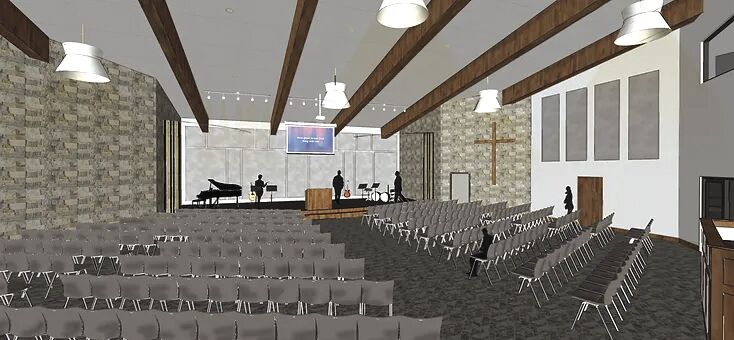
Churchgoers at Preston Christian Church are used to sitting in chairs that overflow into the fellowship hall, but they will have new accommodations this spring.
A new sanctuary and entryway being built onto the country church north of Bruce, South Dakota, will be able to hold 280 people, twice as many as the current space.
When choir students from Bethany Lutheran College make the rounds on their spring tour out of Mankato, Minnesota, the director has special instructions when they stop to perform at Rock Dell Lutheran Church in rural Redwood County.
Recently retired after nearly 40 years at Bethany, director Dennis Marzolf tells his students to take a moment in the country church and soak it in.
The sanctuary of Rock Dell Lutheran contains features of traditional Scandinavian churches, a semi-circle communion rail and a pedestal pulpit among them.
From atop a hill 11 miles due south of Beresford, South Dakota, Roseni Lutheran Church is a monument to history, dating back to the Norwegian settlers who founded the congregation more than 150 years ago.
Former Pastor Clara Nelson leads a children’s sermon. She preached at Rosni Lutheran for 16 years and is credited with helping to draw in young families.
Having come – through wind storms, economic hardships, world wars and declining rural populations – members are preparing to celebrate 140 years of history at Storla Lutheran Church this summer.
An effort us underway to restore the historic pipe organ at Roseni Lutheran Church. “We want that traditional music to continute. It’s part of our past and our heritage,” member Susan Miskimins said.
A church with Swedish heritage sits just off a curving county road, overlooking one of Minnesota’s 10,000 lakes.
Sillerud Lutheran Church, southwest of Balaton, Minnesota, is celebrating 150 years since it was founded. Several church members are descendants of the Swedish church founders, but others who have arrived more recently have found a home in the country church. Members old and new appreciate its rich history, along with all of the changes that have come through the decades.
The parsonage, built in 1872, once housed a pastor and his 10 children. Once removed from the church grounds, it was returned for the 1970 centennial celebration and has served as a museum ever since.
Local historians take great care to preserve old church
A block off of Main Street sits one of Groton, South Dakota’s oldest buildings, the first church built after the city was founded in 1881.
Behind Trinity Episcopal Church is an empty lot that once served as a baseball field. Home plate was directly under the tall stained glass windows custom made in Connecticut to be the altar’s colorful backdrop.
The members of Templeton United Church of Christ like being together.
That’s evident in the way they laugh as they share memories about growing up in the small rural church that sits between farm fields west of Wessington Springs, South Dakota.
Verla and Neal Barber have been longtime church members. Neal traces his roots back to C.S. Barber, pictured in the photo at left, one of the early white settlers who hosted the first Templeton services in his house.
Small church weathers the storm to survive 140 years
Sitting on the countryside of eastern Kingsbury County, South Dakota, the Lake Whitewood Church looks much the same as it did in photographs from its 1906 dedication.
The landscape, however, changed significantly in just the last year when a tornado and derecho winds took down 26 towering evergreen trees that were planted in 1914.
Thea Olson, left, Mrs. C.G. Moe and Mrs. Abe Bergerson were among the earliest members of the Ladies Aid, which made meals and sewed items to raise money for many of the church’s furnishings that are still in use today.
Church members dedicated to community near and far
At first there were two.
Since the 1880s, Lutherans near the village of Storla, South Dakota west of Mitchell supported two churches. They shared in youth gatherings and summer picnics. They shared in tragedy as well, when both church buildings were blown down in one big summer storm in 1924. They each rebuilt and continued their work for another 90 years.
Wood from the destroyed church was used to build the parsonage next door. The new Storla Lutheran is seen here at the building’s dedication festival, Oct. 6, 1929. It still stands today, as does the house, which is no longer a parsonage.
A symbolic art piece hangs above the alter. It was designed by a church member and sculpted by an artist in Sioux Falls to replace a historic painting that was lost to a fire in 1980.
While cars speed by at 80 mph on Interstate 29 between South Shore and Watertown, South Dakota, a mile away there’s an unassuming country church that holds a beautifully grand piece of history.
St. John’s Evangelical Lutheran Church looks like many white clapboard churches from the late 1800s with arced stained glass windows down the sides and a steeple making its signature roofline.
Early impressions: Small church keeps focus on national youth gathering through generations
The older generation at Bergen Lutheran Church in rural Day County, South Dakota, has fond memories of participating in national gatherings of Lutheran kids.
Betty Lou Rhode was one of four local girls to go to the first big youth event in Saskatoon, Saskatchewan. John E. Sigdestad and Kenny Anderson went to the 1955 gathering in San Francisco, and John’s brother David Sigdestad made the trip to Milwaukee, Wisconsin in 1960.
John E. Sigdestad, left, operates haying equipment during a threshing bee held in the fields adjacent Bergen Lutheran Church. The threshing bee is one of many community activities Bergen members are a part of.
When a furnace fire started in the original Bergen church, built in 1892, members carried out pews and record books. The salvaged pews are still used in the rural Day County church today.
David Sigdestad pages through letters from the 1930s he found in his barn. Some of the correspondence was about rebuilding the church after it was destroyed by a fire.
Strong and beautiful: Tabor Lutheran Church a community staple in Strandburg, South Dakota
A stately and sturdy church sits on the edge of the northeastern South Dakota town of Strandburg.
Red brick stretches to the ornate bell tower. Inside, dark wooden railings and yellow stained glass lead to the balcony where you can look down on the gleaming pipe organ and the hand carved wood of the Gothic style altar and matching pulpit. The centerpiece is a statue of Jesus said to be made by Gutzon Borglum of Mount Rushmore fame.
Kathy Granquist prepares soup for a Veteran’s Day supper at Tabor Lutheran Church in Strandburg, S.D. She has been the church’s organist for more than 35 years.
Young members of Scandinavia Lutheran show that membership was once thriving. The church used to run a “Norse” school where children were taught to write and read in Norwegian.
Members prepare to say farewell to small town church
At the end of a narrow gravel street on the edge of what was once a small railroad town, a blonde brick church stands as a stately guard over a quiet cemetery.
The small town of Onaka, South Dakota, in northwestern Faulk County has faded to about a dozen houses, a tiny post office, a park with antique equipment, a seldom used community hall and a bar that’s open three days a week. The town’s only surviving church, St. John the Baptist Catholic Church, will hold its last service June 13. It hasn’t been decided what will happen to the brick building, but the handful of members that call St. John’s home hope to give it a fitting farewell.
At a spacious country church in rural Dimock, South Dakota, there’s a tiny room to the side of the altar where you’ll find the inner workings of a grand pipe organ.
Before the organ was electrified, a teenage boy would sit there during Sunday services, pumping the bellows to fill the wind chest. The boys got 25 cents for their work, and they also took liberties to scrawl their names on the wooden components that fill the room. There are penciled initials, dates, hearts with a cupid’s arrow, even a cartoon tractor.
The garden shed includes a cozy setting for visitors to sit and reminisce. A journal is provided, and a sign says: “Glad you came! This little place is in memory of everyone so dearly loved. Write their story. Write your story. Spend time to remember them. Bring your coffee and your fiends and linger a while. God Bless!”
The Bemis Holland church, built in 1887 had a steeple added in 1910 and then removed in the 1950s. Beside it is the manse, or pastor's residence, which no longer exists.
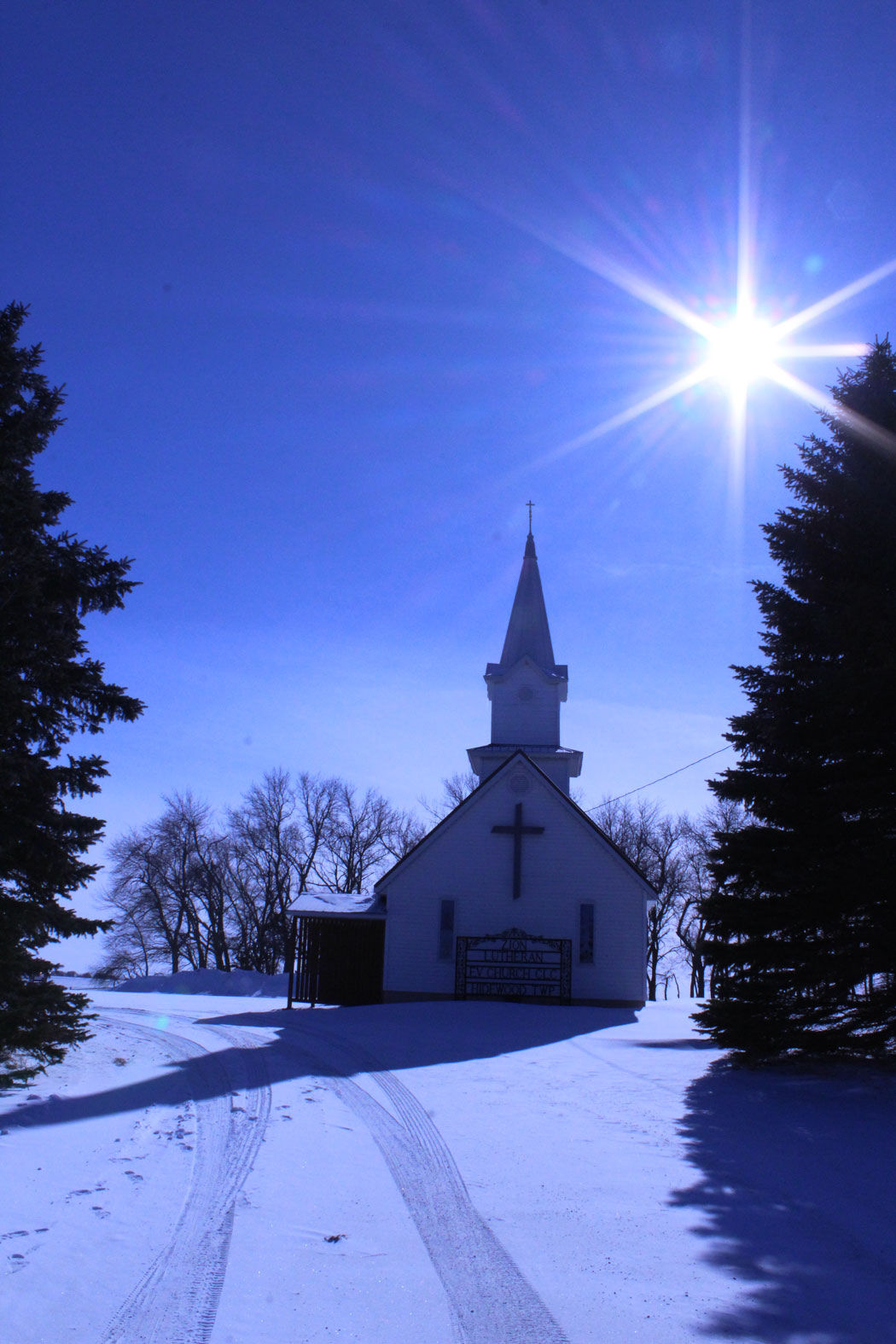
Pastor Paul Krause may only be in his sixth year of serving the rural congregation at Zion Lutheran Church of rural Estelline, South Dakota, but he’s found plenty of personal connections in that time.
The Wisconsin-native comes from a long line of pastors on his mom’s side of the family. He was serving in Markesan, Wisconsin when he got the call to South Dakota, serving both Trinity Lutheran in Watertown as well as Zion, a country church in what’s known as the Hidewood Township of Deuel County.
Kellerton Methodist has "Prayer Bears" - teddy bears sitting in pews that can go to those in need of support. It's tag says "I have heard the word read, prayers prayed, praises sung and sermons preached. I have been loved by the Kellerton folks and soaked in God's love. Now I am coming to bring you comfort and joy with a prayer."
Kellerton Methodist of rural Hazel, S.D., was built in 1898. It once had a bell tower, which was removed when it deteriorated. The bell was moved to the front lawn, and it rings every Sunday.
This summer, members a country church between Hartford and Wall Lake in southeastern South Dakota will celebrate 140 years as a congregation.
The roster of confirmed members still includes several names carried from the 33 German families who were charter members of Wall Lake Zion Gemeinde at its founding June 6, 1881.
Lake Campbell Lutheran Church, in southern Brookings County, South Dakota, turned 150 years old last summer, and a grand celebration was planned.
The coronavirus pandemic caused the party to be put on hold. Church members commemorated the anniversary instead by ringing the church bell 150 times on June 13, the date in 1870 when the church was founded.
Lake Campbell Lutheran Church near Volga, S.D., was built in 1890. A balcony and basement was added in 1924, and a large fellowship hall and kitchen built about 20 years ago allows it to host large gatherings today.
Prayers on the Prairie: Where friends become family
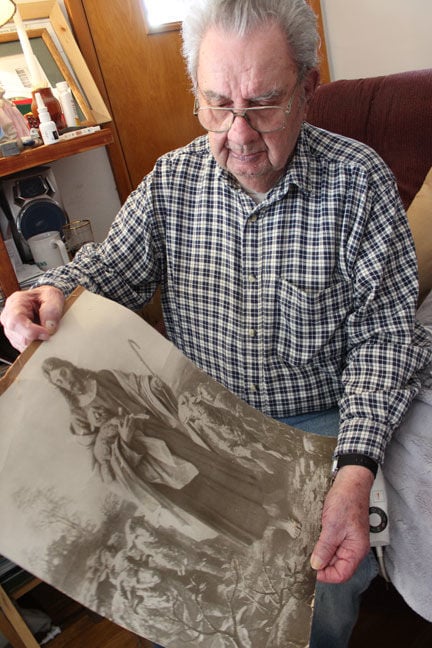
Last Christmas, Merlin Boese shared something special with the children in his church, the Friedensberg Bible Church south of Avon, South Dakota.
It was something he received as a boy at Christmas time – a picture of Jesus the shepherd signed by his Sunday school teacher and dated December 1929, when Boese was just about to turn 5 years old.
Merlin Boese, whose forefathers were amongst the church founders, displays a picture of Jesus he got for Christmas from his Sunday school teacher in 1929.
If not for the square, white bell tower, the historic building southwest of Milbank, South D…
submitted image
Prayers on the Prairie: Country church transforms with the times
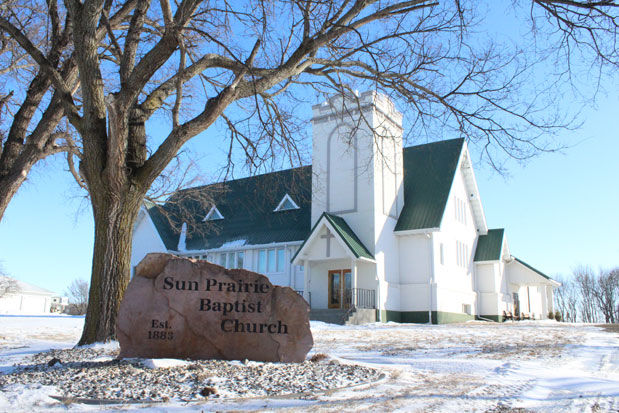
When you pour a cup of coffee at Sun Prairie Baptist Church, the aroma hits you with a rich roastiness and you know there’s something different about this little country church on the South Dakota prairie.
Church coffee isn’t usually on par with the five dollar lattes served at trendy downtown coffee shops, but here, it is.
The church’s tower was refurbished in recent years, and while repairing the windows was too expensive they were saved and added as decoration in the interior stairwell.
Prayers on the Prairie: Family, church family is one and the same
Mission Sunday has always been a special time at St. Paul’s Lutheran Church, located on the edge of the town of Henry west of Watertown, South Dakota.
Held the last Sunday of June, there’s always a special worship service with a guest speaker. When Carlos and Anita Abraham were young, Mission Sunday was a day-long event with a picnic and games. There were two services with food served in between.
A church can feel like home, and for Jaimie Odde, it was a cure for homesickness.
Odde grew up in Sioux Falls. Her husband’s family ranch and a teaching job brought her to the Pollock area in north central South Dakota. She also grew up hearing her grandpa Leroy Iseminger preach, so when she was looking for a church to attend, he referred her to a friend who pastored in the area. He told her she had to go to Norway Lutheran, located north of Glenham, South Dakota.
Farmers bring their tractors, planters and other equipment for a blessing ahead of planting season on Rogation Sunday in this photo from the early 2000s.
Gunder Odde, 7, and his brother Ander Odde, 5, model T-shirts made for Norway Lutheran Church near Glenham, S.D., where their mom, Jaimie Odde is vicar and trainging to be a pastor.
Prayers on the Prairie: Brown Earth church marks era of change on the prairie
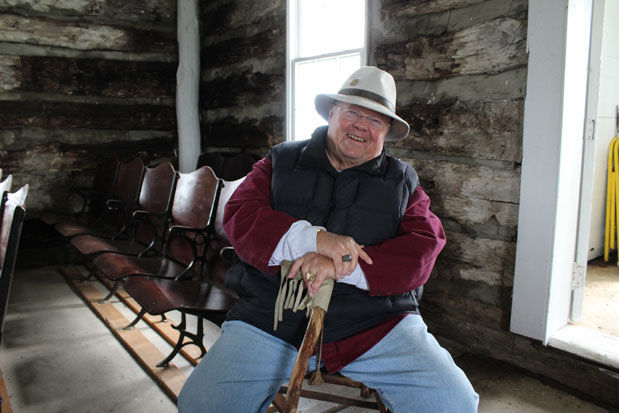
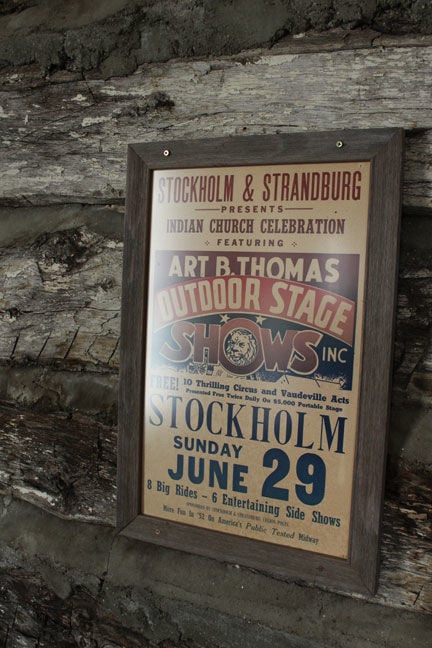
If not for the square, white bell tower, the historic building southwest of Milbank, South Dakota, would look like a settler’s cabin.
Hand-hewn oak logs make up the walls, ax marks still visible where the timber was made to fit. The original caulking has been replaced with concrete, the dirt floor is now cement, and the pane glass windows have been restored. The Brown Earth Indian Church is a monument to a time when two cultures clashed on the northern prairie
A small church in the northern reaches of South Dakota is looking toward the future.
Young families make the church a lively place. Parents of young kids are stepping into leadership roles as church deacons, and older generations are working to make a welcoming atmosphere for kids.
Hoping for clear rural roads to visit more churches
I grew up just down the hill from our church in Clear Lake, South Dakota. Thank goodness we lived close, because my dad was usually still knotting his necktie as we walked out the door minutes before the service was set to begin.
On Christmas Eve, as we make the walk in the dark of a winter evening, my mom likes to remind everyone of the year I was born. A blizzard kept most people from attending the candle light service that year. My parents wrapped me in blankets and battled the wind on the walk to the church’s double doors.
The rocks made for a sturdy foundation at St. John Lutheran Church, and the walls were made of four layers of brick. The solid construction helped the church withstand a devastating tornado that wiped out the parsonage and leveled many farmsteads in the area May 21, 1962.
A strong foundation: Church stands through storms, supports members through theirs
St. John Lutheran Church sits on a rocky ridge west of Dimock, South Dakota. There was no shortage of rocks that members hauled to the church site and crushed for cement or used for the church foundation.
“God was figuring for expansion because he put a lot of rocks here,” church member Jim Neugebauer said.
Prayers on the Prairie: Traditions live on in historic country church
After a snowy winter, members of Goodhue Lutheran Church are ready to hear the Easter message of hope and renewal.
The Easter sunrise service is the first Sunday worship service the country church northwest of Florence, South Dakota, will host this year, and it’s a meaningful one. Goodhue Lutheran, part of a three-point parish, has continued the tradition of hosting the early morning Easter service since 1952. Only one year was it canceled – 1975 – due to a blizzard.
Spring grass turns green around Goodhue Lutheran Church in this photo from a previous year. It was founded by several families who still have members caring for the church today.
For nearly 95 years, Trinity Lutheran Church outside of Oldham, South Dakota, has held just one service a year, on Memorial Day.
Year round, though, the church serves as a memorial to founding families who dedicated their lives to building the little church on a sloping prairie hill.
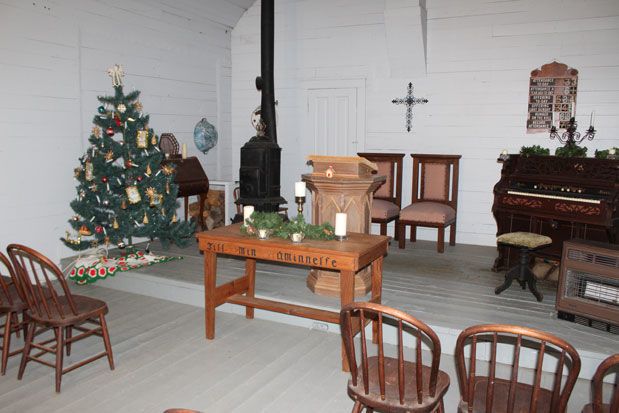
The ceiling and walls of Trinity Lutheran Church are painted with a stencil decoration. A potbelly stove and pump organ are at the front of the church, and a painting of Christ in Gethsemane is the focal point.
Trinity Lutheran, known as the “Hill Church,” sits surrounded by evergreens west of Oldham, S.D. It served a community of Scandinavian immigrants from about 1897 to 1925 before the congregation joined the church in town.
Prayers on the Prairie: Country church carries on Swedish traditions
Christmas is a time when Big Springs Baptist Church dives into its history.
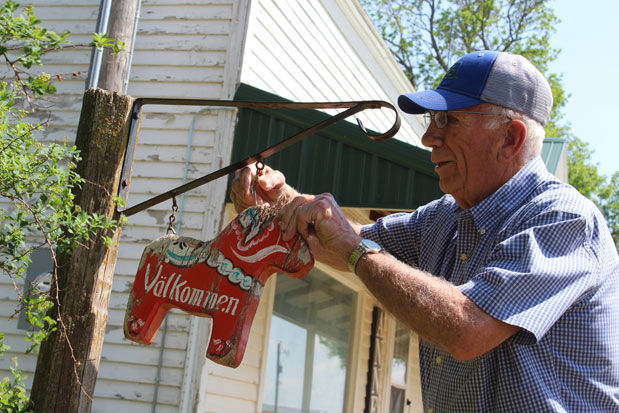
A special “Founders’ Service” is held across the road from modern church building. There sits a small white clapboard building that first served as the Big Springs place of worship in 1874.
The original Big Spring Baptist Church is decorated for Christmas when members have a Founders Service to honor the Swedish families that started the church.
Prayers on the Prairie: Remote country church is close to the heart
There’s a tiny country church in the sparsely populated hills north of Murdo, South Dakota, where the only sounds that break the silence are the chipping of birds and the creaking cattle gates moving in the wind.
Immanuel Lutheran Church is located 17 miles down a roller coaster ribbon of gravel road. Its simple cross-topped steeple looks over acres of grazing lands, home to Ted Turner’s buffalo herds.
Prayers on the Prairie: Youth give rural church a new energy
There was a time when low attendance and dwindling funds pointed to the end of the rural Dawson Covenant Church in southwestern Minnesota, but today, a focus on youth programs has helped the church thrive and grow.
In the last two years, the church has added on to its relatively new building and hired a youth pastor. The church south of the town of Dawson is led by two young pastors with growing families of their own. They’ve helped set the tone for a church that values its youngest members.
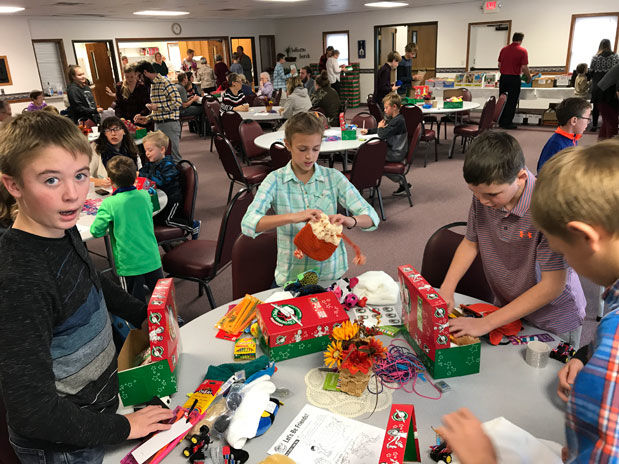
Kids at Dawson Covenant Church prepare gift boxes for other children. The church supports Operation Christmas Child and packed more than 200 shoeboxes as a church family last fall.
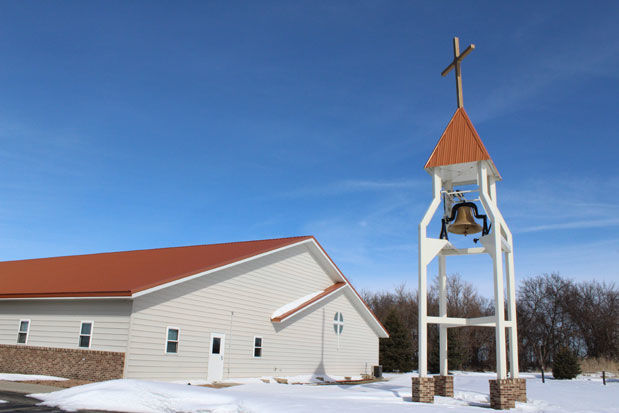
The bell from 1934 has a new home outside of the 2003 building. It’s known as Papa’s Bell for Noach Swenson, who decided the church needed a bell after a faithful member died.
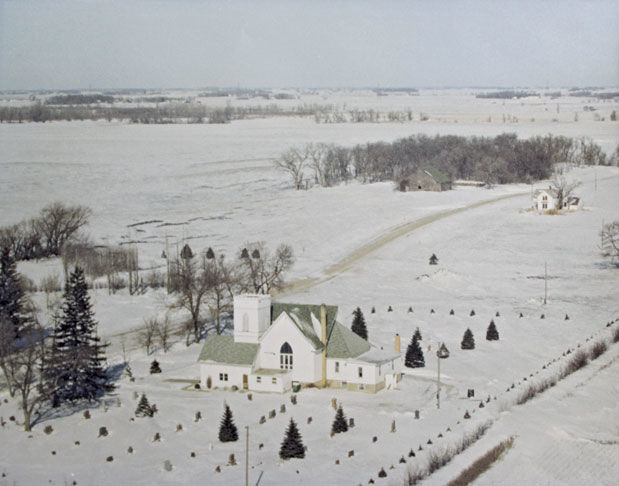
An areal photo of the former church building shows a country setting. Located a mile and a half from the current church, it was torn down, but the cemetery remains.
Prayers on the Prairie: Members look back after church closes doors
Members of a small country church near Howard, South Dakota, were sorry to see the church’s final service come on a June Sunday two years ago, but something that happened during the Lord’s Prayer made it feel like the generations of church members were watching over them.
In honor of their ancestors who founded the church in 1881, they recited the prayer in Norwegian. As they did, a ray of sunlight shined over Jesus’s head on the altar painting – a depiction of Jesus praying in the Garden of Gethsemane, according to those at the service. There was a mummer through the pews as people took notice.
The afternoon sun shines above Belleview Lutheran Church. The church remains, but all of its furnishings were donated or sold in 2016.
Belleview Church was closed in 2016 after a member vote, and the interior was gutted with many of the furnishings donated to another church that had burned down.
Benton Lutheran Church sits on a hill west of Crooks, South Dakota, as a white, steepled beacon.
The historic building is more than just a place of worship and fellowship, though. It’s a sort of community hub where rural residents come for massages and foot care and – during certain seasons – to purchase what some claim are the best homemade pies available for sale.
Benton Lutheran Church near Crooks, S.D., features two large stained glass windows and a pipe organ. The altar speaks to its Swedish heritage. An inscription in Swedish translates to “I prayed for you.”
Benton Lutheran's church building was dedicated in 1915. It now serves as a community hub where people can get massages and foot care on certain days of the week.
Phil Gunderson and Lloyd Sorlien remember when their church was just a pile of field rocks. Now it’s a uniquely constructed stone church tucked away in the rolling hills that descend into the James River Valley south of Menno, South Dakota.
Cars are parked outside Our Saviors Lutheran Church when it was just a basement with a roof. Members worshiped in the basement for about a decade while building plans were put on hold in part due to World War II.
Submitted photo
When Gunderson and Sorlien were young in the 1940s, Our Savior’s Lutheran Church was just a basement with a roof. The congregation had plans for a grander place of worship, but they were put on hold during World War II while supplies went to war efforts.
Local field rock makes up most of the Stone Church, officially Our Savior’s Lutheran near Menno, S.D., but a few pink stones forming a cross at the peak of facade were collected in Norway, the ancestral home of the church founders.
When Emily Wehde sits in the pews of Swedona Evangelical Covenant Church each Sunday, she’s in the place four generations before her have found home.
Wehde, 24, lives in Sioux Falls but carries on the tradition of playing an active role in the country church near her childhood home north of Brandon, South Dakota.
Emily Wehde and Pastor Mick Murphy pose by a pump organ at Swedona Covenant Church. Wehde is a fifth generation member.
Prayers on the Prairie: Well-documented history preserves story of rural church
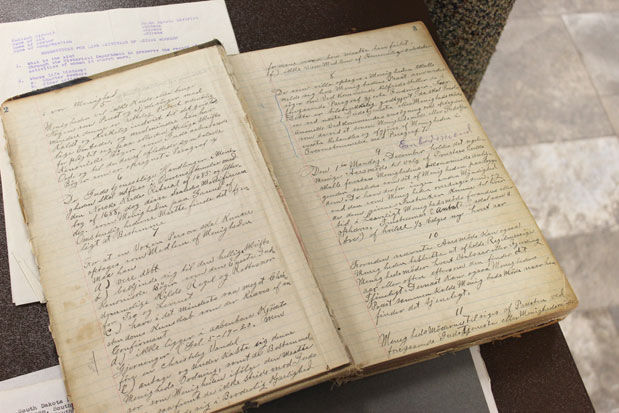
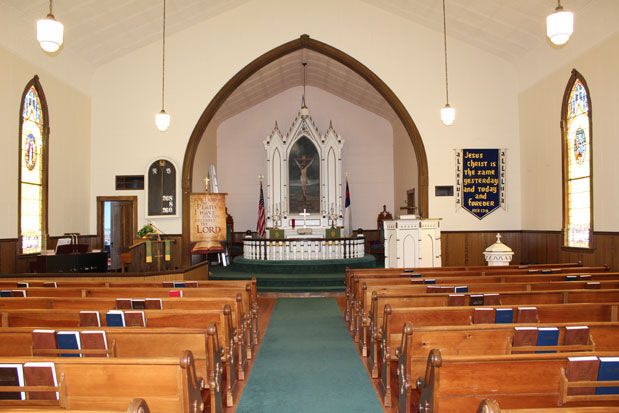
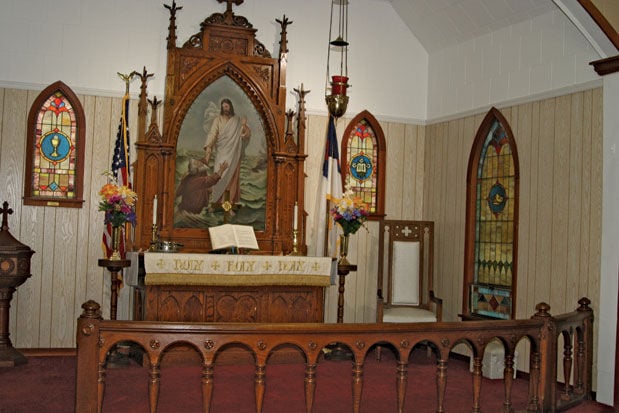
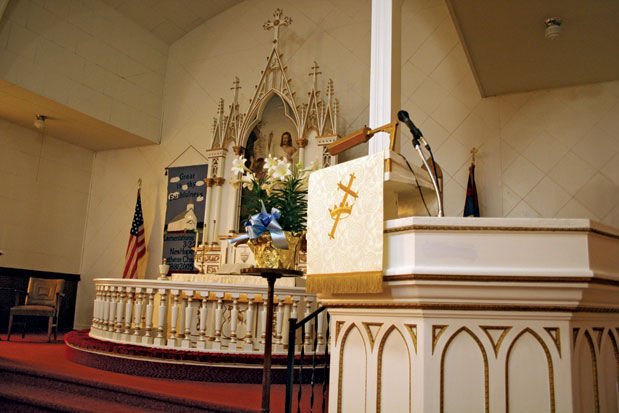
Inside the walls of the 128-year-old Lake Madison Lutheran church are books older than the building itself. They keep records of its members going back generations. They tell personal stories of their lives, and they recount major milestones in the congregation’s history.
Some records are hand written in Norwegian, the perfect scrawl on now-yellowed pages of withered books. Some biographies are organized in three-ring binders, complete with colorized portraits. Others are newspaper clippings pasted in scrapbooks.
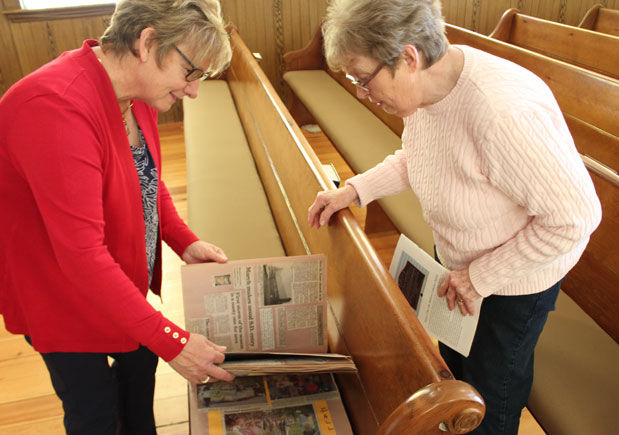
Kathy Phelps, left, and Bonnie Stratton page through a scrapbook of Lake Madison Lutheran Church milestones.
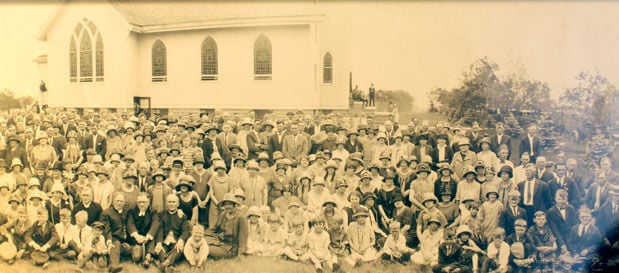
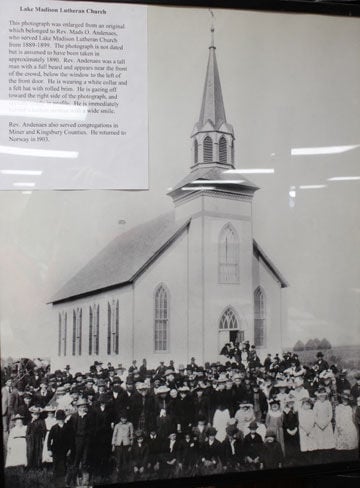
Early members of Lake Madison Lutheran Church gather around the newly built church in this undated photograph that is displayed in the church basement.
Quilters create community of caring at rural church
Behind the wooden pews of Zoar Lutheran Church near Revillo, South Dakota, mismatched chairs surround a large table.
It’s where women of the church gather two times a month to spend the day making quilts. They piece together fabric in patchwork designs and tie colorful tufts of yarn to secure the batting for the warm blankets.
The Zoar Lutheran Church sanctuary features an ornate wooden altar and communion rail.
Bible school at New Hope Lutheran near Hayti, in eastern South Dakota brought out some special traditions.
Kids at their sack lunch outside on the steps leading to the white clapboard church. The youngest kids sat at the bottom, and each year, they would graduate until they got to sit at the top. Once lunch was done, one lucky kid got the favorite job of ringing the church bell.
Prayers on the Prairie: Church membership down, but ‘we’re still here’
Attendance at Wood Lake Lutheran Church on South Dakota’s eastern border isn’t what it used to be.
Where large farming families used to pack the pews and fill out the choir each Sunday, now fewer than 20 people regularly attend services at the 125-year-old clapboard building north of Astoria, S.D.
Prayers on the Prairie: Church finds new role as services end
After 133 years of worshiping on the prairie of southern Lake County in eastern South Dakota, St. Peter Lutheran Church members will attend the final service there the Sunday after Easter, but St. Peter will continue on in different ways.
Members of the church south of Madison, S.D., near the tiny community of Orland, have talked about closing for several years. A 19-1 vote last August made the decision final, and they decided that Easter would be a fitting celebration on which to end.
Church holds special spot in hearts of those near and far
There’s a church that sits along the highway five miles west of the eastern South Dakota town of Bryant, and its tall steeple serves as a sign for out-of-state travelers that they’ve almost made it to their favorite fishing spot at the nearby lakes.
“It’s a landmark, that’s for sure,” said Evelyn Thue, who at 96 has memories of Garfield Lutheran Church when it was bustling with dozens of area families attending services each Sunday.
Couple’s devotion shines through at annual church service
Caring for others runs deep in the family of Dwight Knutson, who farmed for decades north Platte, S.D., and now rents his land.
When he was young, his family took in a transient Irish worker. He showed up one day asking for a job, Knutson said, and he lived and worked with the family, milking cows and doing chores, for years until he died. Dwight’s mother also raised foster children alongside her own.
Prayers on the Prairie: ‘Farm culture’ trust bolsters church
When the Aurora Reformed Church was built in 1914, the simple clapboard building with a squared steeple sat alone on the countryside of southern Aurora County, S.D., about 35 miles east of the Missouri River.
It was the place of worship for a tight-knit Dutch community.
Prayers on the Prairie: Rural setting a strength for historic Swedish church
One rural church in southeastern South Dakota is looking to the future by preserving the past and celebrating one of the things that make country churches so special: A serene setting in the heart of nature.
Beaver Valley Lutheran Church sits on the corner of two highways near the Iowa border. Today, the steepled brick building is not too far from the sprawling developments of the city of Brandon, about three miles from Valley Springs.
Usually, one of the best parts of a church gathering is the food.
That's no different when I get an opportunity to visit rural churches for our Prayers on the Prairie series. We talk church history over coffee. Sometimes there are warm caramel rolls or freshly baked coffee cake. Church members go out of their way to make me feel welcome. On a visit to one church without running water, my hosts even thought to bring a thermos of coffee and disposable cups.
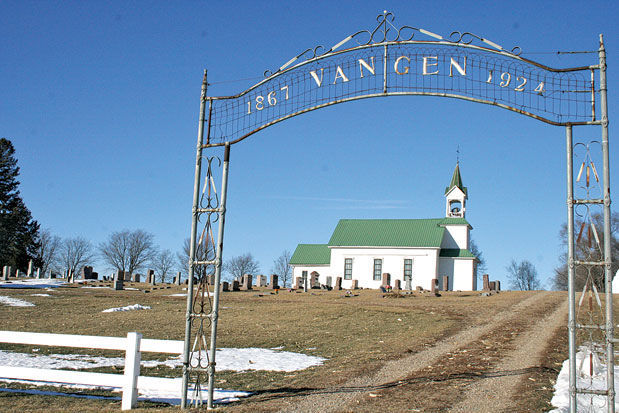
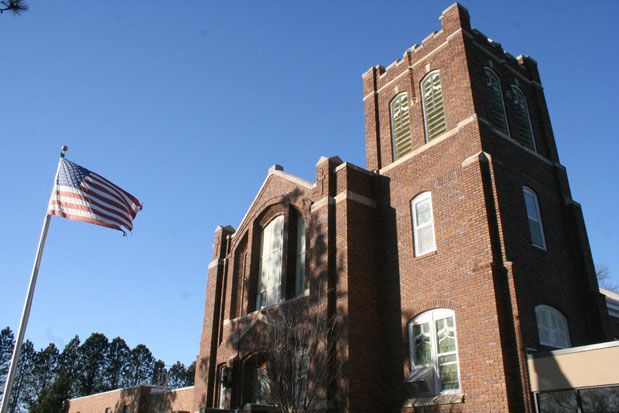
When members of Vangen Lutheran Church talk about the “old church,” they aren’t referring to the 100-year-old brick building in the southeastern South Dakota town of Mission Hill.
When members of Vangen Lutheran Church talk about the “old church,” they aren’t referring to the 100-year-old brick building in the southeastern South Dakota town of Mission Hill.
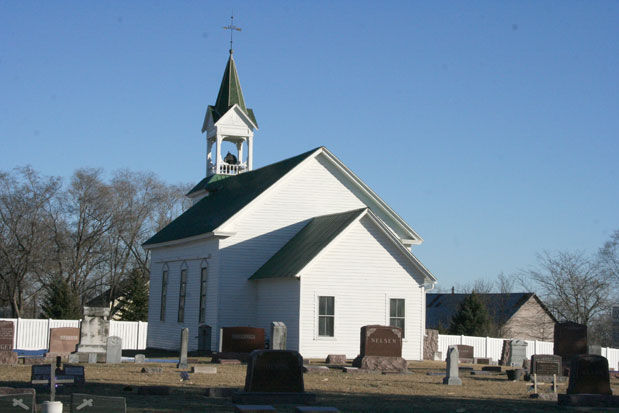
The “old” Vangen Lutheran is a steepled country church on a gravel road east of town. Built in 1869, it’s considered to be the oldest Lutheran church still standing in the Dakotas.
Prayers on the Prairie: Cherished church a remnant of livelier times
Remnants of the past are scattered across the rolling hills that make up the countryside south of Gregory in south-central South Dakota.
Some are ruins, like the cement floor of a honey processing plant where a disastrous fire sent melted beeswax running downhill and put an end to honey-making. Some are holdouts from an earlier era, like the Hilltop Drive-Inn Theater and Carlock Dancehall, both of which still provide entertainment on summer nights.
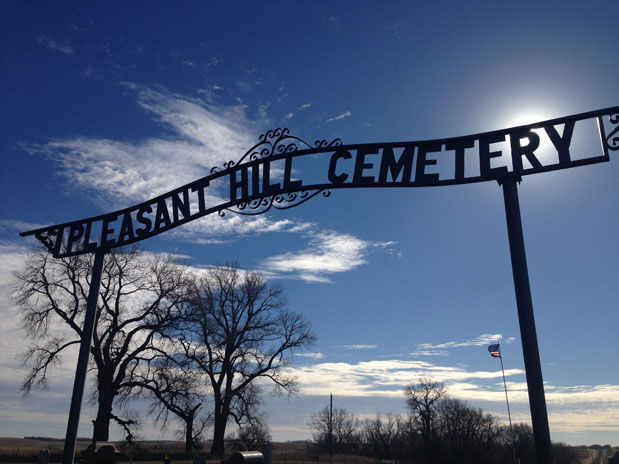
None of the folks who take care of Pleasant Hill Chapel have ever attended worship services there on a regular basis, yet the sense of community that they find at the little chapel near Spink, S.D., and the pride they take in preserving it are profound.
The Pleasant Hill Chapel sits on a hilltop in Union County, in South Dakota’s far southeastern corner. The white steepled church is surrounded by corn and bean fields, pastures full of red and black cattle and farm homes.
kAm|@DE @7 E96 J62C[ E96 3F:=5:?8 :D 6>AEJ]k^Am
The Pleasant Hill Chapel sits on a hill north of Spink, S.D.
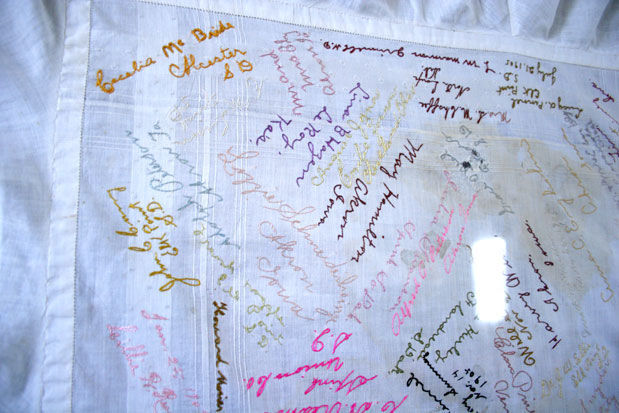
A cloth embroidered with the names of members of the ladies aid dates to 1905. The cloth once served as an organ seat cover and is now framed and displayed at the back of the Pleasant Hill Chapel near Spink, S.D.
Prayers on the Prairie: Young families revitalize small-town church
At a time when many rural churches are closing as members age, move to cities or opt out of church services altogether, a Lutheran church in Vienna, S.D., is stretching for space to hold its over-full Sunday school classes.
Bethlehem Lutheran Church sits on the main street of the east-central South Dakota farm town. Vienna is a quiet town without much more than a grain elevator and one bar, but the church is thriving with families that come from 20 to 30 miles away.
Prayers on the Prairie: Czech church building has varied history
There’s a small and simple church that sits in the heart of Tabor, and it well sums up the heritage of that tiny southeastern South Dakota town as a Czech settlement and a farming community.
The Nedved church is topped with a cross made of redwood from Tabor’s old water tank.
Tri-State Neighbor photo by Janelle Atyeo
Tabor is big on celebrating its Czech heritage, and the church is cherished as what is thought to be the first Catholic church that Czech immigrants built in Dakota Territory. It’s now well preserved on the lot behind the town’s museum, along with other historic buildings – a schoolhouse, a jail and a store – but the church spent most of its existence filled with grain on a nearby farm.
This chalkstone church near Tabor, S.D., was built to replace the Nedved church, which is believed to be the first Czech Catholic church in Dakota Territory.
Church series provided great moments, and will again
Our winter feature on rural churches had me traveling to many tiny towns – some I never had heard of before a member of a nearby country church gave me a call.
A small Norwegian church on the Minnesota-South Dakota border has a connection to several significant events in Midwestern history, and over its 140-plus years, it has made a mark of its own in the surrounding communities and in the lives of its members.
Singsaas Lutheran Church sits in Brookings County, S.D. but it is nearest the town of Hendricks, Minn. Named for a town in central Norway, the church got its start in October 1874 at the home of Norwegian immigrant Nils Trooien.
The bell at Pioneer Lutheran hung below the church’s white steeple for 100 years. On April 19, 2009, it came crashing down into a pile of ashes as the church burned that day.
Church member Larry Holler remembered watching it fall. A phone call woke him about 1 or 2 a.m., and a neighbor told him that the nearby country church was on fire. He had to look out his bedroom window and see for himself to believe it.
Among the farm fields and hog barns northwest of Wilmont, Minn., on the edge of a tiny community where fewer than a dozen people reside stands a pretty standard-looking white wood frame church.
But inside, the church holds something special – relics of the past that have served the small Catholic community for more than 100 years.
Those living in rural areas know that in a medical emergency, help can be a long way away. One remote country church in central South Dakota recently brought life saving tools a little closer to home.