





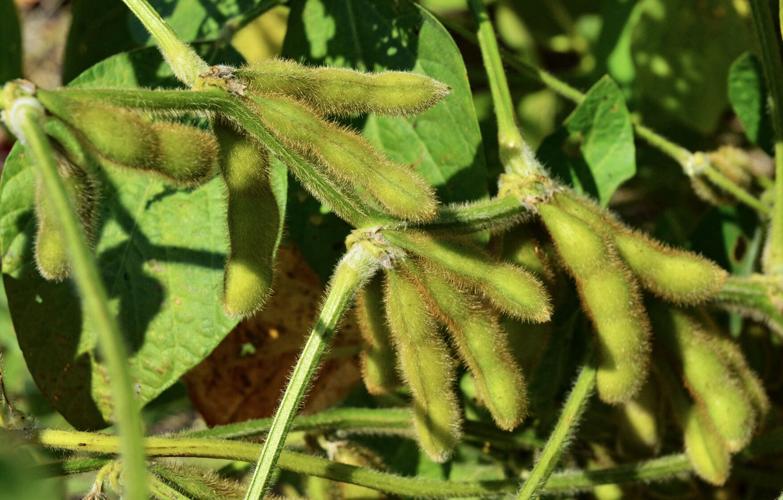



A weapon in the ongoing battle against soybean cyst nematode is becoming increasingly available to farmers. Agronomists have found more-effective resistance with the Peking variety vs. PI 88788.
Among the litany of weeds, diseases and insect pests doing harm to soybean fields, soybean cyst nematode represents the biggest threat. The yield robber is difficult to detect and has adapted well to resistant seed varieties.
“Virtually every soybean on the market has (soybean cyst nematode) resistance,” said Greg Tylka, co-director of the Iowa State University-Iowa Soybean Research Center. “(PI 88788's resistance is) easy to come by, but it’s worn out and losing effectiveness.”
Farmers face an increasing problem with nematode resistance. In the late 1990s soybean cyst nematode began exhibiting resistance to PI 88788. That problem has become worse through the decades.
“It’s nothing new but it’s been building,” said Stephanie Porter, an outreach agronomist with the Illinois Soybean Association. “That’s become an issue. It’s like the silent, deadly pest that is always lurking there.”
But there’s hope.
“The good news is that there’s a much-more-effective, more-powerful resistance starting to become more widely available,” Tylka said. “We’ve seen yield increases of 22 bushels per acre.”
Tylka is talking about the Peking variety, which he said is superior to the common resistant variety PI 88788. The PI strain exhibited acceptable results early on but has become largely ineffective. In some studies nematodes have been shown to reproduce on 100 percent of plants with that strain of “resistance.”
Plants bred with the Peking trait do a better job of fending off the pest, he said. It’s a pest that causes an estimated loss of $1.5 billion annually in the United States. Peking isn’t new, but improved breeding has made it efficacious in more areas.
Tylka has done random two-year surveys since the 1990s in Iowa fields, and each time 70 percent to 75 percent of fields had soybean cyst nematode.
“That number is surprising in two ways,” he said. “It’s surprisingly high, and that number hasn’t really changed over 20 years. That latter point is more intriguing than anything. From a practical standpoint, farmers need to know that three-fourths of their field has soybean cyst nematode.”
Soybean cyst nematode first appeared in the 1970s and is well-established. It currently affects about 80 percent of soybean farmers, Porter said.
She said about 90 percent of soybean varieties have the PI resistance.
“There aren’t many other options,” she said. “Another option is the Peking variety. It has sometimes been attributed to yield drag, but that’s no longer true.”
The Peking resistance trait is promising, but a limiting factor is that most are short-season soybeans not suited for much of the soybean-growing region in the Midwest.
“A lot of these were earlier varieties,” Porter said. “Many are grown in southern Illinois, for instance.”
But Tylka said availability is increasing of appropriate Peking varieties for the Midwest region.
“There’s not enough out there, but it’s getting better,” he said. “I think we’ve turned the corner. In 2022 there were only 47 Peking varieties. Last year there were 87. It’s looking like we’re going to get over 100 Peking varieties in our test this fall. That’s what I mean by turning the corner. We’re starting to see seed companies have it in their breeding programs.”
Jason Bond is a professor in Southern Illinois University-Crop, Soil and Environmental Management. His study of Peking varieties showed they fared exponentially better than PI beans. In the PI variety plot, an average of almost 14,000 eggs were found per five plants in each of five plots. The Peking variety, however, averaged only 296 eggs. The plots were in White County in southeast Illinois.
Those able to use the new Peking variety should not wholly depend on that resistance, agronomists agree. Like other resistance technologies such as glyphosate-resistant soybeans, effectiveness wanes after prolonged use. Porter recommends rotating Peking beans with the PI varieties.
Tylka also warns that Peking’s efficacy will not last forever.
“The problem is, it’s going to break down and lose its effectiveness quicker than 88788,” he said. “We need farmers to use both and alternate. If they don’t, we’re going to be in the same situation as we are now. That will probably be five crop seasons with Peking.”
Crop rotation is also an important tool.
“If you have soybean cyst nematode you shouldn’t be growing consistent soybeans,” Tylka said. “There has been a movement of growing soybeans on soybeans. But you would never want to do that on a field with an infestation of cyst nematodes, in my opinion. When you alternate crops to corn, egg numbers will reduce. One year of corn will reduce numbers from 5 percent to 50 percent.”
In regions conducive to double-cropping, sowing wheat can be a beneficial strategy in battling soybean cyst nematode. Even if the wheat is burned before spring planting, it might be a good idea for farmers with fields heavily infested with nematodes. Research by the Illinois Soybean Association has shown wheat may suppress the pest.
“The wheat does help,” Porter said. “We consider wheat almost like a cover crop, but you can make money off of it.”

Greg Tylka

Stephanie Porter