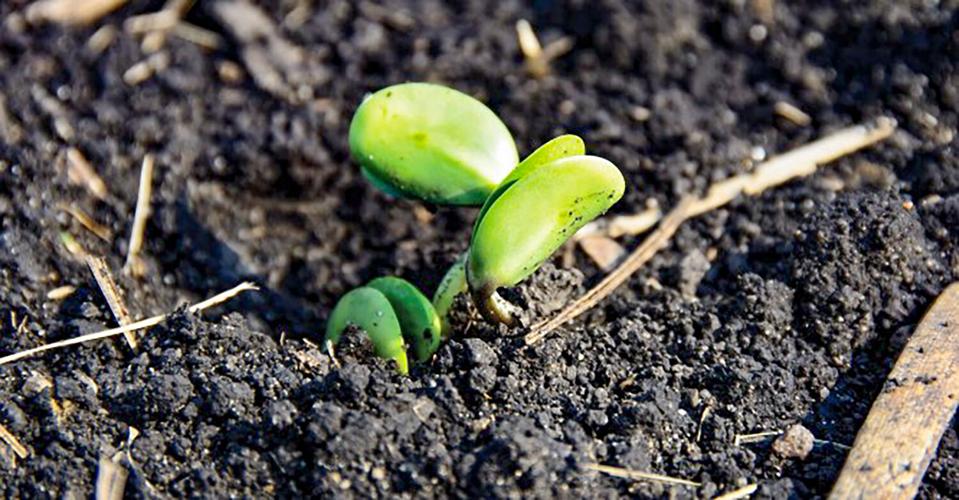





Depending on the circumstances, inoculants may be a good bet. Biological seed treatments provide benefits with little drawbacks for farmers looking to increase nitrogen-fixing abilities of legumes, Barry Fisher says.
“It’s the one seed treatment that has high potential benefits and very, very low potential for negative consequences,” said Fisher, an agronomist whose career trajectory has included a long stint as a U.S. Department of Agriculture soil-health specialist. “If you can get a couple more bushels from a naturally occurring biological inoculant, why wouldn’t you do that?”
There is a wide range of inoculants but most used in commercial row-crop production are forms of Rhizobium, a bacterium that fixes nitrogen. Rhizobium has a symbiotic relationship with legumes such as soybeans, alfalfa and clover. The plants are nitrogen-fixers, converting atmospheric nitrogen into ammonia – which they use for growth.
Inoculants come in four forms – peat moss, freeze-dried powder, granular and liquid. Much of the research into inoculants is dated, but they are widely regarded as being cost-efficient.
Kurt Seevers is a technical-development manager with the agricultural nutrient-production company Verdesian Life Sciences. He puts odds at 70 percent that farmers will have a positive return year after year with inoculants.
“In long-term averages, there’s a 2-bushel yield increase, and there’s a positive response 70 percent of time,” he said. “I ask farmers if they would play a game in Las Vegas where they were guaranteed 70 percent odds of a return. Most put their hands up.”
Considering that adding inoculants to seeds adds an average of 2 to 4 bushels per acre, the return on an increased yield generally pencils out – even with soybean prices that have been at less than $10. The inoculum adds only $3 to $5 per acre in cost and can be applied along with other seed treatments.
“Return on investment can be very, very good or somewhat mediocre, even with $8 beans,” Seevers said. “Inoculation pays.”
Inoculants may be especially beneficial in fields that have not been recently planted to legumes. Examples would be continuous corn or the use of cover crops.
“As farmers start using more and more legumes as cover crops, there are many species that haven’t been there for a while,” he said. “Inoculants are recommended if you want that cover crop to fix nitrogen or for corn to follow.”
Soybeans fix their own nitrogen and Rhizobium can carry over in a field that has been cultivated. Dust spreads it, though in reduced-tillage or no-till environments that may not be the case.
Fisher said, “As you move to a less-tillage situation or growing cover crops plus no-till or strip-till, two things happen. First you don’t have the dust movement of that inoculant and second, you’re not stirring the soil. In the spring these inoculants may not kick into gear until soil temperatures ramp up. With early planting you want that bean to start making its own nitrogen as early as possible. Anecdotal evidence shows that if there’s a place that makes the most sense, it would be no-tilling soybeans into a cover crop. The greatest benefit will come where (producers) are using no-till and cover crops together.”
Seevers likens the activity of Rhizobium to the phenomenon of herbicide resistance.
“In the case of Rhizobium, when we put them in the soil and they set up this neat relationship with a legume plant, it lasts until that legume plant dies in fall,” he said. “The nodule supplies everything they need. They’re protected from the environment.
“When we kick them out at the end of year in the soil with everything else, now they’re competing for resources with everything else that lives out there. The population can crash very quickly.
“Another thing that happens is the ability to fix nitrogen gets diminished because it’s not as important to them for survival. When we put Rhizobium on the seed it’s concentrated where the plant can gain the most benefit.”
Inoculants are largely used with legumes but other crops may benefit from biological enhancement. Azospirillum – another nitrogen-fixing biological – has been shown to increase root development in crops such as corn.
Seevers said, “The really neat thing about Azospirillum is that it contributes nitrogen to the plant almost immediately, as soon as that root system begins to develop – compared to Rhizobium, which takes three weeks. So there’s a delay in the ability to contribute nitrogen to that plant. Incorporating Azospirillum bridges the gap.”

Barry Fisher

Kurt Seevers